





‘Butterfly’ Short Film Depicting Life of Alfred Nakache Receives Oscar Nomination (VIDEO)
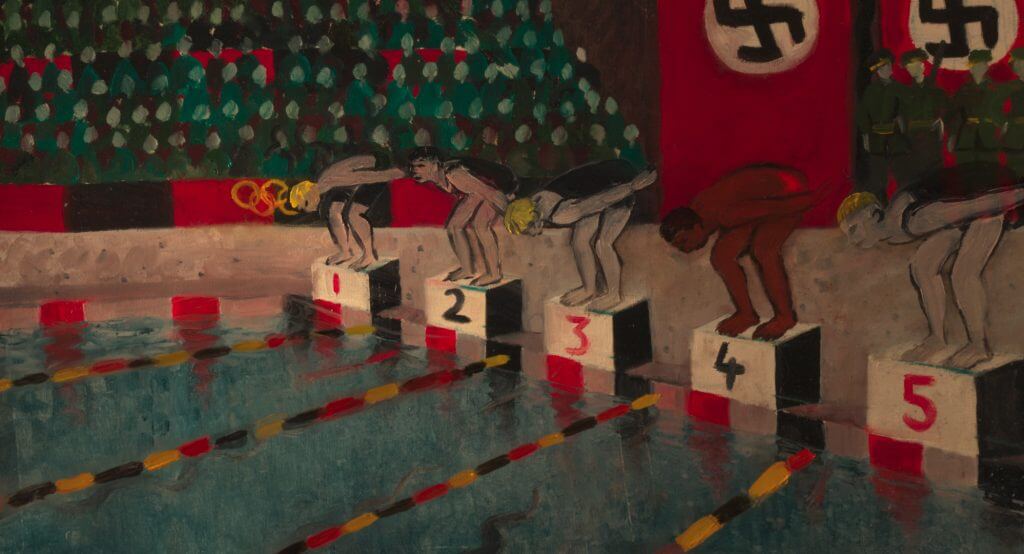
A swimming film has been nominated for the 98th Academy Awards in the Animated Short Film category. “Butterfly” depicts the life of Jewish French swimmer Alfred Nakache, who competed in the 1936 Berlin Olympics in Nazi Germany and was held captive at Auschwitz, where he lost both his wife and daughter. After surviving Auschwitz, Nakache made a triumphant return and competed in the 1948 Olympic Games.
The film by Sacrebleu Productions is directed by Florence Miailhe and produced by Ron Dyens. It depicts the life of International Swimming Hall of Fame member Nakache, who was born in French Algiers in 1915. He was the top swimmer in North Africa by 1931 and was one of the pioneers of the butterfly stroke.
Nakache was on the French Olympic team in 1936 in Berlin, coming face-to-face with Nazi Germany.
He broke the world record in the 200 breaststroke in 1941, but two years later his family was arrested and sent to Auschwitz. He survived, but his wife and daughter did not.
Swimming was his outlet for his grief, and he returned to the Olympics in 1948.
“Like the flight of the fragile and unpredictable butterfly, life confronts us with its uncertainty and its storms. But Nakache’s life story shows us that it is possible to find the strength to overcome adversity, rebuild oneself, and offer a message of hope to the world, even in the most difficult moments.”
Several pools are named in his honor, including in Toulouse, where Leon Marchand began training.
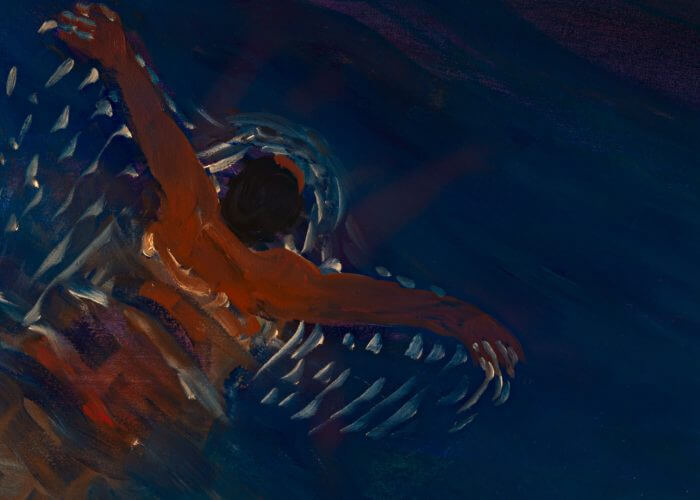
Photo Courtesy: Sacrebleu Productions
The animation of the movie has a technique where a glass plate is painted with oil paint to create the various stages of movement. The drawings are then photographed by a camera overhead, erased and meticulously transformed. Repeated several thousand times, the method creates an illusion of fluid movement, as water, which is the central element of the film.
“Choosing to talk about water through direct animation in paint was an obvious choice for me,” Miailhe said. “The paintings are transformed little by little and as the transformations take place, I create new images. In this way, the film can be invented according to the materials that emerge during the process of creating movement.”
Miailhe has been directing since 1991. She won a Cesar for best short film in 2020 for “Au Premier Dimanche d’Aout” and a special mention at the Cannes Film Festival for “Conte de Quartier” and has been honored for several other films. Her father fought in the French resistance where he met Nakache.
“I wanted to make the whole film and Nakache’s memories be linked to water,” Miailhe said. “To achieve this, I had to transform one or two episodes from his life. Then we had o ensure the whole ting can be understood, including all the flashbacks. The most difficult aspect of the animation was depicting the repetitive nature of the swimming with an animation technique that doesn’t allow for many loops, as well as depicting the slowness of certain underwater movements.
“I wanted the audience to understand the different symbolisms and the multifaceted nature of water. So each ‘water’ was treated differently: The se, the clear and transparent waters of childhood, the murky waters of the camps, and the sea of lovers.”