




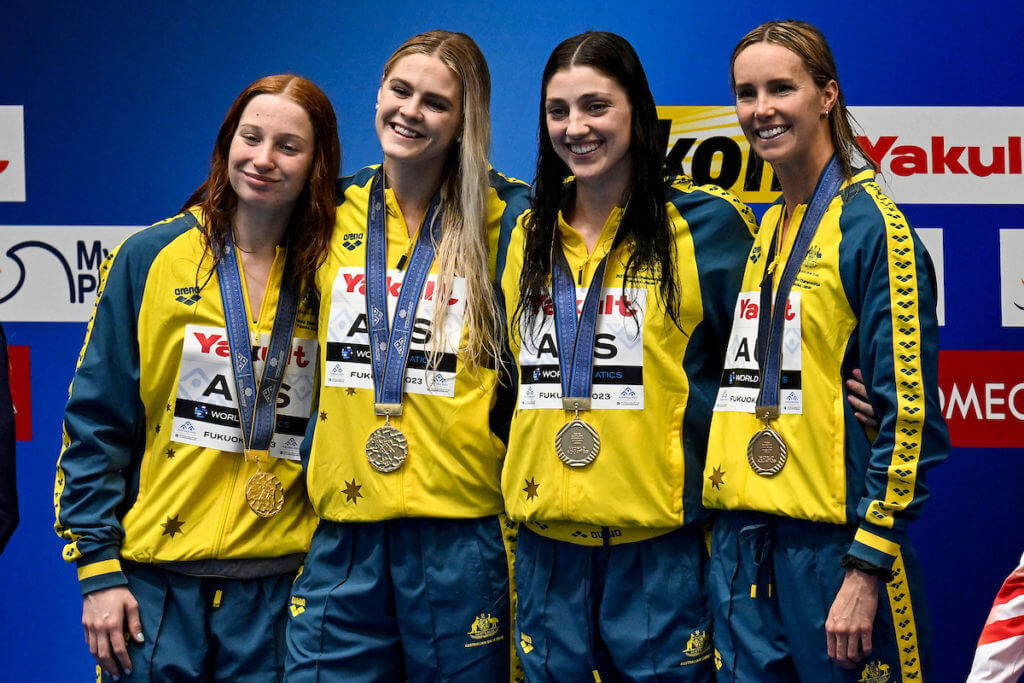

World Relay of the Year (Female): Australia Fulfills Potential With 400 Freestyle Relay World Record
Over the last decade, Australia has been the world’s dominant team in the women’s 400 freestyle relay, having won three consecutive Olympic titles and four of the last five world titles (three in a row). At the Tokyo Olympics, Aussies Bronte Campbell, Meg Harris, Emma McKeon and Cate Campbell became the first quartet to ever break 3:30, swimming a time of 3:29.69 to beat the silver-medal-winning Canadians by more than three seconds.
McKeon had the quickest split that day at 51.35, but maybe Australia could have been even faster that day. After all, Cate Campbell was more than a second off her quickest split ever (a mind-blowing 50.93) while younger sister Bronte led off in 53.01 after swimming sub-53 in the 100 free on numerous occasions in her career.
Well, the latest incarnation of this Australian group left nothing to chance at the 2023 World Championships. In the two years since Tokyo, Mollie O’Callaghan had emerged as the next great Australian freestyler, winning the 100 free world title in 2022 (before winning the 100 again plus the 200, in world-record time, in 2023) while Shayna Jack had provided a lift since her return from a doping suspension. In the relay prelims, Jack had entered the all-time top-10 in the 100 free with her 52.28 leadoff. Meanwhile, Harris still had a spot on the relay while McKeon was back on the global scene after skipping the 2022 Worlds.
Speaking of skipping, Australia went right over the 3:28-range. In the final, O’Callaghan led off in 52.08, her best time and enough to put Australia more than a second ahead of every other leadoff swimmer except Sarah Sjostrom, whose Swedish team was unlikely to keep pace down the stretch of the relay. O’Callaghan was almost two seconds up on the United States, considered the primary contender for silver entering the race.
Next, Jack split 51.69, the quickest mark of her career to that point, with Harris following at 52.29, some eight tenths faster than she went in the Olympic final two years earlier. The race was long since decided by the time McKeon dove in for the anchor leg, but her 51.90 was still the second-best split in the field behind Jack.
Australia’s final time was 3:27.96, a massive world record. The winning margin, three hundredths shy of four seconds, was entirely reflective of the dominance Australia has built in this event. Harris had the slowest split of the four Aussies, and only two others in the entire field surpassed her 52.29: Sjostrom, with her 52.24 leadoff, and American Kate Douglass, who split 52.28.
Four days later, Australia would crush another women’s relay world record as O’Callaghan and Ariarne Titmus bookended the nation’s 800 free relay, and the Dolphins are set up for the Paris Olympics with a huge advantage on the rest of the world in the women’s freestyle relays.