




World Championships, Day 6 Finals: Kate Douglass Crushes Second-Fastest Time Ever in 200 Breast for Runaway Gold
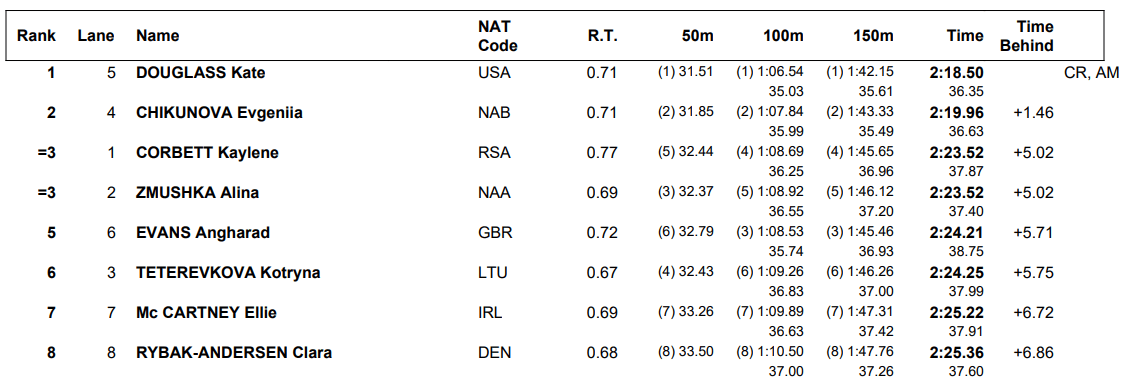
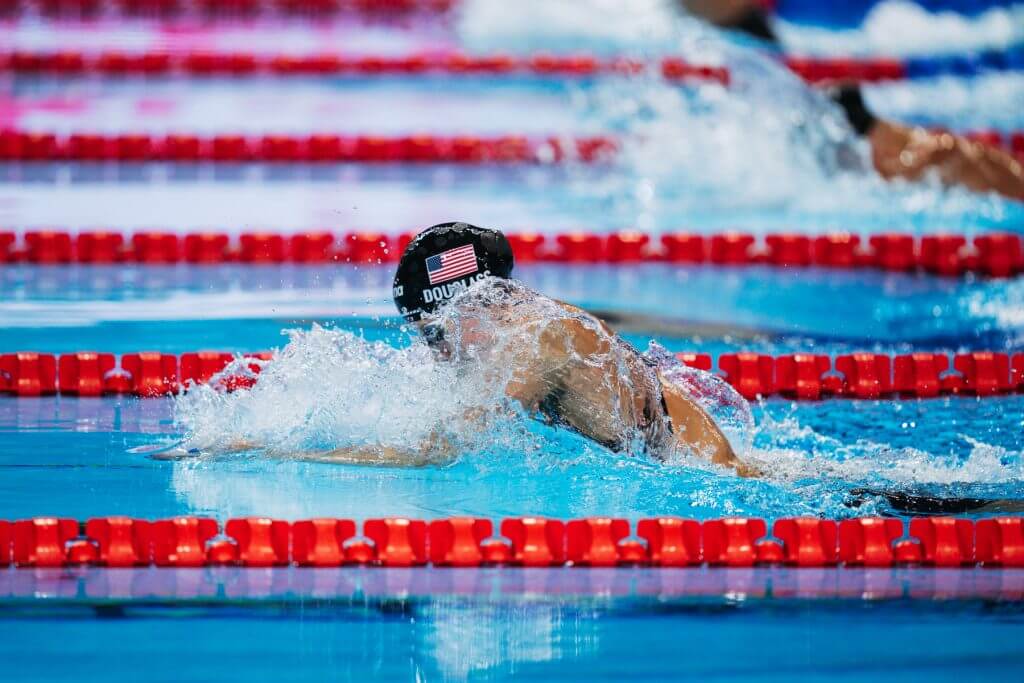
One year after winning Olympic gold, Kate Douglass has cemented her status as the international queen of the 200 breaststroke. This time, the 23-year-old American had to grapple with the world-record holder competing at a long course World Championships, but Douglass blasted off each wall to defeat neutral swimmer Evgeniia Chikunova for gold.
This was the first time Douglass, the Olympic champion, had faced off in long course against Chikunova, the Russian swimmer who holds the world record at 2:17.55. Entering the meet, Tatjana Smith (née Schoenmaker) was the only other swimmer in history to break 2:19, and she retired after last year’s Olympic Games. But in this race, the race was never close after the opening lap.
The versatile American jumped into a big lead on the second 50, splitting almost a second ahead of anyone else in the field, and she reached the wall significantly under world-record pace in 1:06.54. Chikunova closed slightly on the third length, but Douglass remained well clear and under world-record pace. She could not quite keep up with the record coming home, but she did annihilate her best time while storming to a dominant win.
“My race plan in this particular event has been to try to go out 1:06, and I know that my back half isn’t as strong as others, so I think it’s important for me to get out fast,” Douglass said. “With my 100 getting better this meet, I felt like I was capable of going out faster.”
Douglass finished in 2:18.50, knocking three-quarters of a second off the American record of 2:19.24 she swam in the Olympic final. The time was the second-fastest performance ever recorded, and she also surpassed the Championships record of 2:19.11 set by Denmark’s Rikke Pedersen in 2013.
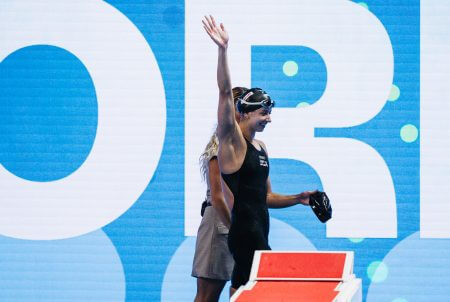
Kate Douglass — Photo Courtesy: Emily Cameron
“I’m really happy with the 2:18. I did not expect to go that fast tonight,” Douglass said. On her matchup against Chikunova, she added, “Honestly, I was really excited to race her tonight. I felt like we were both gonna push each other to be better. And honestly, if I wasn’t racing her, I don’t know if I would have gone a 2:18. I think that really helped push me to be my best.”
Chikunova also got under 2:20, her time of 2:19.96 earning her a long course World Championships medal for the first time. ” “I always hope for the best, for the best result that is possible, but this is what it is,” she said. “In any case, I am content that I fought until the end, especially considering that I was already wiped out after the last turn.”
As the top-two swimmers stole the show, a battle for bronze developed behind them. Great Britain’s Angharad Evans rebounded from a disappointing 100 breast to reach the final and swim for third place for much of the race, but she faded down the stretch. That gave an opening for South Africa’s Kaylene Corbett and neutral athlete Alina Zmushka to come through the field, and they recorded matching times of 2:23.52 to share bronze. Evans ended up fifth in 2:24.21.
“It’s my first medal and I’ve been working hard to get to this point, so of course I’m very happy because a medal is always good, regardless of its color,” Zmushka said. “I didn’t believe it at first. I was looking up to see what place I got and when I saw it, it was such a thrill, a surprise – a great surprise – and I was boundlessly happy. I have been working for this for a long time.”
Like Chikunova and Zmushka, Corbett reached the podium at a long course World Championships for the first time after many years racing alongside Smith in these major finals. Her medal was South Africa’s second of the evening after Pieter Coetze took bronze in the men’s 200 backstroke, and he recalled seeing Coetze’s parents cheering from the stands as she realized the scope of her accomplishment.
“I don’t think I have the vocabulary to explain how this medal feels,” Corbett said. “In the past, since 2019, I’ve been in the top-eight in the world. So, to finally break into the podium has been a huge relief for me. I’m just really, really proud. I wish Tatjana Smith was there on the podium with me. Since she’s retired, I must say that it means a lot to me to know that I’ve been racing with her for literally forever.”
Douglass has been one of the few Americans to emerge relatively unscathed from the stomach illness which has hampered the team’s results this week in Singapore. Competing in the 100 breaststroke for the first time at a major meet, Douglass was the surprise top qualifier into the final and ended up winning silver, crushing her best time by a half-second in the process.
While it’s her breaststroke events that have stood out the most in Singapore, Douglass is known for her incredible versatility. She had the fastest split on the U.S. women’s silver-medal-winning 400 free relay and raced in the 50 butterfly semifinal moments after this gold-medal performance in the 200 breast. However, the quick turnaround prevented Douglass from reaching the final as she fell to 14th.
“I was just really excited to win a gold for Team USA, especially with the tough week, week and a half that we’ve had,” Douglass said. “That was really important for me, to contribute to the team and to kind of help to boost the team’s morale and boost our confidence going into these last two days.”
Douglass and Chikunova entered the meet considered the big favorites in the 200 breaststroke. Douglass had won medals in the event at the past three World Championships before taking down Smith for Olympic gold in Paris, putting up an American-record time of 2:19.24 in the process. But in the months later, the only active swimmer ahead of Douglass on the all-time list would re-emerge.
Chikunova had never before won a long course international medal in the 200 breast. She made her debut in the Tokyo Olympic final as a 16-year-old, missing the podium by just four hundredths. In the middle of the three-year span when Russian athletes were largely excluded from international competition, Chikunova blasted her sensational world record.
The two standouts raced for the first time at the Short Course World Championships in December, and Douglass took care of business by two-and-a-half seconds, taking down the short course world record in the process. In a long course rematch less than nine months later, the result slightly closer but similarly dominant.
- Swimming World Meet Page
- Psych Sheet
- Meet Results
- Day-by-Day Schedule
- U.S. TV/Streaming Coverage
- How to Watch
- World Aquatics Homepage