




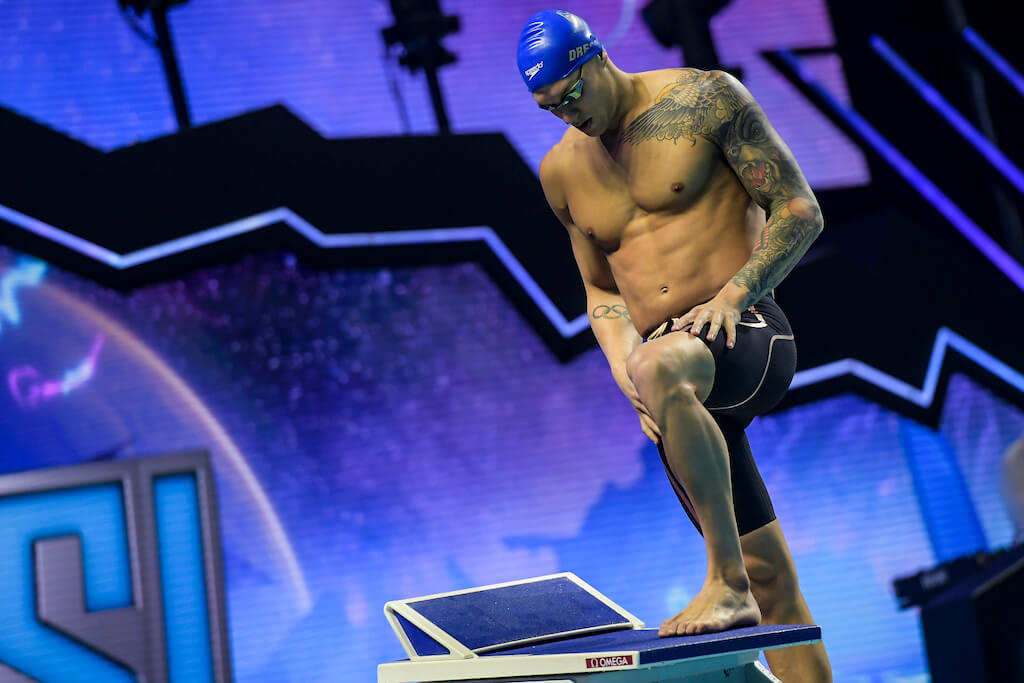

The Moments Before a Race and How to Prepare
We all know the feeling moments before the starting sound comes from the officials’ tent. The muffled splash of a race finishing in the lane next to you, the hum of teammates talking between heats, an official’s whistle cutting through the noise and your favorite hype song blasting through your headphones. And the feeling –a combination of nerves, confidence and pure adrenaline building as you wait to dive into the cold water.
If you’ve been competing long enough, the moments before a race aren’t new. Most swimmers have lived through them hundreds of times. Still, it’s never something you completely get used to. So, how do you prepare for those moments?
Race Psychology
First, let’s look at the psychology behind them. The moments before a race often are often filled with nerves, which are a part of the body’s “fight or flight” response. These nerves are often linked with athletic performance. Sports psychologists and scientists have studied pre-race anxiety and excitement for years, and swimmers can experience both, whether it’s a middle school state meet or the Olympic Games.
This ties into something that many swimmers know: everyone will have a different answer to this stress. Some people need calm to regulate their nervous system. Others thrive on the stress – blasting music, jumping around before a race, and using caffeine to advance their adrenaline as momentum. The point is, there’s no universal method. Nobody knows your mind and body better than you do, and what works for one athlete won’t always work for the next. But researchers have agreed on one thing: Consistency matters.
How to Prepare
One of the most effective tools in managing pre-race nerves is developing a pre-race routine. Routines reduce potential anxiety, stabilize your nervous system, and can help you enter a sort of automatic state that will allow your brain to act instinctually. The more consistent your routine becomes, the more your mind will associate those actions and pre-race moments with readiness, rather than panic.
At most competitions across the board, you’ll probably be able to see athletes doing this in a wide variety of ways. Whether it’s shaking your arms out or listening to the same song, these subtle cues are a part of the preparation necessary for a race.
For me, some of my worst races have been ones where I stepped onto the block with a thousand thoughts flying around in my head. When that happens, you dive in scattered and unable to focus on the lap in front of you. Needless to say, it’s not a great place from which to start.
The best strategy I’ve found – and one backed up by research published by the National Library of Medicine – is visualization. Athletes who take the time to visualize key parts of their race are proven to have had higher athletic achievement and success. It doesn’t have to take up too much of your race day. For me, it’s taking the time to picture small moments of the race: pushing my feet off the starting block, the rotation of my stroke, and pushing off the wall. These moments help me lock in to the few minutes ahead of me and focus on that rather than the other noise around.
Final Thoughts
Swimming, like any race-driven sport, will always be centered around adrenaline. That comes with the territory. But, that adrenaline doesn’t have to control you. With a good routine, you can meet those pre-race moments with confidence and excitement.