





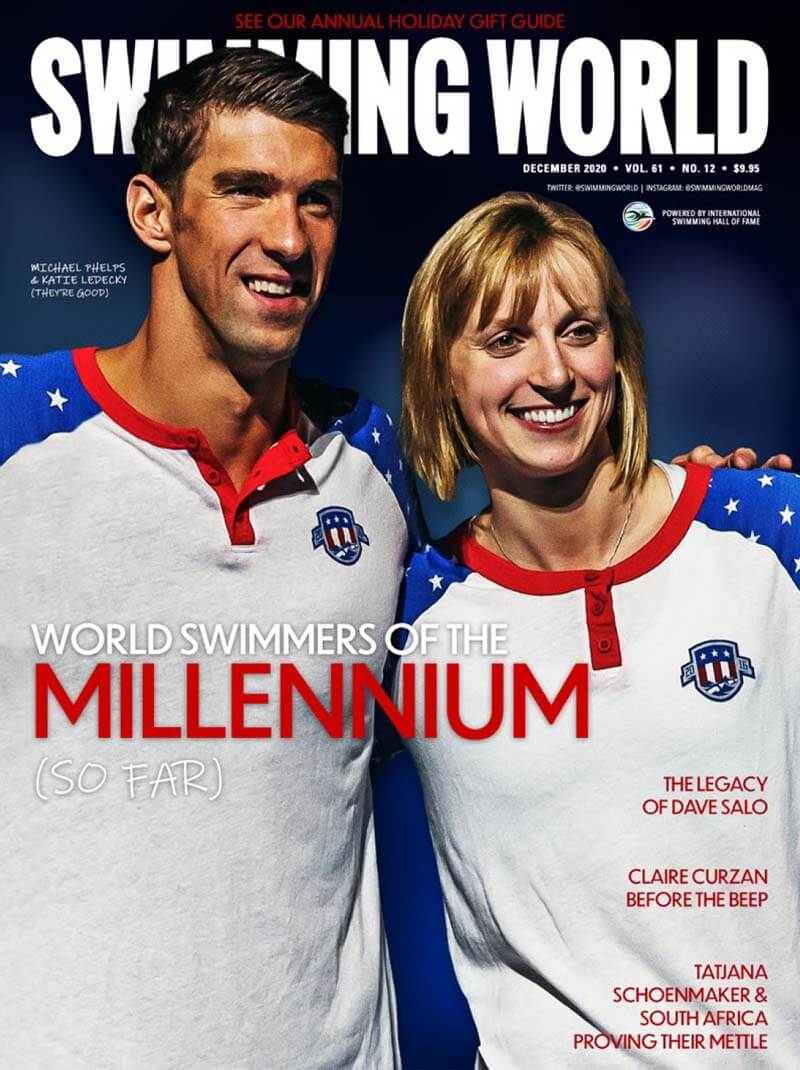
The latest issue of Swimming World Magazine
is now available for download in the Swimming World Vault!
Non-Subscribers Can Download This Issue Here
How They Train: Weymouth Club Waves’
Thomas Hagar
By Michael J. Stott
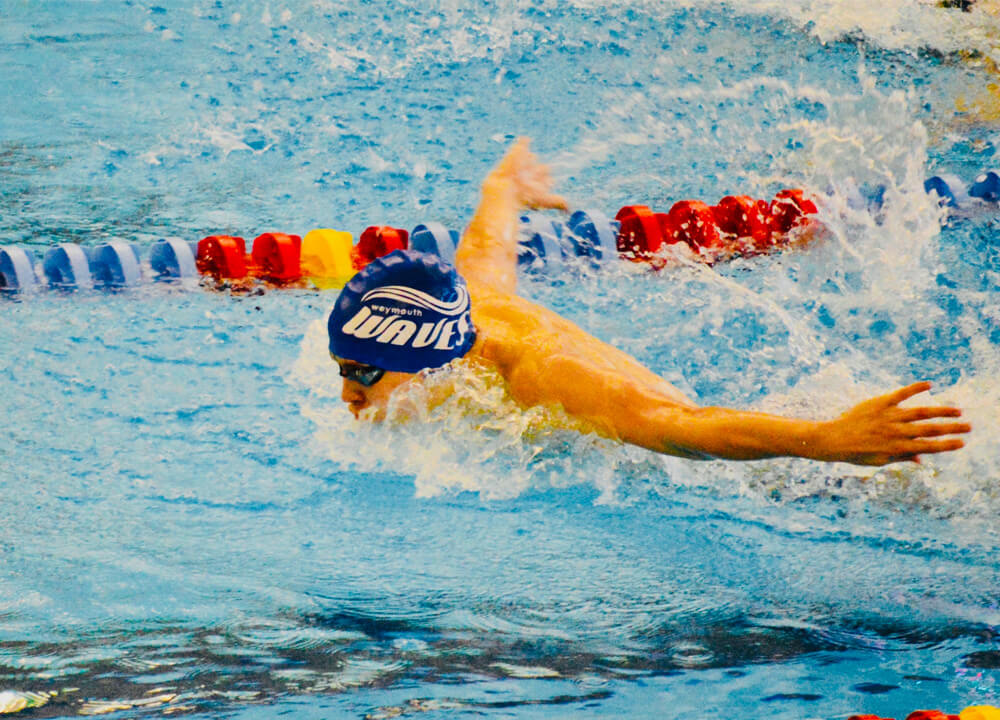
Thomas Hagar is a sophomore at the Xaverian Brothers High School in Westwood, Mass. He could be a poster child for talented young men who buy into the swim program of a process-oriented coach. From age 13 to 15, his time drops for his best events are impressive: 100 yard back, 8.86 seconds; 200 back, 21.74; 100 fly, 6.82; and 200 fly, 16.66.
Hagar and Coach Michael Brooks began working together in August 2018 shortly after Brooks arrived at Weymouth Club in Massachusetts.
“At the time, he was a tiny 13-year-old boy with high spirits and high energy who talked a very big game,” says Brooks. “Initially, his mouth outran his accomplishments. However, it was heartening to know that I had a swimmer with big goals who wasn’t afraid of making them public. And he wasn’t afraid of working for those big goals.
“A related challenge was when he fell short of his expectations—whether at meets or practice—he would pout and have an existential crisis. Two years later, he has practiced resilience, and he is progressing nicely. He is learning to understand that he isn’t going to be great every second of every day.
“There was a key moment a year ago when Thomas decided to become a leader. He had been holding back for a while, following the older kids—because that’s what younger kids are ‘supposed’ to do—even if he was strong enough to pass them. After some encouragement, prodding and mild irritation on my part, he stepped up and assumed the mantle.
“It truly was like flipping a switch from off to on. His practice performance elevated overnight and has stayed that way,” says his coach.
To read more about how Thomas Hagar trains with coach Michael Brooks,
check out the Swimming World December 2020 issue…Click here to download now!
 [PHOTO CREDIT: PETER H. BICK]
Get Swimming World Magazine and Swimming World Biweekly FREE When You
Become A Member of the International Swimming Hall of Fame
New! 30 Day Membership to ISHOF AND Digital Swimming World Subscription for just $10 a month!
Want more? Get a 1 Year ISHOF Family Membership With Swimming World Print AND Digital Subscription Order Now!
Non-Subscribers can click here to download this issue for only $5.94
Swimming World Magazine December 2020 Issue
FEATURES
012 SWIMMERS OF THE MILLENNIUM’S FIRST 20 YEARS (2000-19)
by John Lohn, David Rieder, Andy Ross and Dan D’Addona
World & American: Michael Phelps & Katie Ledecky
European: Pieter van den Hoogenband & Inge de Bruijn
Pacific Rim: Ian Thorpe & Leisel Jones
African: Chad le Clos & Kirsty Coventry
019 PROVING THEIR METTLE
by Andy Ross
After the South African media made several disparaging comments about the women’s swimming team in 2016 when none of their swimmers had qualified for the Rio Olympics, Tatjana Schoenmaker and her South African teammates have been supporting one another and working together to show just how good they can be.
021 FIT TO BE TIED
by John Lohn
At the 1972 Munich Olympics, Sweden’s Gunnar Larsson was awarded the gold medal in the men’s 400 IM, edging USA’s Tim McKee by 2-thousandths of a second. Subsequently, international swimming rules were changed to record results to 1-hundredth of a second, allowing for ties among swimmers with identical times.
034 MENTAL PREP: BEFORE THE BEEP WITH CLAIRE CURZAN
by Shoshanna Rutemiller
COACHING
010 TOUGHEST WORKOUTS (Part 2)
by Michael J. Stott
Swimming has had its share of taskmasters over the years. In the second of a two-part series on workouts designed to push swimmers to their limits are some sets from respected authoritative figures at Germantown, Arden Hills, Bluefish and Florida who have trained exceptional athletes that have excelled on the international stage.
038 SWIMMING TECHNIQUE CONCEPTS: BREASTSTROKE BREATHING HEAD TIMING DELAY
by Rod Havriluk
In breaststroke, most swimmers learn to synchronize their head and arm motions to breathe and to recover to the non-012 breathing position. However, a delay in the head motion both to breathe and to recover affords benefits of less resistance, more propulsion and a faster stroke rate.
040 SPECIAL SETS: DAVE SALO—THE MAN AND THE METHOD
by Michael J. Stott
Dave Salo has represented the United States as an Olympic, World Championships and Pan Pacific Championships coach and has guided the USC Trojans to 18 NCAA Top 10 finishes in 14 years. But his enduring legacy will most likely be his training mindset that emphasizes race-pace training and quality over quantity.
043 Q&A WITH COACH MICHAEL BROOKS
by Michael J. Stott
044 HOW THEY TRAIN THOMAS HAGAR
by Michael J. Stott
TRAINING
037 DRYSIDE TRAINING: POSSIBLY THE 5 BEST DRYLAND EXERCISES EVER!
by J.R. Rosania
If done properly and regulary, these exercises can enhance your stroke, technique, power and speed.
JUNIOR SWIMMER
047 UP & COMERS: ERIKA PELAEZ
by Shoshanna Rutemiller
COLUMNS & SPECIAL SECTIONS
008 A VOICE FOR THE SPORT
009 DID YOU KNOW: ABOUT THE ART OF SWIMMING?
026 HOLIDAY GIFT GUIDE
036 DADS ON DECK
046 HASTY HIGH POINTERS
048 GUTTERTALK
049 PARTING SHOT
Swimming World is now partnered with the International Swimming Hall of Fame. To find out more, visit us at ishof.org