




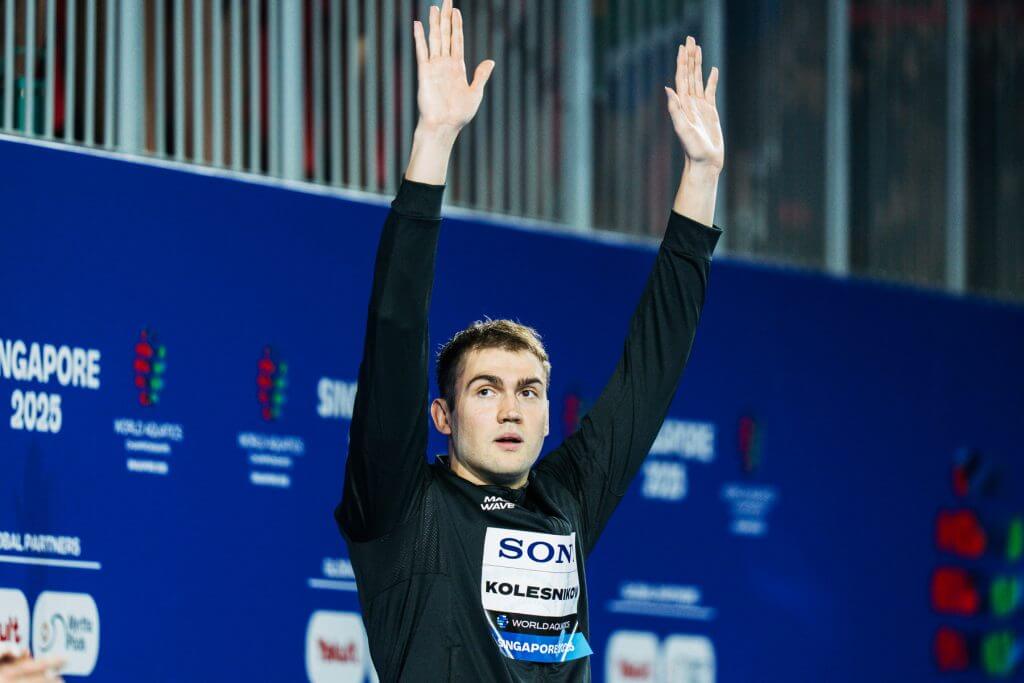

Neutral Power: Russian Swimmers Had Impressive International Return in 2025
For three years, Russian swimmers were largely absent from international swimming competition, exiled as a result of their country’s illegal invasion of Ukraine. The International Olympic Committee opened pathways for Russians to compete in the Paris Olympics as neutral athletes, but only one swimmer took advantage.
But in late 2024, a large group of Russian swimmers competed as Independent Neutral Athletes at the Short Course World Championships and captured 10 medals, six of them gold, three of them on relays. Seven months later, a team even more representative of the country’s aquatic abilities raced at the long course global meet in Singapore. Between those two championship meets, Russia has returned to its status as one of the world’s top swimming nations, particularly on the men’s side, just as was the case in 2021 and before.
The last major international competition before Russia’s ban was the Tokyo Olympics, where Evgeny Rylov swept gold medals in the 100 and 200 backstroke while Kliment Kolesnikov joined him on the 100-meter podium with silver. Rylov’s public support for the Ukraine war virtually ruled out his chances of returning to international waters in a neutral capacity, but Russia remains a dynamic force in men’s backstroke.
The 2024 short course meet saw Miron Lifintsev break out with gold medals in the 50 and 100-meter races. Entering Singapore, Russian swimmers held the second and fourth seeds in the 100 back thanks to Kolesnikov and Lifintsev, and it was somewhat of an upset when neither reached the medal stand in an extremely quick final, where a sub-53 performance was required for a medal.
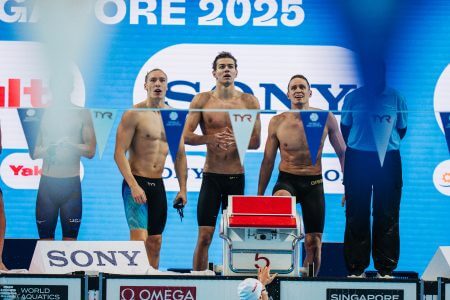
The Neutral Athletes captured the world title in the men’s 400 medley relay Photo Courtesy: Emily Cameron
Later in the meet, however, Lifintsev would make up for that disappointment when he blasted a relay leadoff time of 51.78. The time was unofficial since he was leading off the Russian mixed 400 medley relay, but it was quicker than the winning time posted by Pieter Coetze in the individual event. The only man to ever swim quicker is world-record holder Thomas Ceccon. That swim would be the spark that propelled the neutral team to gold in championship-record time.
The man who followed Lifintsev on that relay was Kirill Prigoda, a 29-year-old breaststroker who won his first international medal in 2014. He was the bronze medalist in the 100 breast at the 2017 World Championships and winner of the 200 breast at the Short Course World Championships a year later. Russia’s long ban wiped out a large portion of Prigoda’s would-be prime, but he was back in force this year. He clocked 58.53 in the 100 breast prelims, which was faster than the eventual bronze-medal time, and he went on to earn silver in the 50 breast.
On the mixed relay, Daria Klepikova and Daria Trofimova recorded the best swims of their life to maintain the two-second advantage that Lifintsev and Prigoda had built. Four days later, things were much tighter on the men’s relay, with Italy leading at the halfway point and France with 100 meters remaining, but Andrei Minakov and Egor Kornev came through to help their team return to the gold-medal podium. Thus, of the eight relays contested at the World Championships, two went to a team not officially associated with any country.
The group of neutral athletes finished the World Championships with eight total medals, most of which came in the back half of the meet. The team’s only women’s medal came in the 200 breaststroke, as world-record holder Evgeniia Chikunova grabbed silver. A day later, the mixed 400 free relay team set a European record on the way to a second-place finish behind the United States.
And the final day of the meet produced four total podium finishes. Naturally, one of them came in a men’s backstroke race as Kolesnikov stormed to a long-awaited world title in the 50-meter sprint, his first individual crown despite holding the world record in the event for the better part of four years, while Pavel Samusenko tied for silver. After that, Ilia Borodin claimed bronze in the 400 IM; he was the short course world champion in the event last year, but this was his first chance in a major long course final after he contracted COVID-19 at the Tokyo Games before being away from international racing for three years.
Finally, the men’s competition concluded with the neutral athletes winning the men’s 400 medley relay in dramatic fashion. If any of the swimmers felt rusty following their long absence from high-stakes meets, none of them showed it.
Of course, the “neutral” moniker derives from the extremely complex international realities, a compromise meant to respect athletes while still punishing their nation. We’ll see if and when this group is permitted to don the colors of the Russian Federation, but regardless, they will remain a force in global swimming competition.