





By Ailish Dougherty, Swimming World College Intern.
We all know the requirements for the “ideal” swimmer’s body – tall, long arms, long torso, long and wide feet and hands, broad shoulders, huge lats, strong core. But what if you don’t measure up?
Certain physical characteristics have been proven advantageous. For example, the average height of men Olympic finalists in 2016 was 6’2”, while the national average hovers at around 5’9”. Women Olympic finalists in 2016 were also, on average, 5 inches taller than the national standard.
Taller swimmers can propel themselves more quickly through the water, while large hands act as paddles to ensure the maximum amount of water is being pulled with each stroke. Long, wide feet and flexible ankles aid in a powerful kick to propel the body through the water. Broad shoulders and a triangle-esque body shape contribute to a swimmer’s sense of balance.
Having a center of mass in the upper torso is ideal because of its proximity to the center of flotation and buoyancy, the lungs, thus making it easier to float horizontally with less effort. Wingspan and arm length are crucial when considering the energy expended with each pull – a swimmer with ridiculously long arms (a longer “lever,” if you will) can theoretically take fewer strokes per lap because of their extended reach, and thus use less energy to go the same distance.
Long arms and fingers are also great for finishes (think about Phelps’ 0.01 second win against Cavic in 2008). Other advantages include double-jointedness and flexibility, which allows for a greater range of motion in the water, more potential energy with each movement, and thus more power.
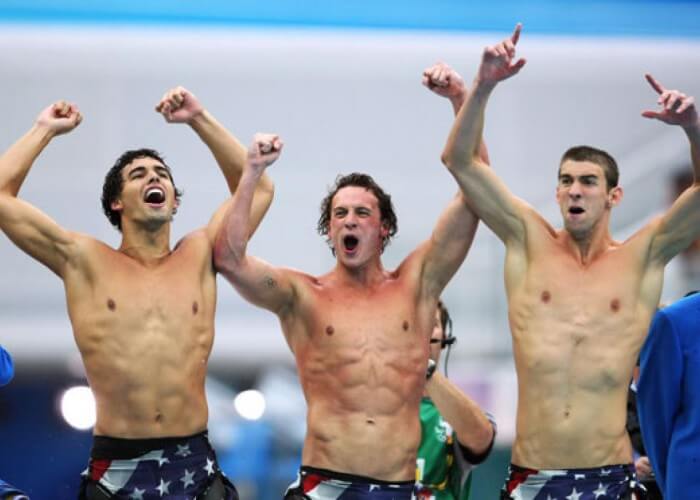
Photo Courtesy: NY Daily News
The question becomes, what about the exceptions? Yes, a swimmer may possess God-given traits that can’t exactly be altered, but there are things that a swimmer who may not measure up to the standards of “greatness” can control, such as muscle mass, technique, and flexibility, in order to keep up with their competition.
Overall, a swimmer who is at an effective disadvantage due to size or proportions must train harder than a swimmer with the gift of a natural swimmer’s physique, but they must also train smarter. Focusing on efficiency and technique are key, rather than muscling through a set relying solely on power.
Let’s think about some exceptions to the golden rules, and what can be done to enhance performance in these cases.
I’m a 5’3″ freestyler – what do I do?
The key for shorties is turns. Turns, turns, turns. Use your compactness to your advantage, and get in and out of your walls quickly and efficiently. Become a small, tight ball so that you can use that momentum to bust out your dolphin kicks and keep up with the giant in the lane next to you as you accelerate into your breakout. Underwaters can also be your secret weapon – use every inch of the 15m.
I have baby hands – should I just quit now?
Instead of relying on your hands for your pull, focus on using your entire forearm to catch as much water as possible and propel you forward. Work forearms and tricep extensions – keep your elbow high and pull all the way through to your hip, because you’re going to need every last inch of that stroke to help you keep up with the dude with the huge mitts you’re racing. Furthermore, cultivate your core strength and use your hips and shoulders to help you rotate as much as possible with every stroke.
My Ape Index is -4 – I just can’t keep up!
So you don’t have a Phelpsian wingspan. In this case, a higher stroke rate is essential. Because your reach is not as lengthy as your opponents’, you will be unable to keep up if you try to match their long, gliding stroke. A faster turnover will set a rhythm that will allow you to expend less energy with each stroke but to take more of them. But remember: your kick must match your increased stroke rate in order to reach maximum efficiency.
I can’t even touch my toes – How am I supposed to be loose in the water?
Flexibility is key for swimmers for two reasons. One, a stretched muscle has longer fibers, which can create more force when contracted. Thus, flexibility in muscles increases our pull power. Second, flexibility training increases the range of motion for your joints, which allows you to move the joint instead of moving your whole body back-and-forth. This decreases turbulence and allows for a more fluid, smooth stroke. Consistent stretching, especially of shoulders, back, and hip flexors, in addition to preventing injury, can help with this issue.
There are many exceptions to the golden rules of swimmer bodies, but exceptions don’t have to equal roadblocks. There are so many ways to train with purpose so as to minimize technical errors and maximize proper skills like great starts, turns, breakouts, and finishes. Understand your own specific strengths and limitations, in order to develop specific tricks to compensate for your drawbacks and play upon your assets.
All commentaries are the opinion of the author and do not necessarily reflect the views of Swimming World Magazine nor its staff.
the author is incredibly knowledgable and rocks my socks!!!!!
CG?????
Excellent write-up! A stark contrast to “there is no such thing as natural talent.” A small point I wish to nitpick is that hard work, while well-advised, isn’t an equalizer in many situations.
Many physical limitations are all but ignored in any swimming literature I’ve read. For example: various physiological breathing issues with respect to swimming (that can’t be overcome completely) , poor sustained hand strength, a more curved back versus a staighter torso, and less than straight legs and knees.
I could never be a really good swimmer, competitively, but yet I can get all that I need to out of swimming. This didn’t stop me from making swimming part of my life. If you are interested in the butterfly stroke, I created a webpage (my only personal website) which dissects the fly in detail. It’s written for everybody, but if you read, you will see the theme which the above article is about. And should you read, critique at will. (Click on the icon to the left of my name.)
Spiros Gianniotis are you the rxception? ?