




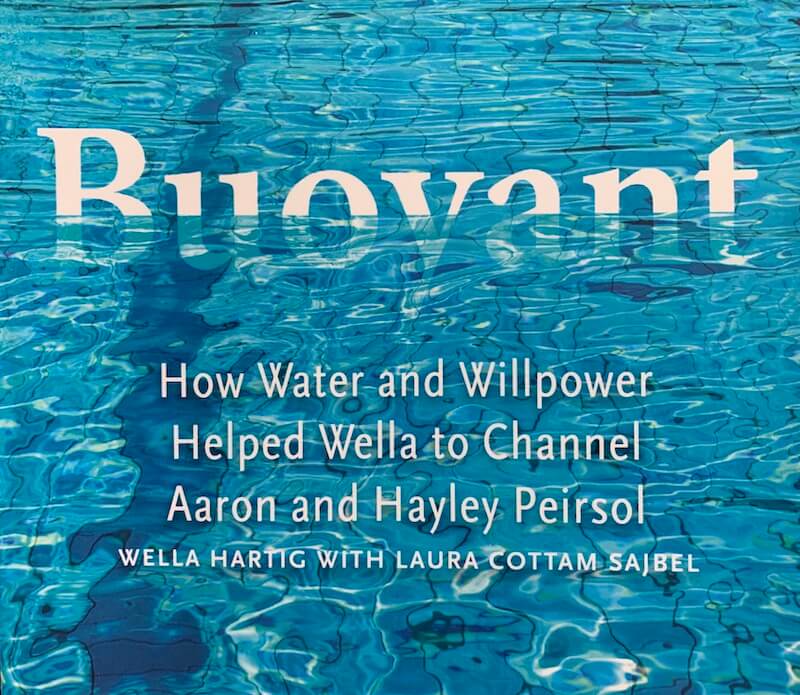

Buoyant, penned by swim mom Wella Hartig with Laura Cottam Sajbel, is seeped in the light and dark of life. After reviewing the book back in 2013, I spoke to Wella, mother of former US teamsters and swimmers for life Aaron and Hayley Peirsol, from her home in Costa Rica.
I asked her why she wrote her story down and what the water gave her; and how she dealt with a decision that left her alone with two young children and coping with distress and the disappointment that dominated until the Olympic dream touched her life. No better day to celebrate her story than Mother’s Day.
Wella’s trip to Sydney 2000, funded by an unknown benefactor, was the start of personal healing. Below the interview, read a fuller extract from the book at the point the family is set to follow Aaron to his first Olympics at 17 and his first visit of many to the ultimate podium in sport. The book, flush with the stuff from which ideas may flow, begins with a quotation from Isak Dinesen (Karen Blixen) that speaks of the romanticism at the heart of the author, the mother and a relationship with water that was part of the essence of her children before they were born.
“The cure for everything is salt water – sweat, tears, or the sea” – Isak Dinesen (Karen Blixen)
“I have to swim every day to feel somewhat me. I can see the ocean as I’m talking to you. It’s heaven. Its something I have to have, like air to breath” – Wella Hartig
A short extract from Buoyant on the shift from son to swimmer and a champion-in-the-making:
After the Pan Ams in Winnipeg, family life changed for Wella, Tim, and the kids. “You’re never the same once someone is that good,” Wella observes. Events suddenly seemed to swirl around them, and there was no time to prepare. They were in for the ride of their lives, with almost no idea about what to expect. “It was surreal,” Wella remembers.
“I was not even sure how the process worked – the Trials, making the team . . . I didn’t even know the athletes went to camp. I don’t even remember that swim when he made it in the two-hundred-meter backstroke.”
Wella Hartig talks to Craig Lord:
Why write the book?
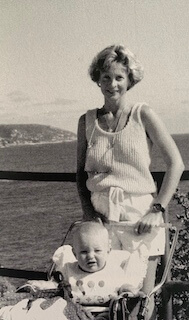
Wella with her baby son, Aaron in a stroller on the ocean front – Photo Courtesy: Wella Hartig
That’s really interesting. It was almost like I had to do it. I remember I would go for runs with him husband and I’d say there’s a good book in me. I had all these things in my head. I couldn’t stop thinking about it. It was coming out of my pores. I also believed that my story could be of benefit to others.
If I had had something like this to turn to when I was going through what I was going through it may have helped. I felt very alone and I was scared to death and had two children that I had big dreams for. I felt in essence, so often, ‘my God, what have I done, I’ve blown it … God give me another chance … I’m not that religious but it is how I felt.”
Whether to ‘god’, nature, a force beyond, do you pray, do you consciously ask for support?
“Oh yeah. It keeps me going, it truly does. When I go swimming I swim for an hour, sometimes more, and I pray for many, for the people I know who have cancer, for the friend who just passed away, for all who need help.
I pray for an hour while I’m in the water and I’ve done that for the past 35 years.
I don’t swim to the clock but by saying prayers. Its a force that’s stronger, stronger than me. I feel support from it.
Was writing your experiences down therapeutic?
It was certainly therapeutic. I have spent a lot of time crying and I didn’t even know that I’d suppressed some things as much as I did. I talk of panic attacks [in the book] and that’s when really know that you need help becomes it comes from nowhere. It came on me when I was driving Hayley school one day. I was young, in my late 30s and that moment felt like it was the culmination of everything. I did not know that my son was going to be gone so much after the age of 12. I thought ‘is this what happens when they’re fast?’. I had no experience of what happens to talented people in sport or anything else.
The way I tell it to people is that Aaron served his country. I never saw him on birthdays from 15 to 27.
He has a summer birthday but he was always gone. I really gave Aaron to the United States, in essence. Both Hayley and Aaron served their country very well and were respectful of that, of what they said or did. That’s super important to me. There was dignity and humility: you are your name.
In the book, fearlessness is cited by Tim as qualities in both Aaron and Hayley. Is that how you see it?
Yes, it is. I wish it wasn’t there – and to have two children that way at once was pretty frightening. Aaron would go out, from a young age, on waves 20ft tall, body surfing,. He’d come home and do that three days before going to the Olympics. If his coach had known… it was just something he grew up doing. And Hayley was always an open, free spirit. She will try just about anything – and doesn’t want to get married.
[Through laughter] She feels a sort of pity for the friends of her age who are married and have children. She says ‘they need to find themselves’. I take some responsibility. I used to tell them when they were young that you don’t know what you want until you’re in your 30s.
Were they weatherproof in the way they were because of their early experience – or was that nature, is it innate?
I think it is innate but I think, too – and this may sound strange – that from the second I was pregnant with Aaron, I had to do 144 lengths of the pool at a go. I was not a swimmer but I would swim for an hour and a half. I kept doing it, felt [compelled]. The doc said ‘whatever you’re doing, continue to do it’. I did – and he never did know what it was I was doing.
I felt from the very beginning that I had to be in water, I felt that he [the child] was a swimmer.
Did I do subliminally? I don’t know but practically from the second he came out he was in the pool. I had him in the water from two weeks.
Your wedding to Tim Hartig in spring 2004 was a private ceremony for two. I wanted to know when Aaron, on his way to triple gold in Athens, got to know and how he felt, but no further mention of it is made. Was that deliberate or a pure reflection of how the event fit into all your lives at the time?
It wasn’t a giant deal. Tim and I just decided ‘let’s do this’. We already felt married. Some people didn’t know how or what context to put him in. I didn’t care for that, it hurt a lot. With Hayley and Aaron, we kind of looked at each other and said ‘ok, that’s good’.
The end of chapter 9, the Sydney 2000 adventure end by saying that you had “turned around a lifetime of disappointment”. How did you deal with disappointment and were your children aware of it?
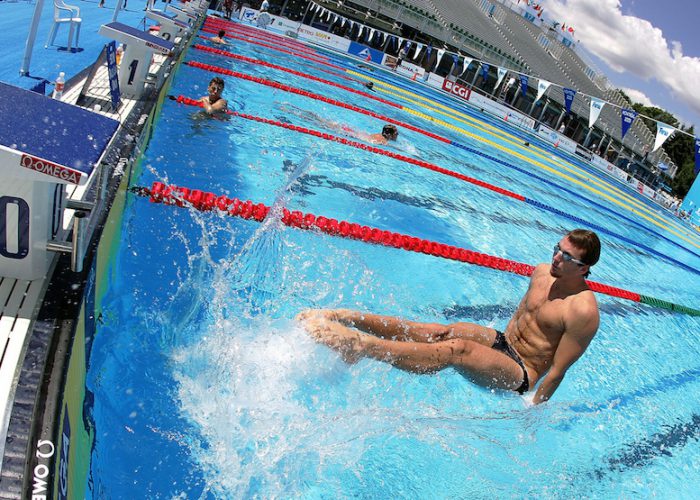
Aaron Peirsol practices for another fine start in the midst of a brilliant career – by Patrick B. Kraemer ©
No, I didn’t tell them. I honestly did not, purposely. It was the same with other things Hayley thanked me this week. She’s into Waldorf Schools [an approach to early childhood education that is largely experiential and sensory-based] and is studying Steiner [the Waldorf philosophy is that of the Austrian philosopher Rudolf Steiner]. Her professors are amazing, She said thanks to me ‘for not ramming religion down our throats’. I now see that that was a gift. I was really afraid of growing up. I grew up with catholicism and thought I was constantly being watched. I had some issues with that and think I still do … it stays with you forever.
On the disappointment, I was more of a frail child, the fourth child and the last of four children. A lot of people say that parents gets tired towards the end [of their child-rearing days] and give up. I was left to flutter around. I needed direction and didn’t get that. I found something precise in life and it gave me something I never had before; it developed me as the person I am now.
It is not a comfort zone but I’m pretty pleased with the way I look at life now compared to 10 years ago. I’ve found my peace.
Has water helped that process and what does it mean to you?
Everything, I think. I have to swim every day to feel somewhat me. I can see the ocean as I’m talking to you. It’s heaven. Its something I have to have, like air to breath. I feel like I have to have this salt water and all of that to feel alive.
Alongside water, can you name the three (or however many) things that are dearest to you, in no particular order?
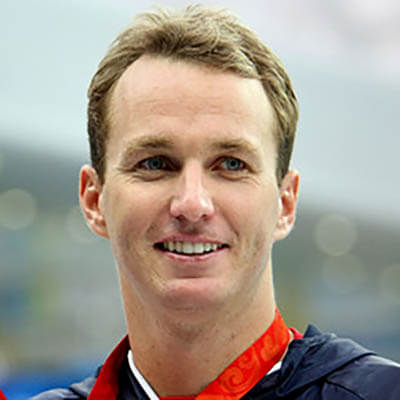
Aaron Peirsol – Photo Courtesy: Jed Jacobsohn
1. Finding my husband Tim. He is the Yin to my Yang. He is, in a way, like Aaron. When I get upset and lose it a little and worry too much, he tells me its going to be ok and why its going to be ok. I love him for it. He’s really positive.
2. My children. Hayley and Aaron are the loves of my life, in a different way to my husband, of course. I loved them so much that I didn’t know it was possible to love anything that much. Far from swimming and their achievements, they are such good people. I was walking Dudley, my Scottie in the jungle and thinking that beauty on the outside is lovely but it does fade; the beauty inside a person can continue, forever. That’s what they have: they are beautiful on the inside. They are caring individuals.
3. Swimming and running together. I owe everything to those two things to get me through. When I go running, I’m huffing it but when I’m doing it I get ideas and that’s when it all gets worked out [like the prayer in water]. I’m not a big drinker. A lot of that is to do with my father; she he drank he was a different person. He’d say yes to everything but the next day when he was sober he would never remember he’d said ‘yes’. I never wanted to do that.
An extract from Buoyant (reproduced by kind permission of the authors):
Chapter 9, Perseverance
Given their financial circumstances as the 2000 Olympics approached, there seemed to be no way Wella and Tim could come up with the money to fly to and stay in Sydney, should Aaron make the Olympic team. Then their luck changed. That May, a friend of Wella’s from the dentist’s office, Michele Mullen, spearheaded a fundraiser for the family at Shark Island, now the Newport Beach Yacht Club1, with invitations sent only to friends outside the swimming world, to avoid fanning any sensitive feelings among fellow swim families.
John Moffet, a breaststroker from Stanford who had been named to two Olympic teams, in 1980 and 1984, spoke at the fundraiser on behalf of Aaron. People donated items for a silent auction; nearly 150 people attended. Michele recalls that the event raised several thousand dollars and involved help from Wella’s sister Patte and several of the water polo families, whose kids were friends with Aaron.
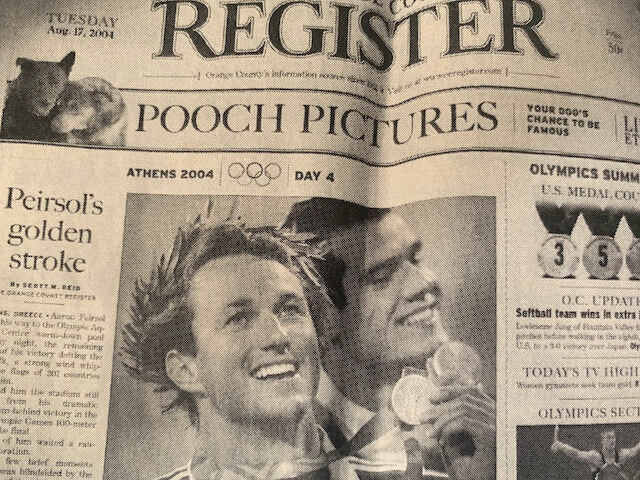
Photo Courtesy:
At the time, the economy had dipped and lots of Californians were taking out second mortgages, a point Wella and Tim make to underscore the generosity of those who came to help. The fundraiser had to be held before Aaron officially made the team—the time was short between the Olympic Trials and the actual Games – but Coach Dave Salo felt so certain about the outcome that the event forged ahead. One donor took Tim aside and offered his frequent-flyer miles to send the family to Sydney. Then, Wella and Tim got a call regarding “an anonymous person who wants to know if there’s anything he can do.”
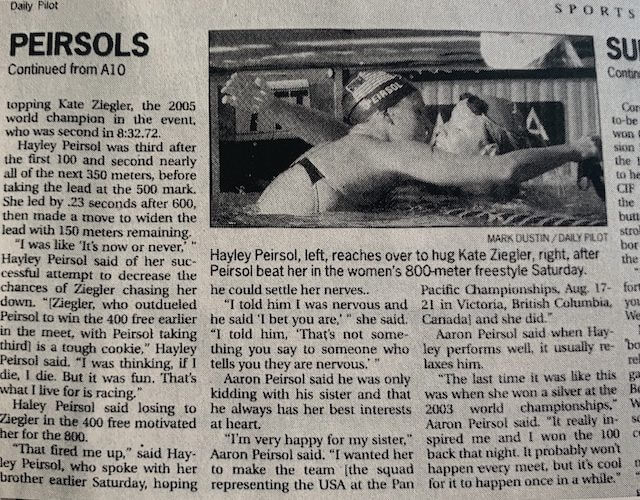
Photo Courtesy:
After Aaron officially made the team, that benefactor called again to ask, “What do you need to make the trip doable?” “A check came in the mail from a foundation that we couldn’t track and helped pull it together for us,” remembers Wella. “You know, a lot of parents don’t get to go, can’t afford it. We’ve heard stories [at the Olympics], about how a whole town got together to send some parents. But for us, living in Southern California, some people were saying, ‘They don’t need that money. Look into them – they don’t need the money.’ People we thought were our friends weren’t there helping.” Fortunately, others were.
Wella’s friend Barbara, a fellow Y lap-swimmer, had once been a flight attendant and remained in touch with a pilot and his family in Sydney, who graciously offered their home to Tim, Wella, and Hayley for the duration of the Olympics.
Things appeared to be coming together.
It is not uncommon for parents of Olympians to be strapped for funds, after scrimping and saving for the training their prodigies require to ascend to the highest levels of sport. While spectators are thrilled by the prowess of the athletes, they tend to assume that someone covers expenses for these talented competitors, who practice single-mindedly for years to represent their country. Many athletes in unsponsored sports are reduced to fundraising through bingo games and bake sales, to cover basic expenses.
From Buoyant: How Water and Willpower Helped Wella to Channel Aaron and Hayley Peirsol © 2013
Review – by Craig Lord
Beyond the draw of one of the world’s all-time greats of swimming, I knew I would love Buoyant by Wella Hartig – mum of Aaron and Hayley Peirsol – with Laura Cottam Sajbel, the moment I read the quotation opposite the Contents page.
The cure for anything is salt water – sweat, tears, or the sea – Isak Dinesen
If you’ve never read anything by Karen Blixen (Karen von Blixen-Finecke, née Karen Christenze Dinesen) pick something up and wallow in the warmth, the majesty and melancholy of it all well before your days are done.
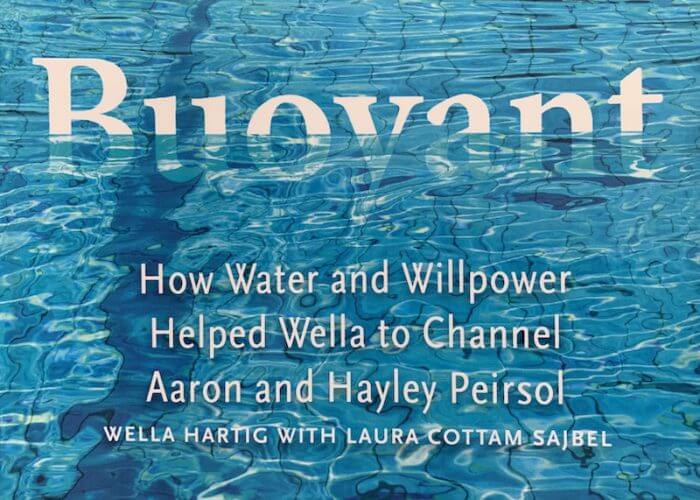
Buoyant – written by a swim mom – Photo Courtesy: Wella Hartig
On the way to the place we all must go, Blixen, ailing back home in Denmark, wrote of her longing for Africa with these stirring words:
“If I know a song of Africa, of the giraffe and the African new moon lying on her back, of the ploughs in the fields and the sweaty faces of the coffee pickers, does Africa know a song of me? Will the air over the plain quiver with a colour that I have had on, or the children invent a game in which my name is, or the full moon throw a shadow over the gravel of the drive that was like me, or will the eagles of the Ngong Hills look out for me?”
What Africa was for Blixen, water has been to Wella Hartig and her kids, the passion, the play, the roller-coaster ride of challenge, of setback, of soaring moments of joy, elation, experience so enriched as to, dare we suggest it, come closer to answering the question “why are we here” than most other searches do.
There are moments in Buoyant where Hartig and Cottam Sajbel capture the thoughtful pace of Blixen. Parenting, writes Hartig,
“is hardly less daunting than being an elite athlete perched at the start of a race: a baby’s very life depends on its parents’ choices and circumstances. Though we are sent home with registration papers and troubleshooting guides for products as inconsequential as a new toaster, there is no handbook to rear any child, let alone one born with a magnificent and undeniable talent”.
The term gifted is mentioned soon after and if that theme is one of the pillars that underpin the journey of a woman raising talented children in a specific environment under a specific set of circumstances, then love is the foundation to all things in this tale told through a mother’s experience in the wake of a life less ordinary as a child herself.
If the story is well-structured and draws you in like the flow of a stream on a summer’s day, then the detail, divine in places, painful in others, appeals to all senses. There are moments when you can close your eyes and almost feel what it would have been like to stand there on the beach, at the pool, at the water’s edge.
Wella Hartig swam throughout her pregnancies and dreamt that her children would be swimmers. Nothing is inevitable but if there is a case for stating that the more you dream and the more you believe that the dream will come true, the more likely it will all pan out as imagined, then Buoyant champions it.
Genes are an important part of sporting success but the habits of dedication, discipline, determination and sheer hard work with a smart edge are forged in the furnace of example and experience, direction and guidance. The role of Tim Hartig in the party in the elite pool is well-told by the authors and adds a layer of explanation that is hard, if not impossible, to find in any literature on the trail of Aaron Peirsol’s evolution to one of the all-time greats of his sport.
The romanticism in his mother passed to her children. Take this from Aaron recalling a trip to the International Swimming Hall of Fame in Florida:
“I remember being pretty inspired by what I was seeing, by the history of the sport. I became a bout of student of the sport, the history and the past of it. And a lot of it, too, wasn’t just swimming for me. I was growing up around the ocean, and a lot of guys who first started the sport of swimming were just guys who happened to be good in the water. They happened to be good swimmers, so they went and swam in the Olympics. That’s the way it was. When you look back into the 1910s, the 1920s, it wasn’t like they were professional swimmers. That’s what I respected probably more than anything.”
Chapter headings give a clue to the chart of this journey, each like the name of a great sea-faring vessel: Perspective, Endurance, Equilibrium, Guidance, Character, Humility, Responsibility, Talent, Perseverance, Intensity, Respect, Triumph, Willpower and Balance.
Don’t read between the lines: buy it and soak it in, to the last page of the tale when Aaron reads a quote written on a wooden bench on Jeffreys Beach in South Africa:
“The sun’s mirror has a salt that sweetens the soul”.
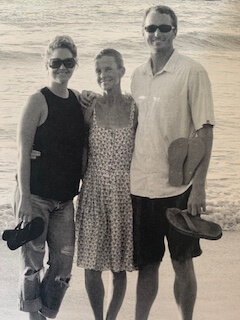
Wella Hartig flanked by her children, Hayley and Aaron Peirsol – Photo Courtesy: Wella Hartig
As I read, many miles from the sea this day of writing, I could feel the ocean breeze, the wisp and wet and whirl of spray on a beautiful day.
In this time of e-books, I read Buoyant on my iPad and enjoyed the e-flick ease of pages; but I then bought the book. This is a work that deserves a place alongside the treasured tomes on swimming that line my office. Like many of those other books, it will be a place to turn to for inspiration and memory and, come the time, I will point my own children to it and hope they feel the same spray of life in all its richness.
End Review
And so it did … and then a second copy arrived, it included kind, hand-written notes from the authors inside the cover – and those last two sentences of my review were on the back cover alongside fine words from coaches Eddie Reese and Dave Salo. And my day that day was complete.
Here’s to my mother this day, to Aaron and Hayley’s mom and all the swim mothers out there who guide and go beyond.
Where to buy Buoyant:
Thank you Craig! Very nice surprise!