






After Lackluster Olympics (Except Marchand), Men’s Breaststroke Resurgence Underway
In one of the most competitive swimming finals of the Paris Olympics, Nicolo Martinenghi won 100-meter breaststroke gold by two hundredths. He denied Adam Peaty the chance to become only the second male swimmer in history to earn an Olympic three-peat as Peaty tied for silver with American Nic Fink. Surprising German Melvin Imoudu was only six hundredths further back.
Nowhere to be found was Qin Haiyang, the Chinese swimmer who dominated all three breaststroke distances at the 2023 World Championships. Qin ended up a distant seventh, almost two seconds slower than his best time, but he was far from the only swimmer to finish with a much-slower-than-expected performance. All three medalists had posted times well under 59.00 earlier in the year, only for a time of 59.03 to be sufficient for Olympic gold.
Whispers circulated that the temporary pool installed inside La Défense Arena was a slow one, with swimmers hampered by the shallower-than-usual depth. Whatever the reasons, this was the first 100 breast final at a World Championships or Olympics where no swimmer broke 59 since Japan’s Kosuke Kitajima made the inaugural journey below the mark at the 2008 Beijing Games. Not including the lightly-attended World Championships in early 2024, this was the first global meet since 2017 that a time above 59 even resulted in a medal.
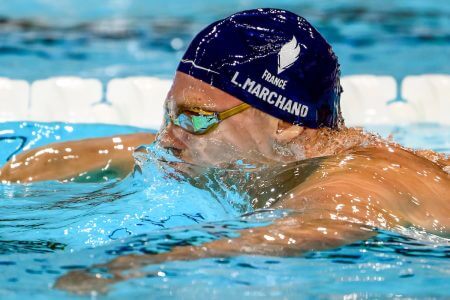
Leon Marchand — Photo Courtesy: Andrea Staccioli / Deepbluemedia / Insidefoto
Three days later in the 200 breaststroke, Leon Marchand swam the second-fastest time in history on the way to gold, completing a historic double with two individual golds in one session. Defending champion Zac Stubblety-Cook earned silver in a solid time of 2:06.79, but the surprise was the 2:07.90 of Dutchman Caspar Corbeau being good enough for bronze. That finished the year as the world’s eighth-fastest time. Qin, meanwhile, swam four-and-a-half seconds off his world record as he was eliminated in the semifinals.
Now, with elite swimmers building toward another championship showdown at the Singapore World Championships, the results from Paris are looking like the outlier. Qin leads the world rankings at 58.61, and his Chinese countryman Sun Jiajun has also gone below 59 in the 100 breast. Martinenghi’s Italian teammate Ludovico Viberti defeated the Olympic gold medalist at the country’s domestic championships. Viberti’s mark of 59.04 was just one hundredth off what Martinenghi swam in Paris.
Meanwhile, the top time in the world in the four-lap race belongs to a 24-year-old Japanese swimmer whose biggest accomplishment to date was Short Course bronze in the 200 breast in December. Yamato Fukasawa swam a time of 2:07.44 while a pair of his countryman who have won World Championship medals in the event, former world-record holder Ippei Watanabe and Yu Hanaguruma, are also ranked in the global top-four. Hanaguruma clocked 2:07.93 in March, meaning Japan’s third-fastest swimmer is almost as fast as the Olympic-bronze-medal-winning time.
Qin is the only other swimmer to clear 2:08 thus far this year, with his 2:07.53 posted back in March, while Marchand swam a time of 2:08.25 last weekend in Austin. Kirill Prigoda, returning to contention as a neutral athlete following Russia’s exile from international waters, recently clocked 2:08.38 on the Mare Nostrum circuit. The 200 could also get faster in the coming weeks with 2025 world No. 2 Matt Fallon and Stubblety-Cook both set to race at their respective national selection meets.
Meanwhile, the 50 breast deserves additional attention now that it has been added to the Olympic program, and there have already been 12 swimmers to break 27 so far this year; in comparison, only six went that fast in the semifinals at the 2023 World Championships.
The speed posted across the men’s breaststroke distances in 2025 slightly lags behind what had been done to this point in 2024, but remember that this is a post-Olympic year, where swimmers often slowly build back to top racing shape following layoffs. There was also no global meet held in February, as was the case last year.
Sure, Peaty will not compete this year and we have not seen Fink since the Olympics, but the rest of the top contenders in the 100 will remain in the picture this year while the 200 might be stronger than in 2024 with the recent results out of Japan. Particularly with Qin back in top form, signs are pointing to a much swifter standard of contention when the leading contenders reconvene in Singapore this July.