




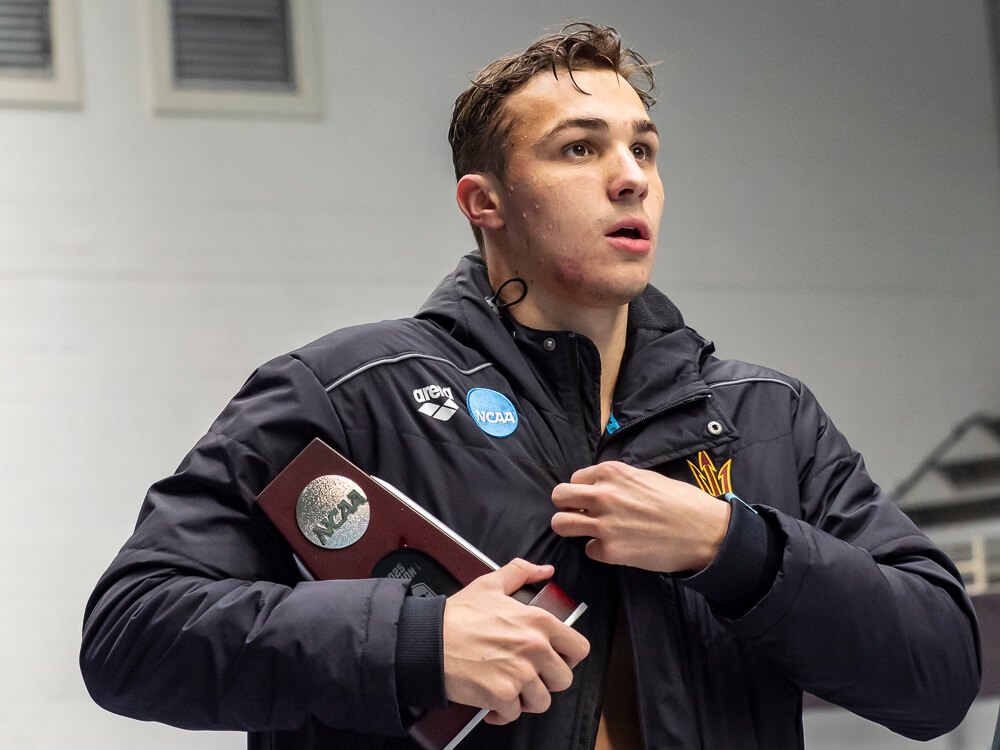

What Ilya Kharun’s Swap Means for the American, Canadian Programs
Ilya Kharun fell into the lap of Swimming Canada in 2022, a program-changing talent the Canadians didn’t know they could count on.
Four years later, he’s a similarly stunning surprise for the Americans, the Arizona State star switching his national allegiance back to the United States on Monday.
Kharun’s journey is a fascinating one. Born in Montreal, he was raised in Las Vegas, assuming he was an American for international purposes until he was named to the 2022 Junior Pan Pacs team. When his parents – retired gymnasts turned performers for Quebec-founded and Vegas-based Cirque du Soleil – went to submit paperwork, they found only a Canadian passport from his birth.
That year included a since-rescinded national age-group record for the U.S., the American Jr. Pan Pacs invitation and an international bow for Canada at the World Short-Course Championships.
More than three years later, with a little more time and agency on Kharun’s part and two Olympic medals in his bag, the soon-to-be 21-year-old will begin representing the United States.
Kharun’s pathway is a story of developmental success for the U.S., his training conducted at Sandpipers of Nevada and Arizona State. His international accolades with Canada speak well of that country’s ability to acclimate and not squander found developmental money, and coaches there deserve praise for elevating a talented teen to an Olympic medalist.
Here’s what the seismic continental news means for both sides of the border.
For the Americans
Butterfly goes from a question mark to an area of strength, at a time when the other two non-freestyle strokes are languishing.
Kharun is the ninth-fastest performer in history in the 200 butterfly via his 1:52.80 at the Paris Olympics to earn bronze. Of the eight in front of him, only five have swum their times since the Tokyo Olympics in 2021. They include the ever enigmatic Kristof Milak and Leon Marchand, Kharun’s former ASU teammate for whom the 200 fly may or may not be in his voluminous menu of possible events in the future.
The 200 fly was the event in which the U.S. had its biggest success at the 2025 World Championships, with Luca Urlando going 1:51.87 to become the fourth-best performer in history (behind Milak, Marchand and Michael Phelps) and win the only gold medal for the beleaguered American men. Kharun was fourth in 1:54.34, .17 behind Harrison Turner in his bid to add to bronze in the 100 fly.
The 200 fly is a spot of opportunity in the American program. Recent placements at major meets:
- 2025 Worlds: Urlando gold, Carson Foster 5th
- 2024 Olympics: Thomas Heilman 10th, Urlando 17th
- 2024 Worlds: Zach Harting 11th
- 2023 Worlds: Thomas Heilman 4th, Foster 6th
- 2022 Worlds: Urlando 5th, Trenton Julian 16th
- 2021 Olympics: Gunnar Bentz 7th, Harting 9th
The 200 fly has been a place to sneak onto the team. No more.
Urlando and Kharun are the clear top two. The pressure will be on prodigy Thomas Heilman to even get to the next Olympics. The knock-on effect is to the IMs, where Carson Foster will be able to focus his energy. Maybe even a turn to the 200 breast, where a lane to an Olympic spot would seem much more open?
The 100 has a similar crunch. At the Paris Olympics, Heilman didn’t make it out of prelims, and Caeleb Dressel didn’t survive semifinals, bringing the ignominy of an American-less final. Urlando has tended toward the 200, but he’ll be in the mix in the 100. And Kharun will vie for direct qualification in the 50 fly.
That narrows the path for Dressel to make his fourth Olympics even more.
In the bigger picture, the U.S. men are suddenly short on reliable suppliers of international hardware, much less stars. Kharun steps into that void as one of the four or five best medal hopes for Los Angeles in 2028.
One other thing to watch: Kharun used to be a 200 flier who could pack a sprint. Working with Herbie Behm, he’s not that anymore. He’s an 18.31/41.03 50/100 freestyler in short-course yards. That hasn’t yet translated to the long-course pool, his best times at 22.06 and 49.37 that wouldn’t contend for even relay spots. But with time to focus on it, could he become a darkhorse contender for the 400 free relay, particularly with the non-expanded quota places for more events at the Los Angeles Olympics in 2028?
For the Canadians
Kharun’s emergence was program-changing for the men’s team. His departure is similarly so.
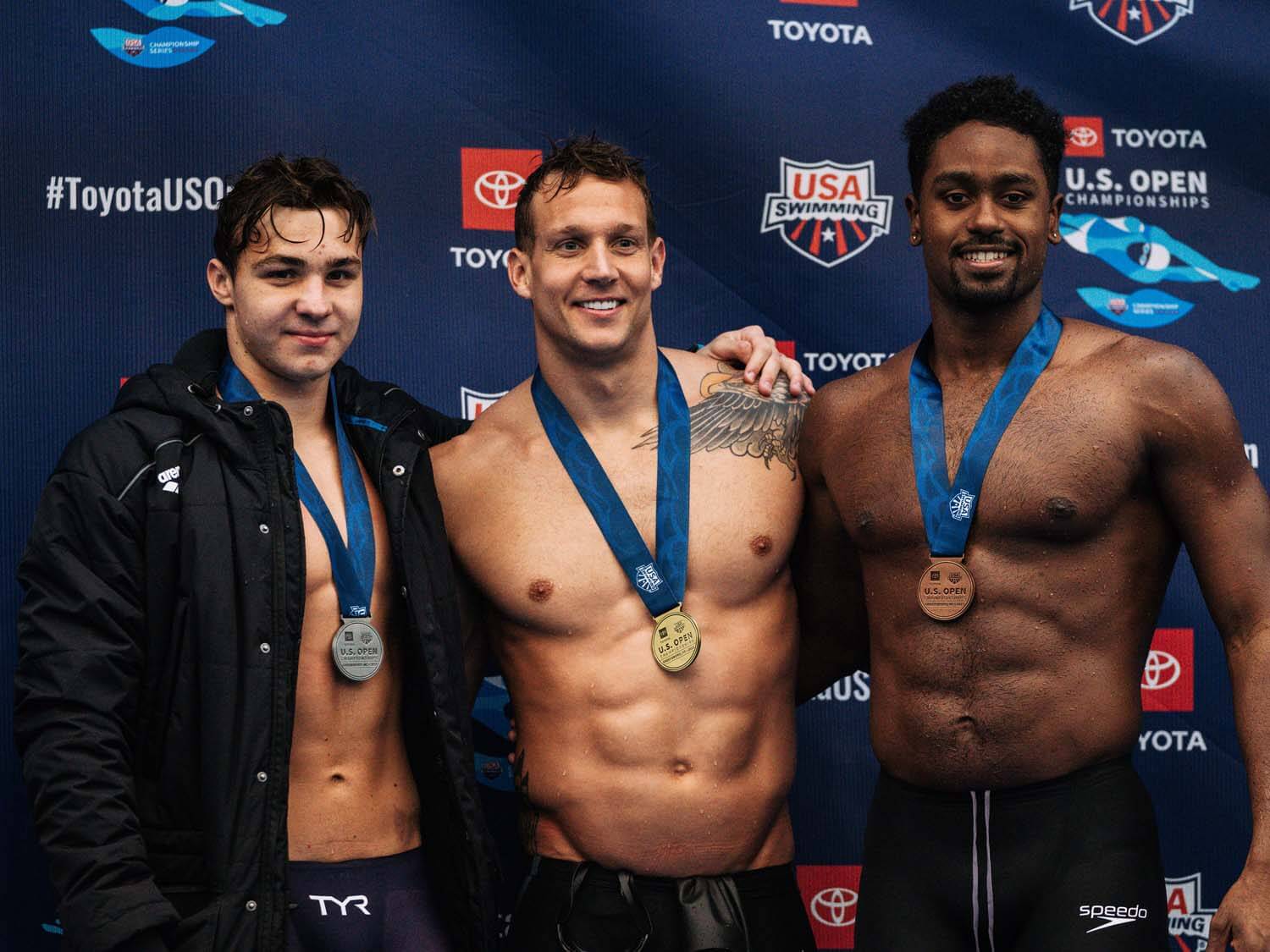
From left, Ilya Kharun, Caeleb Dressel and Josh Liendo at the 2023 U.S. Open; Photo Courtesy: Emily Cameron
The Canadians never got the chance to max out what a relay with Kharun and Josh Liendo could do, missing a piece or two. Finlay Knox filled in ably as a breaststroker for a couple of years, and it wasn’t until Blake Tierney pushed into 53-low as a backstroker that they could do something. At Worlds in 2024, the Canadians went 3:29.75 to finish fifth and set a national record with the fastest back half in the field.
Those dreams are gone, and Liendo in fly and Ruslan Gaziev in free brings them back to the back to the same point until they find a consistent 59-point breaststroker at best. (Oliver Dawson is progressing in that direction.)
Writ large, Liendo and Kharun sharing the podium in the 100 fly was one of the highlights of the Olympics for the Canadians, in the non-Summer McIntosh category. After the long Canadian female ascendancy led by Kylie Masse, Penny Oleksiak, Maggie Mac Neil et. al, Kharun joined Liendo to bring the Canadian men to similar relevance. His departure and McIntosh’s world-beater status moves the pendulum back to the women.
At Olympic Trials in 2024, Kharun won the 200 fly by nearly five seconds. He was the only swimmer to hit the Olympic qualification time, and while the three guys behind him in 1:59s were also 2005 birth years, it’s a long climb. (The A standard for LA is 1:54.69).
The 100 fly is in better shape, not just because of Liendo, the Olympic silver medalist who remains the face of the Canadian program, if that ever changed. Knox was under the OQT for Paris at 51.42 at Canadian Trials but was locked out as the third-place finisher. Filip Senc-Samardzic has gotten under 53, is 20 and is training with Behm at Arizona State.
In Singapore this summer, Kharun’s bronze in the 100 fly was the only Canadian male medal, edging Liendo by .02 seconds. Beyond his finals appearances in the 100 fly and 200 fly (where he finished fourth), only Liendo in the 100 fly and Tierney (fourth in the 200 back) made finals. That dearth of star power only got worse Monday.
