




Virginia Favored to Win Sixth Consecutive NCAA Women’s Title (Team Standings Predictions)
No women’s swimming and diving team has ever captured six consecutive NCAA Division I titles. Texas took five in a row from 1984 through 1988, and then Stanford matched that feat from 1992 through 1996, only to be denied the sixth title by 11 points in 1997. Virginia has matched that record, dominating the meet every year from 2021 through 2025. The Cavaliers were favored to win in 2020 as well prior to the meet’s cancellation because of the COVID-19 pandemic.
Now, Virginia seeks history this week in Atlanta, with another loaded roster favored for a first-place finish. Just like in previous title-winning seasons, Virginia has crushed its competition throughout the regular season and at the ACC Championships. Now, the team owns the top seed in all five relays plus four individual events entering the NCAA Championships. Here is how we foresee the competition going.
1. Virginia Cavaliers
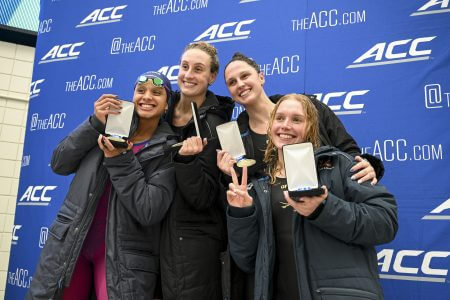
Virginia’s Sara Curtis, Anna Moesch, Aimee Canny & Claire Curzan — Photo Courtesy: ACC
After last season, Virginia graduated the swimmers who made up arguably the most accomplished swimming duo in college swimming history, Alex Walsh and Gretchen Walsh. Alex won NCAA titles over five individual events in five different seasons while Gretchen rewrote the record books in the sprint events. And still, this team led by head coach Todd DeSorbo is loaded with talent.
Claire Curzan remains the country’s best backstroker, having lowered the American and NCAA records in the 200 back at ACCs while approaching the mark in the 100. Curzan is also a top challenger in the 100 fly. Anna Moesch enters the meet seeded first in the 100 and 200 free, threatening to down Missy Franklin’s 11-year-old record in the 200 free. Katie Grimes, a two-time U.S. Olympian, has produced strong swims in her second season with the team, positioning her as a top-three contender in the distance races and 400 IM.
Virginia has a pair of fourth-year swimmers taking on their biggest roles yet in Aimee Canny and Emma Weber. Canny, once known primarily as a freestyler, is among the top contenders in both IM events plus the 200 breaststroke, while Weber is continuing to build on her extensive international experience in the breaststroke events. Weber is one of four Cavaliers who won individual gold medals at last summer’s World University Games, along with IMer Leah Hayes, butterflyer Tess Howley and mid-distance freestyler Cavan Gormsen.
And of course, the pipeline continues to bring in new talent, with a freshman class including top Italian sprinter Sara Curtis, budding mid-distance standout Madi Mintenko and versatile Bailey Hartman. This group has already contributed to amazing freestyle relay performances, with Curtis joining Curzan, Moesch and Canny to swim an NCAA record in the 400 free relay while Mintenko, Gormsen, Moesch and Canny were not far off of the 800 free relay mark. With all of those pieces in place, Virginia looks unbeatable yet again.
2. Stanford Cardinal
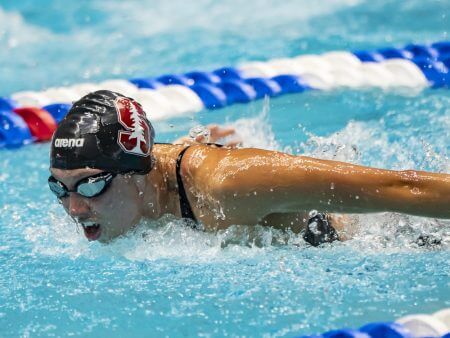
Torri Huske — Photo Courtesy: Peter H. Bick
Stanford begins a new era this season as Chris Lindauer takes over head coaching duties from Greg Meehan, who won three national titles during his time with the program. But in some respects, this is also the end of an era as Torri Huske completes her college career. Huske, the Olympic gold medalist in the 100-meter butterfly in Paris, has only won one individual NCAA crown in her career, last season in the 200 IM, but she is in a strong position in the 100 fly plus sprint freestyle events this year following Gretchen Walsh’s graduation.
Also in her final season is Lucy Bell, the reigning NCAA champion in the 200 breaststroke and top seed entering the event this year. Bell is also the only returning A-finalist from the 200 IM at last year’s NCAAs, and she is seeded second in the 400 IM. One spot behind her in that race is defending NCAA champion Caroline Bricker, a junior. To accommodate the new NCAA Championships schedule, Bricker dropped the 200 IM from her program and returned to the 200 breast, and she will also contend in the 200 fly, an event in which she was the long course U.S. national champion last year.
Stanford lacks a breadth of scorers across events, leaving a large responsibility on the big three. The team has key supporting pieces in Gigi Johnson, one of only four swimmers to break 50 in the 100 fly entering NCAAs, plus sprinter Annam Olasewere, and their contributions on relays will also be vital. Stanford will hope to get individual points from swimmers like Lucy Thomas, Kayla Wilson and Emily Thompson. The team’s significant overachievement from its supporting players last season helped Stanford take second place, its highest finish since 2019.
3. Texas Longhorns
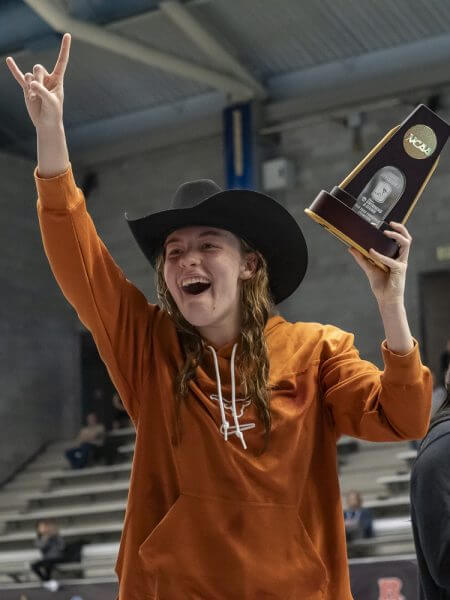
Photo Courtesy: Peter H. Bick
Going for a sixth top-three finish in six seasons under head coach Carol Capitani, the Longhorns will rely on continued excellence from Jillian Cox, who won national titles last season in the 500 and 1650 freestyle and enters as the favorite to repeat in both events. Texas also gets big diving contributions, with two top-eight divers returning from last season in 3-meter national champion Alejandra Estudillo plus Bayleigh Cranford.
Texas graduated Emma Sticklen, the three-time national champion in the 200 fly, but Campbell Stoll has stepped into that role as the team’s top butterflyer, winning titles in the 100 and 200 at the SEC Championships. Eva Okaro, a new arrival from Great Britain, might already be the best sprinter in program history, and she is a top-eight seed in the 50 and 100 free for the NCAA meet. Also new to the team is Nikolett Padar, who is seeded fourth in the 200 free, and the Texas freestyle group also includes accomplished returners Erin Gemmell, Lillie Nesty and Kate Hurst.
The Longhorns will also hope to see breaststroker Piper Enge plus IMers Campbell Chase and Angie Coe break into the scoring. They could make a major difference in an expected tight battle for top-three finishes.
4. Michigan Wolverines
Michigan is poised for a significant jump in the standings from the team’s ninth-place finish one year ago. Central to those efforts will be Bella Sims, who transferred from Florida after claiming five top-three individual finishes at her first two NCAA Championships. Sims, who has represented the U.S. in mid-distance freestyle going back to the Tokyo Olympics, will eschew that stroke individually this season to focus on the backstroke events, where finished second to Curzan at the 2025 national meet, plus the 400 IM. Sims has returned to the longer medley this year with a flourish, with her time of 3:58.02 the top mark in the country.
A second Wolverine enters NCAAs as a top seed, Hannah Bellard with a time of 1:50.34 in the 200 butterfly. Bellard also should score top-eight points in the 500 free and 400 IM while Stephanie Balduccini remains one of the top 200 freestylers in the country. Sprinter Brady Kendall and breaststroker Letitia Sim are other swimmers that could qualify for multiple finals in their individual events, with Lexi Greenhawt capable of providing additional top-16 points. Michigan also has all five relays seeded fifth or better, and in the 800 free and 400 medley relays, only Virginia has posted quicker times this season.
5. California Golden Bears
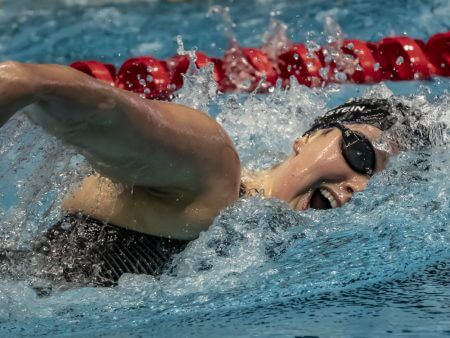
Claire Weinstein — Photo Courtesy: Peter H. Bick
For the first time since Dave Durden took over leadership of the Cal women’s program, he brings a team with top-five capabilities to the national meet. The Golden Bears’ best swimmer is freshman Claire Weinstein, the World Championship bronze medalist in the 200-meter free. Weinstein has not approached her best times this season, but her marks from her high school days would be good enough to challenge for the national title in the 500 free and closely contend in the 200 and 1650-yard events.
In a surprising turn, the team’s top performer this season has been sophomore Mia West, who became the first Cal woman to win an ACC title in swimming this year. West has quickly become a top-three contender in the 200 IM while also boasting big scoring potential in the 200 free and 100 back. New to the Cal roster this year is Teagan O’Dell, a multi-time National High School Swimmer of the Year, and she will race both IM events plus the 200 back. Mary-Ambre Moluh is one of only six swimmers to crack 50 in the 100 back this season while other Bears with scoring potential include butterflyers Annie Jia and Lilou Ressencourt, freestyler Ella Cosgrove, IMer Ava Chavez and the breaststroke trio of Elle Scott, Silje Slyngstadli and Abby Herscu.
6. Louisville Cardinals
Following the addition of Anastasia Gorbenko to the Cardinals’ roster, Louisville has a chance to match or improve upon last year’s seventh-place finish and maybe make a run at the top-five. Gorbenko will be the top seed in the 200 IM at her first NCAA Championships, a time of 1:5x.xx putting her a full second ahead of the field, and she also ranks third in both breaststroke races.
Meanwhile, Julia Dennis is back for one final season with Louisville, capable of a significant point haul in the sprint events but with an even larger potential impact on relays alongside swimmers like Caroline Larsen, Julie Mishler and veteran Ella Welch. All Louisville relays 400 yards and shorter are seeded among the top-five. In breaststroke, Mia Cheatwood is a strong No. 2 to Gorbenko, and Louisville even has strong distance talent from the duo of Thilda Haell and Leticia Fassina Romao.
7. Tennessee Lady Volunteers
Mona McSharry has departed following a brilliant five-year career in Knoxville, but Tennessee returns with a pair of swimmers seeded in the top-eight in all three of their respective individual events. Camille Spink is coming off an SEC Championships in which she swept the 50, 100 and 200 free, the effort including her first-ever 50 free performance under 21 to make her the top seed for the national meet. Spink also has a mark of 46.01 in the 100 free, making her the third seed behind Moesch and Huske, and 1:41.74 in the 200 free.
Ella Jansen won a pair of B-finals at last year’s NCAA Championships, and she looks to take a step forward in 2026. She arrives at the national meet with top-six seeds in the 500 free, 400 IM and 200 fly, with teammate Emily Brown joining her as a contender in the fly and medley. McKenzie Siroky is the highest returning finisher in the 100 breast, and the Lady Vols could pick up big points there with Simone Moll and Emelie Fast also in the mix. Mizuki Hirai, an Olympic finalist in the 100-meter fly, has made a quick adjustment to short course yards while Jillian Crooks was the SEC Champion in the 100 back.
8. Indiana Hoosiers
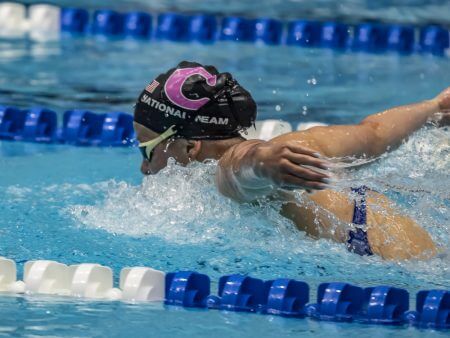
Alex Shackell — Photo Courtesy: Peter H. Bick
Indiana has star-level talent that it will depend on against its national foes: freshmen Alex Shackell and Liberty Clark plus veteran Miranda Grana. Shackell has been a national-level swimmer for years, qualifying for the Paris Olympics and making the final in the 200-meter fly, and she is the third seed in both butterfly events at this meet. Shackell is not racing a third individual event, giving her the chance to swim all five Indiana relays. Clark, meanwhile, has broken out this year, emerging from anonymity to swim times of 1:40.84 in the 200 free and 46.22 in the 100.
Grana is one of only two swimmers entered with sub-50-second times in both the 100 fly and 100 back. The Hoosiers also return NCAA consolation finalists Kristina Paegle and Mya DeWitt plus divers Ella Roselli and Lily Witte, but the graduations of freestyler Anna Peplowski and Ching Gan plus diver Skyler Liu will be tough to overcome. Both Peplowski and Liu won individual NCAA crowns last year.
9. NC State Wolfpack
A few standout performers plus strong relays can push a team into the national top-10, and that’s what NC State is banking on this season with Eneli Jefimova, Leah Shackley and Erika Pelaez set to account for their team’s scoring punch in Atlanta. Jefimova came to Raleigh as already a world-class sprint breaststroker, and she has recorded the top time this season in the 100 breast (56.77) while putting together a solid 200 as well (2:06.33).
Shackley, a three-time individual winner at last year’s World University Games, will race alongside Pelaez in both backstroke events plus the 100 fly. The Wolfpack could go two-up in all of those races, and veteran Kennedy Noble gives the team a third star in backstroke. Noble won 100 back gold at WUGs while taking second behind Shackley in the 50 and 200. That group will also play central relay roles, joined by a sprint contingent of Lily Christianson, Cassie Moses and Olivia Nel.
10. Florida Gators
Despite somewhat of a down season for Florida, a top-10 finish is still within reach if breaststroker Anita Bottazzo and backstroker Catie Choate can take steps forward from their already-impressive swims at the SEC Championships. Bottazzo swept both her events at that meet, with times of 56.87 in the 100 (second in the country) and 2:06.97 in the 200 (eighth). Choate got under 1:50 for the first time in the 200 back, nd she boasts scoring potential in the 100 as well.
Florida’s relays remain a question, but the team has a solid group of returning mid-distance scorers in Michaela Mattes, Julie Brousseau, Lainy Kruger and Addison Reese while Grace Rabb could also make an impact.