





The Art of a Negative Split: How the Tough Take Over
Negative split. What does it mean? What is its significance? A negative split in swimming means the second half of the race is faster than the first half. It is a pacing strategy built around discipline. Start strong and controlled to conserve energy, then let loose in the second half. The goal is simple. Finish faster than you started.
The opposite occurs more often. A swimmer launches off the blocks with guns blazing, jumping out to a big lead. As the race goes on, the legs begin to fade, and the tempo slows. The first 50 to one 100 yards look great, but the second half exposes the swimmer’s stamina. Hammering the front half can work for those who can hold on, but elite swimmers get faster in the later stages. That’s why negative splitting is such a powerful and effective skill.
The Switch That Wins Races
A swimmer who can stay controlled at the start and channel the natural adrenaline of racing has a real advantage. It allows for a strong opening, fueled by that adrenaline, and sets up the ability to flip a switch on the back half. With that ability, the swimmer can hunt down the early sprinters and reel in the leaders. They are accelerating and building speed into the final wall, whereas most others are fading. Negative splitting turns the final meters into a weapon rather than a struggle to the finish.
The Ledecky Standard
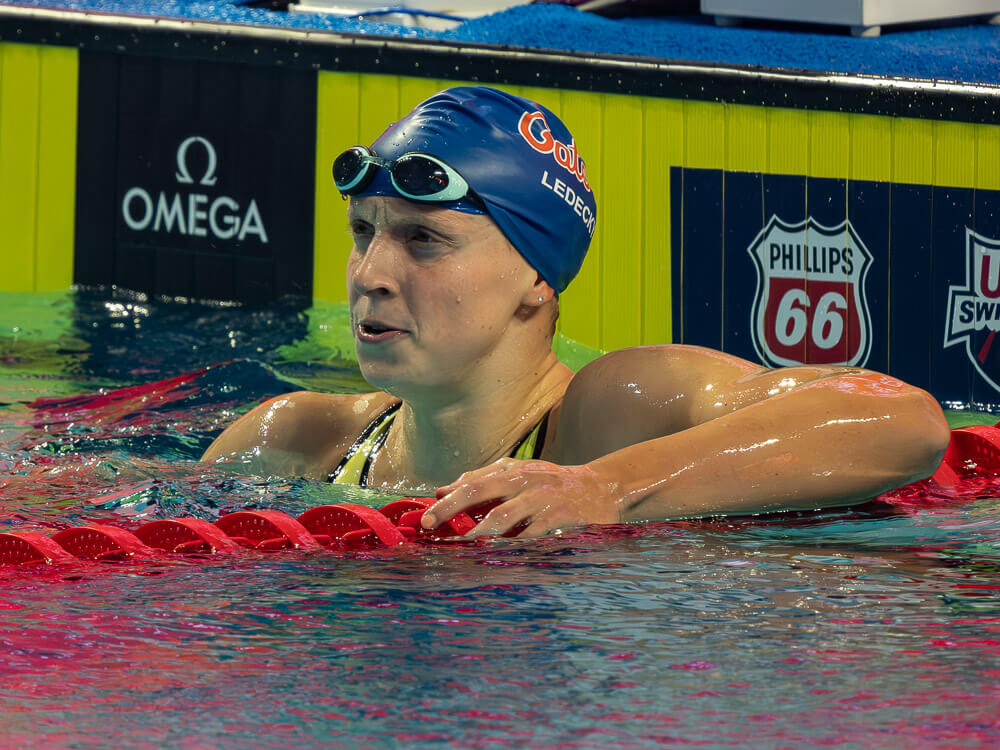
Few swimmers show the power of a negative split better than Katie Ledecky. One of the GOATs of swimming and the clear GOAT of distance, she has produced negative splits in events ranging from the 200 freestyle to the 1500 freestyle. Her ability to keep her splits even, and often descending, is a major reason for her dominance.
Let’s look at her performance at the 2022 Southern Zone South Sectional Championships in Orlando, Florida. She swam the 800 meter freestyle and finished in first place with a time of 8:11.83.
Now here are her 400 splits. Her two 400s landed at 4:05.98 and 4:05.85. Negative splitting an 800 takes a different kind of toughness. That is the part of her dominance that separates her. When the race gets hardest, she gets faster.
The Strong Survive
Negative splitting is one of the toughest skills in swimming. It shows up in practice long before it ever shows up in a race. Coaches emphasize it to push swimmers to develop that second gear for the back half. Practice how you play. Descending or negative-split sets build the foundation to pull it off in a meet. Doing it in practice is difficult. Executing it in an 800 free is another level entirely. That is how Katie Ledecky separates herself. The final meters are not where she holds on. They are where she takes over.
The art of a negative split reveals who breaks and who refuses to. It is learned in practice and proven on race day. Katie Ledecky proves the power it holds. Negative splitting has always been a key part of her success, and it shows how valuable this skill is across the sport. It is a strategy built on patience and toughness. Anyone can start fast. Finishing is what separates the greats.