





Summer McIntosh Dominant in 200 Butterfly as She Chases World Record, With Regan Smith the Clear No. 2
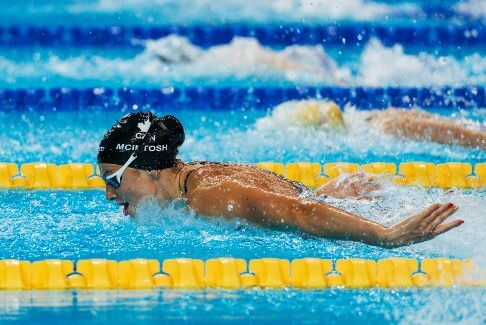
When she touched the wall to earn her third consecutive world title in the women’s 200 butterfly, Summer McIntosh made no secret of her displeasure. McIntosh had given chase to the oldest world record in women’s long course swimming, the otherworldly 2:01.81 set by China’s Liu Zige just months before full-body polyurethane suits were banned from the sport. At the time, the record beat the previous global mark by 1.60 seconds, and no woman had ever gone sub-2:05 in a textile suit.
Over the next decade-and-a-half, no one came close to that record. Sure, the 2:04 club became far more populated, with performances in that territory required to claim Olympic gold medals in 2012 and 2016, but it was not until the Tokyo Olympics when a swimmer again broke into the 2:03s. China’s Zhang Yufei would do the honors as she clocked 2:03.86 to dominate the final.
Regan Smith would come next. Having previously captured silver behind Zhang in Tokyo, Smith clocked 2:03.87 at a June 2023 tune-up meet in Tempe, Ariz., becoming the fourth-fastest woman in history behind Liu, former world-record holder Jessica Schipper and Zhang. But even at her best, Smith has never been able to notch a global-level gold medal in the event thanks to the domination of one Canadian teenager.
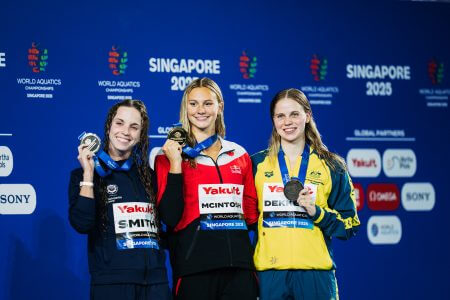
Regan Smith, Summer McIntosh and Elizabeth Dekkers on the podium for the 200 butterfly at the World Championships — Photo Courtesy: Emily Cameron
McIntosh had shown huge year-to-year improvement in the event, dropping her world-title-winning times from 2:05.20 in 2022 to 2:04.04 a year later. Chasing Olympic gold in Paris, Smith never let McIntosh out of sight and nearly caught up with a powerful final underwater kickout. Smith lowered her best time in that race, but it was only sufficient for silver as McIntosh finished in 2:03.03, putting the world record within her reach — or anyone’s reach — for the first time. She followed that up months later by nabbing the short course world record in the event at the Budapest World Championships, taking down a mark that had lasted for a decade.
2025 would bring magical performances in a wide swath of events. At Canadian Trials in June, McIntosh crushed world records in the 400 freestyle and both individual medley events while giving Katie Ledecky’s mark in the 800 free a real push. In the 200 fly at Trials, she achieved the first-ever 2:02 performance, going 2:02.21. At the Singapore World Championships, the 200 fly would be the only race in which McIntosh improved upon her Trials time; after turning under world-record pace with 50 meters remaining, McIntosh slowed slightly down the stretch and finished in 2:01.99, the 0.18 margin from history prompting a few choice words. She would go sub-2:03 one more time to finish out the year, clocking 2:02.62 at the U.S. Open.
The world record is McIntosh’s only true competition going forward. Her best time is almost two seconds ahead of the next-quickest active swimmer, Smith. Aside from that duo, no other swimmer has cracked 2:05 in the last four years. In history, five swimmers have been under 2:04 (Liu, McIntosh, Schipper, Smith and Zhang) while seven others have best times in the 2:04-range: China’s Jiao Liuyang, the United States’ Mary Descenza, Hungary’s Katinka Hosszu, Japan’s Natsumi Hoshi, Spain’s Mireia Belmonte, Great Britain’s Ellen Gandy and Australia’s Madeline Groves. Jiao was the Olympic champion in 2012 while Belmonte edged out Groves for gold four years later.
As for the current landscape of the 200 fly, there are few others knocking on the door of 2:04. Australia’s Elizabeth Dekkers is the event’s most consistent swimmer outside of McIntosh and Smith, having won silver at the 2023 World Championships and bronze this year. Dekkers owns a lifetime best of 2:05.20, tied for No. 14 all-time. Also sitting at that mark is American Tess Howley, who crushed her previous best on the way to gold at the World University Games in July. Fellow U.S. swimmer Caroline Bricker edged out Smith to win the U.S. national title in the 200 fly in upset fashion, notching a time of 2:05.80.
Americans Alex Shackell and Audrey Derivaux, Chinese 13-year-old Yu Zidi, Australia’s Brittany Castelluzzo and Great Britain’s Keanna MacInnes were the only other women to clock 2:06s in 2025. That seems a long way off from the gold standard in the event, but Dekkers’ mark of 2:06.12 was sufficient for bronze in the global final. Outside of the supersuit era, it has never taken under 2:05 to reach the international podium in this event. Continued improvement from any of these swimmers, with Yu as the most obvious candidate given her age, has the potential to make a massive impact.
In the meantime, McIntosh will continue the world-record chase, and odds are good that she will complete her unlikely quest to break the legendary mark in 2026.