




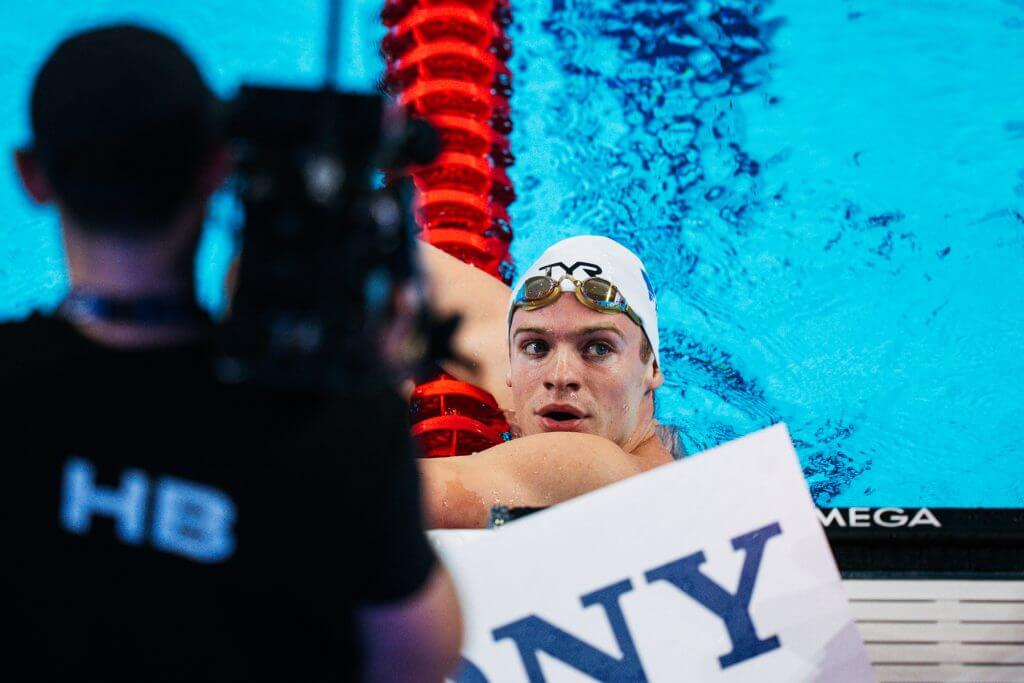

Leon Marchand Alone Atop 400 IM Rankings as Today’s Rivals Struggle to Make Inroads on All-Time List
For Ryan Lochte, the best moment of his Hall-of-Fame career came on opening night of the 2012 Olympics in London. On that late July evening, Lochte declared his status – for the time being – as the world’s best and most versatile swimmer as he dominated one of the sport’s signature races, the Olympic final of the men’s 400 IM. Lochte crushed a field that included two-time defending champion and world-record holder Michael Phelps by more than three-and-a-half seconds. Lochte even appeared to take his foot off the gas down the stretch as he came to the wall in 4:05.18.
At the time, the mark was the second-quickest in history behind Phelps’ world record of 4:03.84. The mark has stood the test of time: in the last 13 years, Leon Marchand is the only swimmer to eclipse that time, and Lochte’s London time remains the sixth-quickest performance in history. Only two other active swimmers have ever broken 4:07.
That stands in stark contrast to most other long course events in men’s swimming, where recent performances dominate the all-time standings. Lochte’s long-standing world record in the 200 IM went down this year, with Marchand clocking an otherworldly time of 1:52.69, and the three men who finished behind Marchand in the World Championships final, the United States’ Shaine Casas, Hungary’s Hubert Kos and Great Britain’s Duncan Scott, all rank among the all-time top-10. The world record in the men’s 200 backstroke has not been threatened since the supersuit era, but Kos and South Africa’s Pieter Coetze both jumped up the rankings with their 1:53s at Worlds.
But in the 400 IM, Marchand’s title-winning time of 4:04.73 was only a few tenths quicker than Lochte went in 2012. Perhaps Marchand was holding back — he did have the 400 medley relay coming up later in the session — but no one came close to the dominant Frenchman as Japan’s Tomoyuki Matsushita earned silver in 4:08.32. Neutral athlete Ilia Borodin finished above 4:09 and still was quick enough to earn the last spot on the podium.
Compare that with some of history’s great medley swimmers, whose best times have stood up far longer than expected. Marchand’s world record is 4:02.50, and Phelps and Lochte come next on the rankings list. In fourth is Chase Kalisz, the Tokyo Olympic champion who competed as recently as the Paris Games, with a best time of 4:05.90 dating back to 2017. Five swimmers own lifetime bests in the 4:06-range: Japan’s Kosuke Hagino and Daiya Seto, Hungary’s Laszlo Cseh and Americans Carson Foster and Tyler Clary.

Carson Foster — Photo Courtesy: Peter H. Bick
Of that group, only Foster and Seto are still active. Foster has not recorded a 4:06 since the 2023 World Championships, but his performance at the recent U.S. Open marked a significant step in the right direction as he clocked 4:07.02, the third-best time of his career.
Times in that 4:07-range have become the international standard for the 400 IM. In 2025, three other men have been that quick, two relatively young Japanese swimmers plus another veteran American. Matsushita, 20, has been the silver medalist in the 400 IM behind Marchand at the Paris Olympics and this year’s World Championships. He clocked 4:08.32 in Singapore before achieving a best time of 4:07.21 in September to make himself the 10th-fastest man in history.
Joining Matsushita among the new generation of Japanese stars is 19-year-old Asaki Nishikawa, who clocked 4:07.67 at the Japan Open last month. Nishikawa, previously the fourth-place finisher at the World Championships, knocked more than 1.5 seconds off his best time and became the 12th-fastest man ever. Additionally, Japanese teenager Yumeki Kojima set the world junior record in the event with a 4:09.38 in August.
The American is Bobby Finke, best known for his three Olympic gold medals in distance freestyle. Finke was able to fit the 400 IM into his schedule at U.S. Nationals, and he delivered a dynamite finish to surpass Foster on the freestyle leg, clocking 4:07.46 to Foster’s 4:07.92. Finke put himself briefly in the all-time top-10 in the event, although Matsushita surpassed him in the ensuing months. Both Americans would have been World Championship medal contenders with their times, but neither one raced the event in Singapore; Finke opted out due to a conflict with the 1500 free while Foster was dealing with an ankle injury at that meet.
The only other swimmers to go sub-4:10 this year are Borodin, American Rex Maurer and Japan’s Kosuke Makino. A mark of 4:12.46 from neutral athlete Maxim Stupin was sufficient for fifth place in the World Championships final. Hardly an indication that a big jump in the event is coming.
For now, the best hope of anyone getting close to 4:05-territory comes from the quartet of Matsushita, Nishikawa, Finke and Foster. Marchand, meanwhile, surely has hopes of breaking his world record and pushing closer to the 4:00-barrier, but such improvement might not be necessary to maintain his four-year winning streak in the 400 IM.