




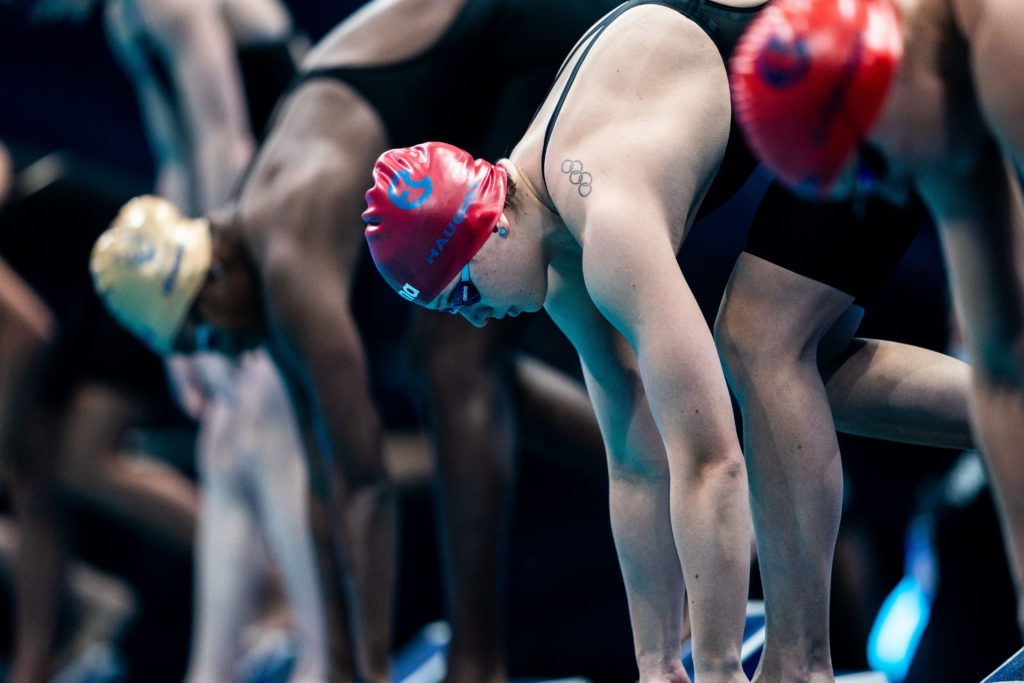

At its core, the conceit of the International Swimming League is about sprinters. With no event longer than 400 meters, the objective is speed. It’s about points, racing, gamifying the wonky times into round-number points. It’s about wondering what would happen if Caeleb Dressel or Sarah Sjostrom got to sprint against anyone and everyone, three or four times over a two-hour program.
All of which makes what Siobhan Haughey has been doing in ISL this season all the more impressive. She’s far from a traditional sprinter, packing her best punch over 200 meters. And she’s not likely to take part in any skins races, lest the distance be up for choice instead of the stroke.
But the MVP of ISL Match 6 for Energy Standard showed just how extraordinary she can be, even if the slate of events doesn’t exactly cater to her expansive expertise.
Haughey won the MVP race with 61.5 points, edging out teammate Florent Manaudou and Aqua Centurions’ Szebasztian Szabo (58 points each) and Toronto’s Kylie Masse (57.5). Each had the benefit of the skins races, Manaudou and Masse winning and Szabo reaching the final. Haughey’s day was long done by then.
But within her fenced-off territory, arguably no one has been more dominant than the native of Hong Kong, who turned 22 Saturday and has celebrated with a slew of national and Asian records.
Haughey led the Energy Standard 400 free relay to victory with a sizzling opening leg of 51.14, not only the fastest time in ISL this season and a top-10 all-time performance but the quickest in the race by just shy of two seconds. She would win the 100 free in 51.30 to open Day 2.
On Day 1, she got the win in the 400 free in 3:58.75, one of only three women to be under 4 minutes this season. Her biggest point haul came in the 200 free, a time of 1:51.42 that, for the second time this year, undercut the ISL record she set last year with DC Trident. Haughey gobbled up 24 points there, with only second-place Rebecca Smith of Toronto and Energy Standard teammate Femke Heemskerk scoring. (Energy Standard overwrote both 200 free ISL records, with Danas Rapsys going 1:41.23 in the men’s race.)
Add in the winning mixed free relay, and Haughey needed just five swims to tally her MVP-winning total. Compare that to the seven swims for Manadou, or eight for Match 5 MVP Tom Shields, or 11 for Match 4 MVP Dressel.
Taking it back to Toronto
When Dylan Kent spoke to Swimming World before the Titans’ inaugural match, the assistant general manager highlighted the team’s second match as a big one to qualify for the ISL semifinals.
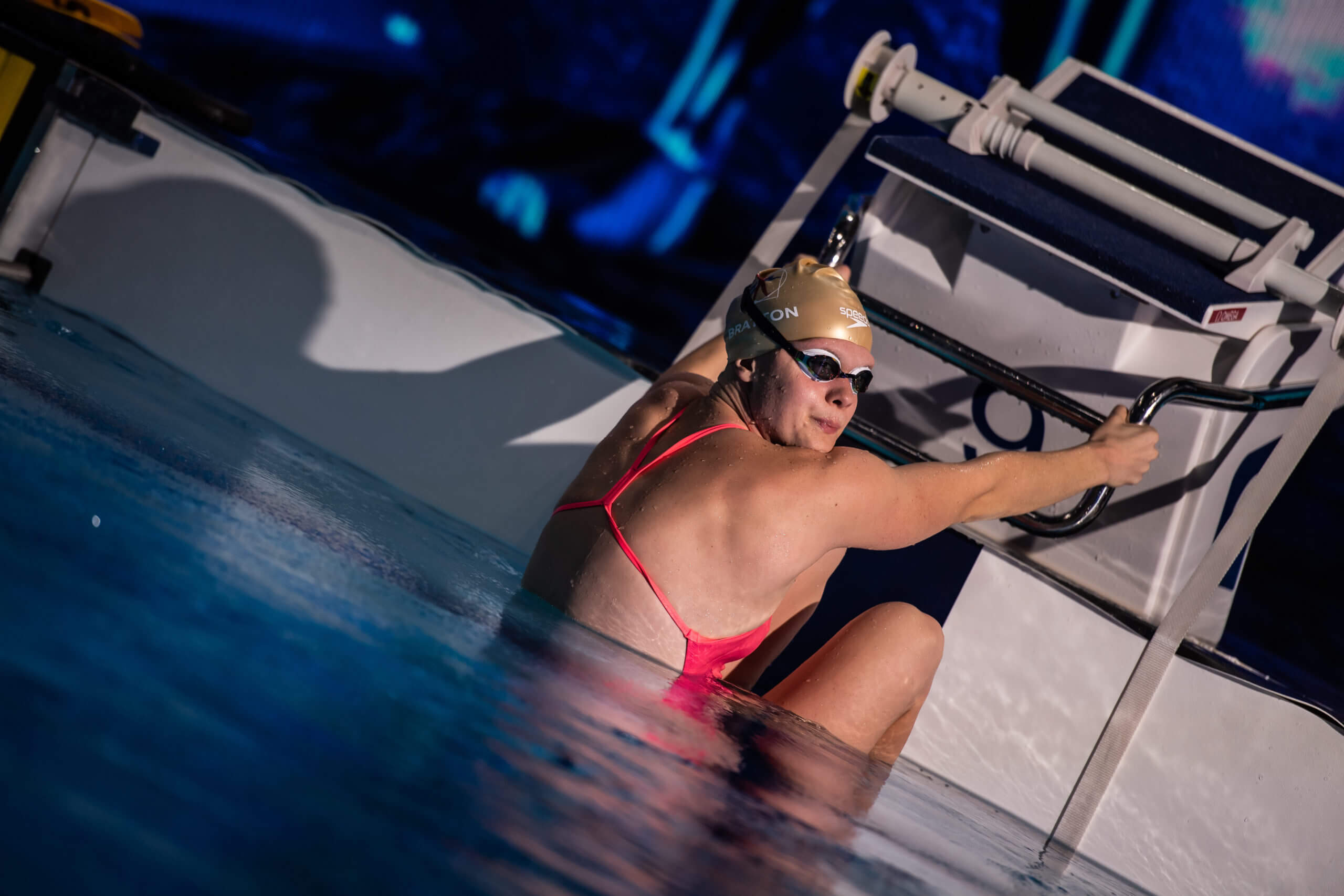
Toronto Titans’ Lisa Bratton Photo Courtesy: MIKE LEWIS
In ISL Match 6, the Titans delivered, finishing second. They were a distant second behind Energy Standard, which was to be expected. But they were clearly better than the NY Breakers in third and Aqua Centurions.
And a big reason is the team’s backstroke core. It was a no-brainer that the Titans, upon winning the women’s medley relay, would pick backstroke thanks to Masse. But as big a factor was the secondary weapon of Lisa Bratton, who has quietly won the 200 backstroke in each of her first two meets, an event where Masse is (on paper at least) favored.
“The back-to-back wins was great,” Bratton said in Monday’s virtual mixed zone via Zoom. “For a lot of us, this is the first time racing since COVID hit, and so I really wanted to come out here and see where I’m at and see where I am in the 2-back.”
The backstrokers have delivered repeatedly. Bratton and Masse went 1-2 in the 200 on Day 1, Bratton’s jackpot meaning they accrued 31 points, earning huge distance over their chasers from the get-go. Cole Pratt earned valuable points in third in the men’s 200. Masse won the 50 back and dominated the 100, the latter a 1-3 result with Bratton. Shane Ryan continued his hot streak, edging Evgeny Rylov and cracking 23 seconds in the 50 and orchestrating an arguably larger upset in the 100, holding off the Russian’s late charge in 50.45. Energy Standard had Rylov and Matt Grevers to play in both events.
With control of the women’s skins, Masse was the obvious pick, first at every stage and winning the final over Energy Standard’s Emily Seebohm.
Of the Titans’ top four swimmers in ISL Match 6, three are backstrokers: Masse with 57.5, Bratton with 39.5, Ryan with 29.0. Other Titans certainly turned in big swims – Kelsey Wog’s win of the 200 breast and second in the 100 by .01 over a pair of chasers, Tess Cieplucha surging past favorite Abbie Wood to win the 400 IM, Rebecca Smith’s big second to Haughey in the 200 free – but the core was backstroke.
“We start off Day 1, 100 fly, 200 back,” Bratton said. “It’s great being able to hop in the pool, get the momentum going for the Titans, get everyone excited and fired up for the days ahead. I think we really lean on the backstroke events, both men and women.”
With three team points, the Titans have five from two matches, tied with fellow expansion side Tokyo Frog Kings. The NY Breakers have five points from three matches, the trio tied for sixth. That puts the Titans in a strong position to make the semifinals.
An Aqua imbalance
From three meets, Aqua Centurions have just three points, fourth place in each outing. There’s a more unusual stat within: The male-female balance in their scoring.
Here’s the team scoring broken down by gender:
- Energy Standard 286 men’s, 297 women’s, 26 mixed
- Toronto Titans 146, 278, 24
- NY Breakers 153, 183.5, 8
- Aqua Centurions 232, 42.5, 16
Much of that is attributable to who isn’t there: Gone from last year are British swimmers Freya Anderson and Hannah Miley; captain Federica Pellegrini was diagnosed with COVID-19 last month, and Elena Di Liddo is among the Italians who didn’t take part over federation squabbles. The Centurions are built on an Italian program whose best swimmers are distance athletes, an area not maximized in the ISL slate, leaving little room for error.
That’s not to undercut some sensational men’s performances, among them Szabo and the sprinting of Alessandro Miressi. But when one swimmer (Szabo at 58) can outscore an entire women’s team, it’s hard to compete.
“We are not disappointed with the team because the men’s part of the team is really good,” Mykhaylo Romanchuk said. “From the women’s, we lost a lot of good girls and the team is a little bit weak in the women’s part. But I hope next year it will be stronger and we will be better from meet to meet.”
.jpg "International Swimming League 2020 - logo")
- ISL WEBSITE
- SEASON 2 SCHEDULE
- EUROPEAN ROSTERS
- AMERICAN ROSTERS
- TOKYO & TORONTO NEW ROSTERS
- CBS TV AGREEMENT
- MATCH ONE RESULTS (CONDORS, ENERGY, CURRENT, BREAKERS)
- MATCH TWO RESULTS (ROAR, IRON, TRIDENT, CENTURIONS)
- MATCH THREE RESULTS (CURRENT, FROG KINGS, TITANS, CENTURIONS)
- MATCH FOUR RESULTS (CONDORS, IRON, BREAKERS, TRIDENT)
- MATCH FIVE RESULTS (ROAR, CURRENT, FROG KINGS, TRIDENT)
- MATCH SIX RESULTS (ENERGY, TITANS, BREAKERS, CENTURIONS)
- MATCH SEVEN RESULTS (ENERGY, IRON, TITANS, TRIDENT)
- MATCH EIGHT RESULTS (CONDORS, ROAR, FROG KINGS, BREAKERS)
- MATCH NINE RESULTS (ENERGY, FROG KINGS, IRON, TITANS)
- MATCH TEN RESULTS (CONDORS, CURRENT, ROAR, CENTURIONS)
- SEMI ONE RESULTS
- SEMI TWO RESULTS
- GRAND FINAL RESULTS