





Commentary: Too Late, But Not – Nancy Garapick Deserves Hall of Fame Recognition
Nuance has always been an aspect of subjective debate, and its role is inarguable across all Hall of Fame discussions. How electors view various factors – eras, injury, extenuating circumstances – is personal. Want some evidence? Earlier this year, the Pro Football Hall of Fame announced its latest induction class and Bill Belichick, widely considered the best coach in history, was not a first-ballot selection.
Belichick will likely earn induction next year, but his initial denial generated buzz in the sports world and cast a negative light on the Pro Football Hall of Fame’s selection process. At least one voter indicated that Belichick did not receive his support because he voted for senior candidates who were running out of time to land in the Hall. Like it or not, that approach painted a clear picture of an imperfect process.
The International Swimming Hall of Fame (ISHOF) is not immune to similar nuance, and the recent death of Canadian Olympic medalist Nancy Garapick provides proof. Sadly, Garapick passed away last week at the age of 64, and while her vast accomplishments in the sport were celebrated, there was something missing from the obituaries and tributes: Hall of Fame status.
It’s important to note the significance of ISHOF in recognizing the wonderful history of aquatic sports, particularly what has unfolded through the years between lane lines. The Hall of Fame inducted its first class in 1965, a group headlined by the likes of Johnny Weissmuller, Duke Kahanamoku, Gertrude Ederle and Dawn Fraser. In the years since, the custodians of the Hall have done a brilliant job recognizing the greatest of the greats and sharing memorable stories of aquatic sports. A new ISHOF museum is under construction and, by late 2028, fans will have the chance to celebrate history at a state-of-the-art facility.
But like any Hall of Fame, determining inductees is a complicated process. I speak from knowledge, due to my fortunate standing as a member of ISHOF’s selection committee. Each year, our committee members weigh candidates and cast votes that determine the next induction class. In some instances, the process is not difficult. Heck, who wasn’t going to vote for Michael Phelps? At times, however, difficult decisions must be made, and various circumstances must be considered.
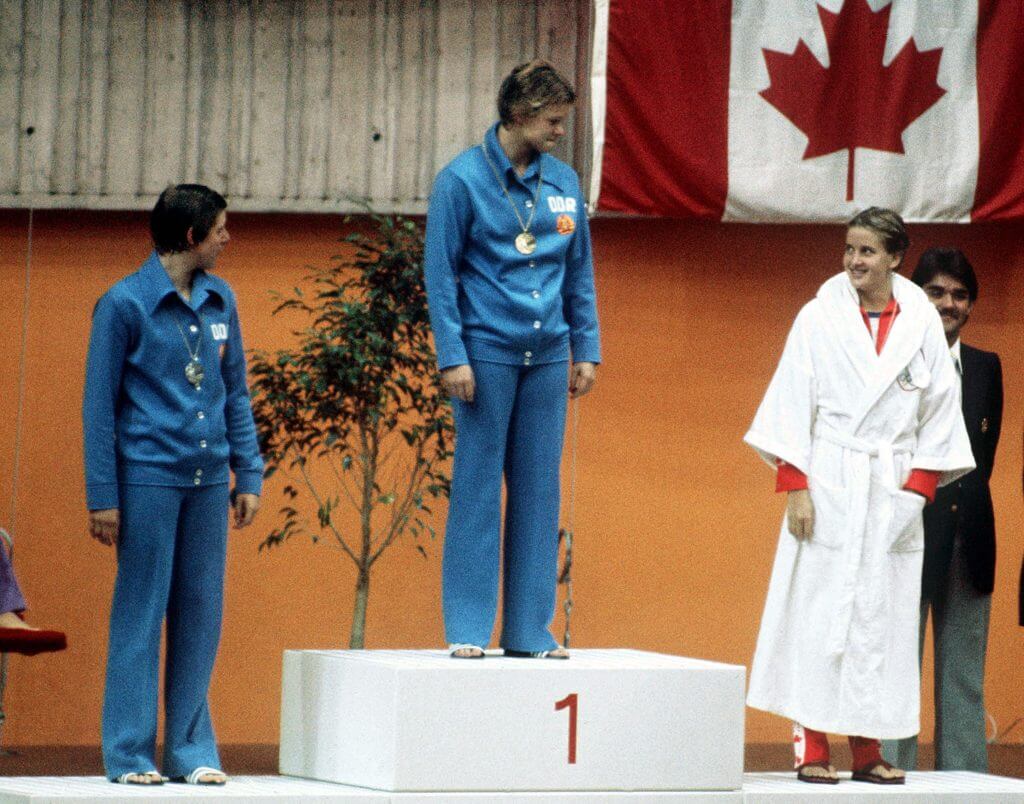
And that brings us back to the late Nancy Garapick, whose career exploits rank her among the finest Canadian swimmers in history. A world-record setter at the age of 13, Garapick won a pair of bronze medals in the backstroke events at the 1976 Olympic Games in Montreal. A year earlier, at the World Championships in Cali, Colombia, she was also a double medalist.
Four podium finishes in major competitions solidified Garapick as a Canadian legend, but those achievements do not warrant Hall of Fame induction – at least on the surface. Delve a little deeper into Garapick’s career, though, and her accomplishments shine brighter. How? Well, each time Garapicked medaled at the Olympics or World Champs, she was defeated by East German athletes now known to be connected to the country’s systematic-doping program. Here’s the breakdown:
- At the 1976 Olympic Games, Garapick was the bronze medalist in the 100 backstroke and 200 backstroke. In both events, she finished behind East Germany’s Ulrike Richter and Birgit Treiber.
- In the 200 backstroke at the 1975 World Champs, Garapick earned silver behind Treiber, while finishing just ahead of bronze medalist Richter.
- In the 100 backstroke at the 1975 World Champs, Garapick was the bronze medalist. Finishing ahead were Richter and Treiber.
Remove Richter and Treiber from the 1976 Games, warranted for their performance-enhancing drug use, and Garapick would be known as a multi-time Olympic champion. That status would be a lock for Hall of Fame induction. Instead, she has been overlooked for years, the victim of a doping program that fed its teenage athletes the anabolic steroid, Oral Turinabol.
As noted previously, the Hall of Fame selection process can be challenging. Should Pete Rose, the game’s all-time hits leader, be in the Baseball Hall of Fame? Shouldn’t Belichick have been a first-ballot choice? Do Barry Bonds and Roger Clemens belong in Cooperstown? Obtaining a consensus is not easy, and the beliefs of one selector often run in conflict with the vantage point of another voter.
Garapick is not alone in her situation as a victim of doping, and so precedent is established. An argument can be made that American Shirley Babashoff and Dutchwoman Enith Brigitha were the two-biggest casualties of the East German doping machine, these superstars of the sport robbed of multiple global titles between the Olympic Games and World Championships during the 1970s. While Babashoff earned induction in 1982, the doors to the Hall of Fame did not open to Brigitha until 2015 – decades too late.
Yes, Better Late Than Never is a true sentiment, and at least Babashoff and Brigitha are Hall of Fame members. But despite stone-cold evidence of the GDR’s systematic-doping program, they have never been retroactively awarded the gold medals they rightly deserve by either the International Olympic Committee or World Aquatics. Garapick, of course, falls in the same category.
Craig Beardsley. Photo Courtesy: Swimming World Magazine.
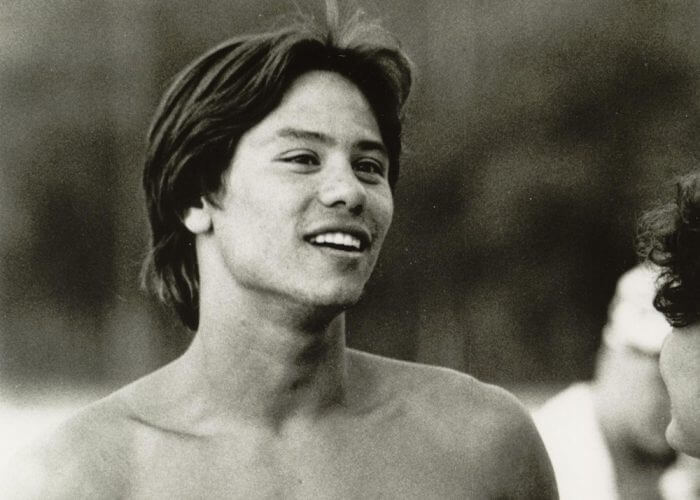
Meanwhile, for Craig Beardsley, Hall of Fame induction should have come much earlier than 2022, the year he was enshrined. A year out from the 1980 Olympic Games, Beardsley was well-positioned to make a run at a gold medal in Moscow. However, political interference short-circuited those hopes, as President Jimmy Carter announced in early 1980 that the United States would boycott the Games in response to the Soviet Union’s invasion of Afghanistan.
In the aftermath of that decision, Beardsley established a pair of world records in the 200 butterfly and collected a second straight gold medal in the event at the 1982 Pan American Games. But Beardsley never received his Olympic opportunity, as he finished third at the 1984 Trials, one spot shy of qualifying for the Los Angeles Games.
For years, a missing piece of Olympic hardware proved to be the obstacle between Beardsley and The Sash, the red ribbon presented to all inductees of the International Swimming Hall of Fame. Ultimately, voting by the Hall of Fame’s selection committee went in Beardsley’s favor, and the Team USA stalwart was honored in Fort Lauderdale a few years ago, with a huge gathering of former teammates and friends in attendance.
Nancy Garapick is now gone, and no matter what happens in the future, she will never have the chance to hear applause as an inductee of the International Swimming Hall of Fame. Yet, her legacy will live on as a great of the sport, and she deserves to have further recognition attached to her name.
Hall of Famer.