





At Final NCAA Championships, Hubert Kos Instills Fear in Competitors, Augments Elite Credentials
For some historically great swimmers, name recognition can defeat opponents before the race begins. Think Michael Phelps, Katie Ledecky and Leon Marchand — so many races begin with their rivals knowing victory is a near impossibility.
It might be time to put Hubert Kos among that group. The 23-year-old Hungarian has only won international gold medals in one event, the 200-meter backstroke, but consider the full package of his results over the past year and especially at the NCAA Men’s Championships. In his college finale of a college career, Kos was the top performer on a title-winning University of Texas squad, marking the third consecutive NCAAs that Kos has played a critical role in a national-title-winning effort.
Swimmers rightly dread Kos opting to contest one of their best events. Just ask Josh Liendo, who needed a six-tenth time drop, a perfect finish and the fastest performance ever to escape the 100 butterfly final with a victory. Never mind that Liendo was the two-time defending champion, the one chasing Caeleb Dressel’s NCAA record since 2024, while Kos was a complete newcomer to the 100 fly. Remember that if not for an NCAA schedule change eliminating the 200 IM as a realistic racing option, Kos would have never touched the 100 fly.
In that same race, Arizona State’s Ilya Kharun finished third, becoming the fourth man ever under 43, and he was ticked off. Not because Liendo beat him — that was expected — but because he couldn’t keep up with Kos, his former teammate for one season at Arizona State, in an off-event for the latter. “Hubi comes out of nowhere and does things like that,” Kharun said. “I expect that from Josh, but it was very disappointing that I got third.”
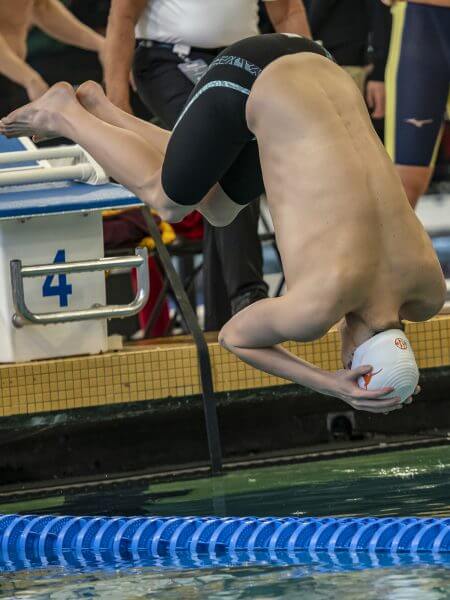
Hubert Kos — Photo Courtesy: Peter H. Bick
That same scheduling conflict made Kos consider the 400 IM as well. Count Texas teammate Rex Maurer, the winner of the 400 IM in American-record time, among those relieved he chose differently. “I think that would have been a great race,” Maurer said. “With the new schedule change, it shows that doesn’t matter for him. He can throw down whenever he needs to.”
The closest recent comparison might be Marchand, Kos’ training partner the past four seasons. Imagine the fear that defending Olympic champions Kristof Milak and Zac Stubblety-Cook felt when Marchand confirmed his Paris Olympic participation in their respective events, the 200 butterfly and 200 breaststroke. Marchand went on to take down both in the same session to win double gold.
Amid his slate of individual races, Kos moonlighted as the Longhorns’ top sprinter. He clocked 19.30 as the butterflyer on Texas’ 200 medley relay and then blasted an 18.22 split on the 200 free relay, jumping the Longhorns from outside the top-eight seed times into a tie for fourth place. His 42.52 butterfly split on Texas’ 400 medley relay was best in the field, ahead of Liendo and Kharun, and leading off the Longhorns’ 400 free relay at the conclusion of the meet, Kos touched first in the final heat in 41.15.
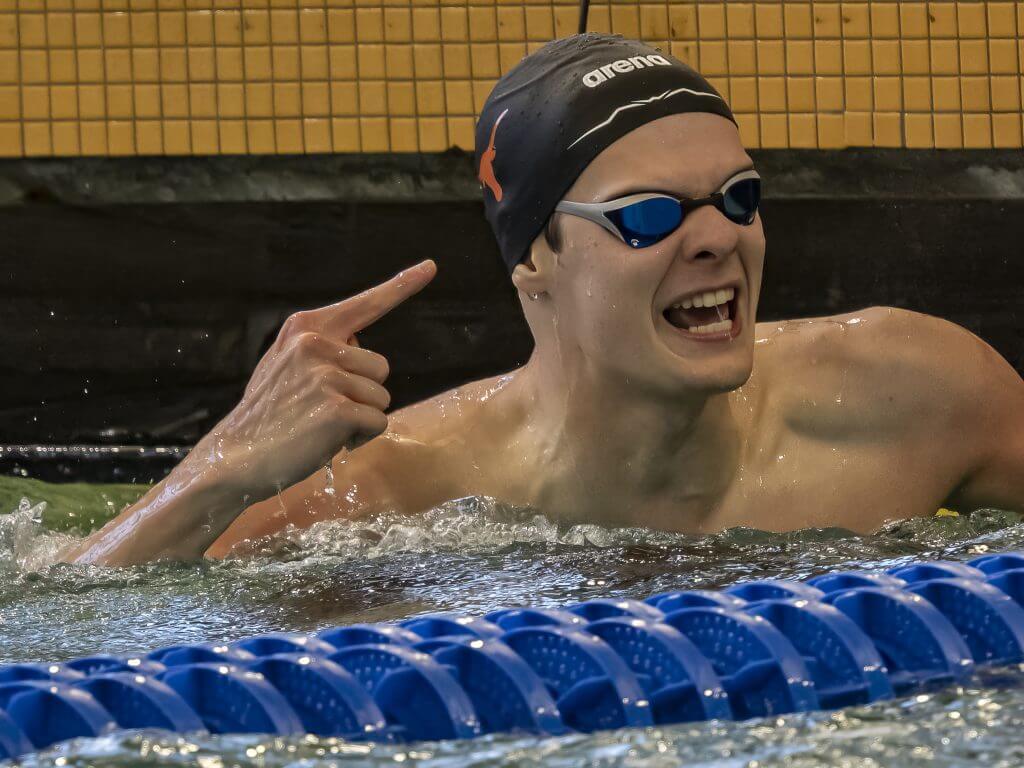
As for his signature backstroke events, Kos was simply marvelous. A seemingly close 100-yard race, one which Kos won by just two hundredths last season, turned into a complete rout. He broke his own NCAA and U.S. Open records in prelims and then became the first man ever under 43 with an almost inconceivable time of 42.61. A dramatic lane line celebration signified the importance of the achievement for Kos.
“The 100 fly was sort of a last minute addition, and I’m super glad I did it because honestly, yesterday, it’s hard to be on the losing side of a race, but that might have been my favorite race ever,” Kos said. “I think my 100 backstroke is now my favorite race. The Olympics was more of a pressure situation and I’m only swimming for myself, and here I’m swimming for the team. It’s the last time I get to do that, and I really wanted to do it for the boys and do it for myself. So that’s probably the most I’ve ever reacted after a race, and honestly, I think definitely my best race ever.”
He followed that up with a 200 back win in 1:34.13, cracking his 2025 NCAA record by eight hundredths and dominating the field by three seconds. His dominance in the 200 is nothing new; Kos is undefeated in the event globally over the past three years, with an Olympic gold medal, two long course world titles and a short course win to show for it. Last fall during the World Cup circuit, Kos broke the first world record in the short course meters version of the event.
The change is the 100s coming along quickly, and the momentum he is building should be cause for concern around the world. He reached the World Championships final for the first time last year, placing a close fourth, and he followed that up with a world record in the short course meters event in October. It’s not impossible to imagine a forthcoming era of dominance over both distances.
Not that Kos will be reading too much into his rising stardom anytime soon. No protégé of Bob Bowman, the same coach who guided Phelps for decades and Marchand now, would let that sort of messaging get in the way of continued progress.
“If you start thinking about things like that, it doesn’t do you any good. Bob always tells us to focus on the process and the results will come. And I think that our whole team does a really, really good job of understanding that concept and listening to his words,” Kos said. “If you start thinking about like, ‘Oh, like, I’m like the best at something,’ it doesn’t really help you. Obviously, it’s good to have confidence, but you need to keep training and improving every single day if you want to stay at the top.”
Kos will not win every time in every event, just like Phelps, Ledecky, Marchand and all the others, but he bears watching in every race he enters. The world’s top 100 butterflyers and even 200-meter specialists should be thinking about Kos potentially adding their events. His breaststroke remains a work-in-progress, but that’s all that separates him from Marchand in the long course 200 IM.
Kos is steadily building an aura of greatness. He did not win the most events at his final NCAA Championships, with Liendo sweeping his three sprint races, but Kos is the one starting his professional career with a case as the best in the world.
.jpeg "2026 NCAA Division I Men's Swimming and Diving Championship - logo")