




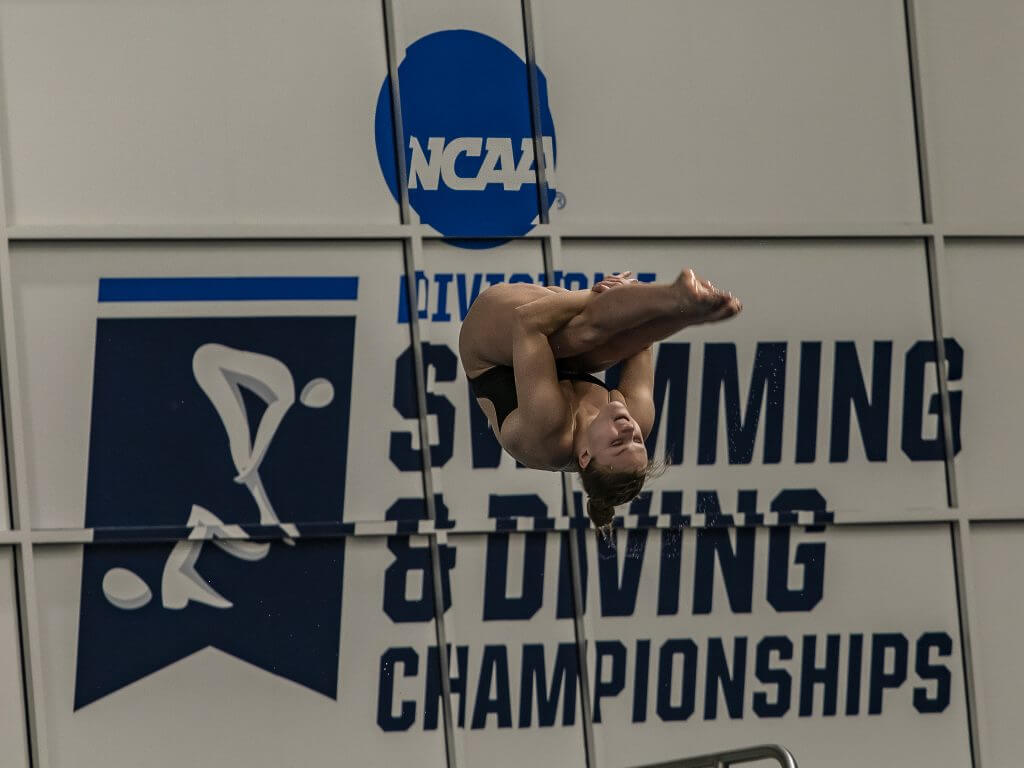

Amid Format Changes, NCAA Divers Mixed on New Split Finals
The reaction to changes in the swimming portion of the NCAA Division I women’s championships last week was almost uniformly negative. The feeling about changes in the diving program were more mixed.
The 2026 edition of NCAAs included no B finals for swimmers, award ceremonies moved to the end of the sessions and a changed event lineup, among other alterations in qualifying.
For divers, the eight-person finals at the end of each night session were broken into two segments – with a three-dive opening round (two in the case of platform) and a three-dive final round.
The logic, as was the reasoning for most of the meet changes, was geared toward television, with two shorter breaks of about 30 minutes each in lieu of a single diving break of an hour or longer. That meant a final in which the eight competitors dove three times, sat for about a half-hour, then dove three more times, a particular challenge to the usual intensity and rhythm of finals.
“It’s interesting, because for us, once you get in the competition, you kind of have that mindset, and having that break, it kind of breaks that mindset that you have during the competition,” 1-meter champion Chiara Pellacani said. “So it’s definitely something different. I didn’t hate it. It was fine. But I think I definitely like better how we usually do it.”
NCAA Meet Controversy
- CSCAA Response to B Finals: New NCAA Format ‘Requires Adjustment’ in Some Areas
- ‘The Biggest Bummer:’ NCAA’s Experimental Cut of B Finals Met with Widespread Criticism
- Indiana Diving Coach Drew Johansen Releases Letter Defending NCAA Changes
The three NCAA divers who won national titles are experienced internationally. Pellacani, the 1-meter champ from the University of Miami who successfully defended her title from last year, is a two-time Olympian representing Italy. She finished fourth on springboard at the Paris Olympics and is a seven-time World Championships medalist, including gold in springboard mixed synchro at the 2025 World Championships.
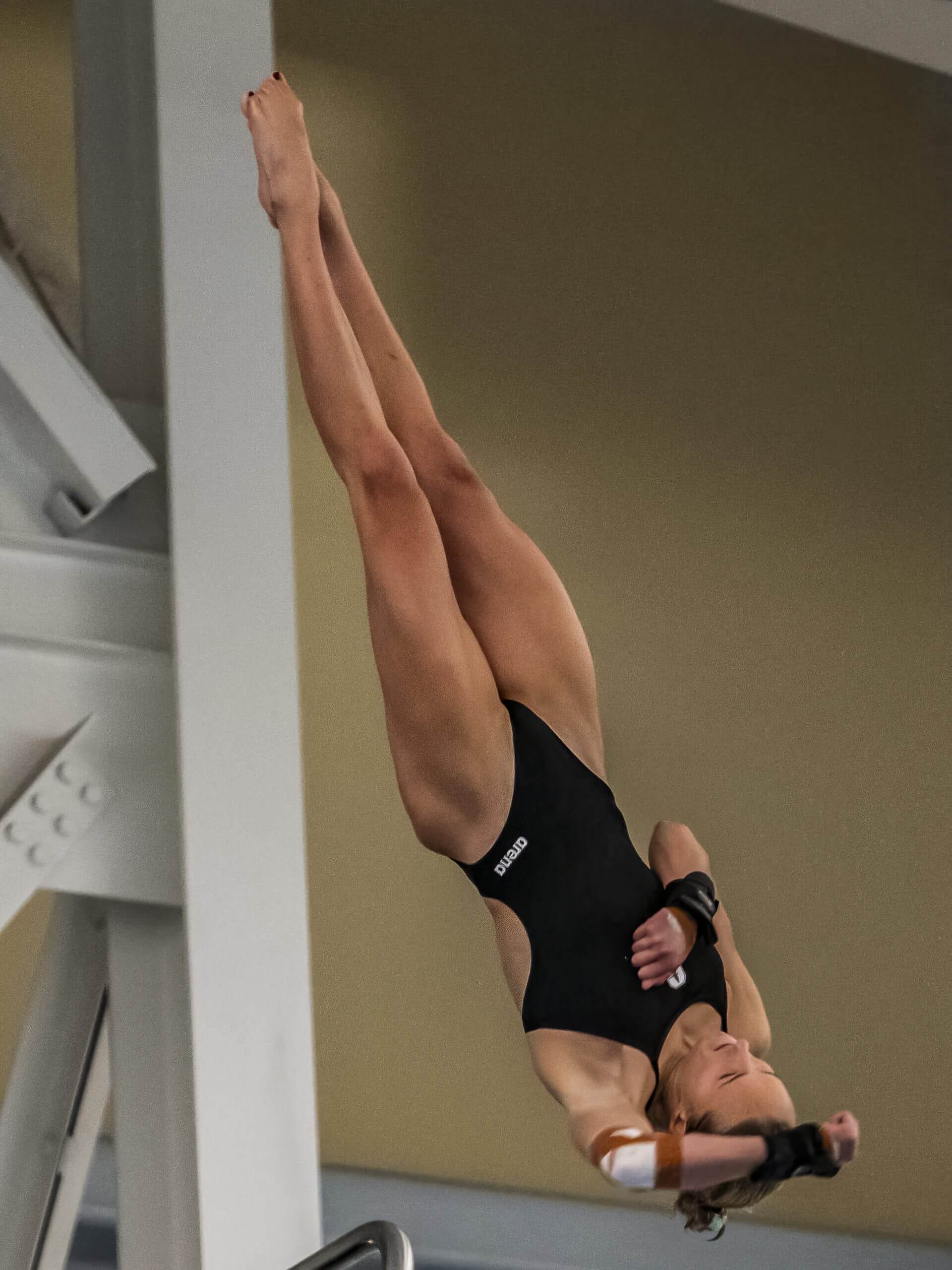
Stanford’s Ellie Cole; Photo Courtesy: Peter H. Bick
Ellie Cole, the Stanford freshman who set an NCAA Championships record on platform, was a Paris Olympian representing Australia. Sophie Verzyl of the South Carolina, who won her first NCAA title on 3-meter, has dived internationally for the U.S. on the World Cup circuit. All three know a thing or two about the world’s diving competition structures.
Cole and Verzyl both cited the World Cup schema of shorter dive rounds as similar to what the NCAA was using, though the World Aquatics system is a head-to-head rather than an eight-diver round.
Cole also cited prelims, with 50 or more divers participating, as providing a long time between dives that was similar to the wait during the diving swimming break.
“It’s a little bit different with head-to-head and everything else, but it’s again, three dives and then a break, and then you do your two dives afterwards,” Cole said. “And also the prelim, we had quite some time in between our dives, and so honestly, it was just like a longer wait. It didn’t really bother me.”
Verzyl, while not wanting to attribute any her troubles in the competition to the new format, did notice a different dynamic from the rest.
“I think it’s interesting,” she said. “I don’t necessarily think it’s bad or good. It’s another challenge that everyone else is dealing with in the room, so it’s not like you’re on your own having to overcome that. I did feel like it kind of put a stop to my flow, my competition flow. I fell like once you get to three rounds, OK, you’re in a rhythm now. And it kind of put an abrupt stop to that I felt was uncomfortable, but again, everyone’s dealing with it.”
In the less subjective realm, all three diving finals had substantial movement in round-to-round placement. The 1-meter was a thriller, Pellacani taking the lead in the fourth round – i.e., the first round of the second finals tranche – then holding off a sensational dive from Verzyl in the final dive of the night to win by 0.25 points. Texas’ Bayleigh Cranford leapt four spots from seventh to third in the final round.
On 3-meter, Verzyl led after three rounds, Minnesota’s Elna Widerstrom took the lead after four with Verzyl sliding to third, then Desharne Bent-Ashmeil of Tennessee led after five rounds before Verzyl won it in the sixth.
Might the new format have had something to do with the volatility? Verzyl thinks so. But if the reason for the movement is that divers are falling out of their rhythm, maybe that’s not ideal.
“I do want to say it is partially because of the break,” Verzyl said. “I don’t want to blame any mistakes on a break, because a mistake is one that I made, and the best athletes can overcome that and not let that affect them. But I do feel like it did disrupt at least my flow, so it probably did others. I honestly do feel like it was because of the break.”
All the divers stressed that there’s no advantage at play. The format is what it is. Everyone knows it. Everyone is equally affected. It’s a fair format.
But it is different. And for such a different format to be sprung upon NCAA divers for the first time at the end of the season is a significant change. Verzyl wondered if maybe mimicking the split at Zones qualifying meets as prep might be useful.
“In a final, you’re used to the fast moving pace,” Verzyl said. “There’s eight of us, and so you’re used to going and you get in this flow and this rhythm, whereas the break felt out of place. It was weird. It felt like I was in a prelim again, which prelims and finals have very different energy, and so it kind of did disrupt my finals pro.
“Everyone’s dealing with it, so it’s not like I can be mad at the situation, but I do think that it was a way to learn and figure out how to get yourself back into your flow once you’ve been taken out of it.”