




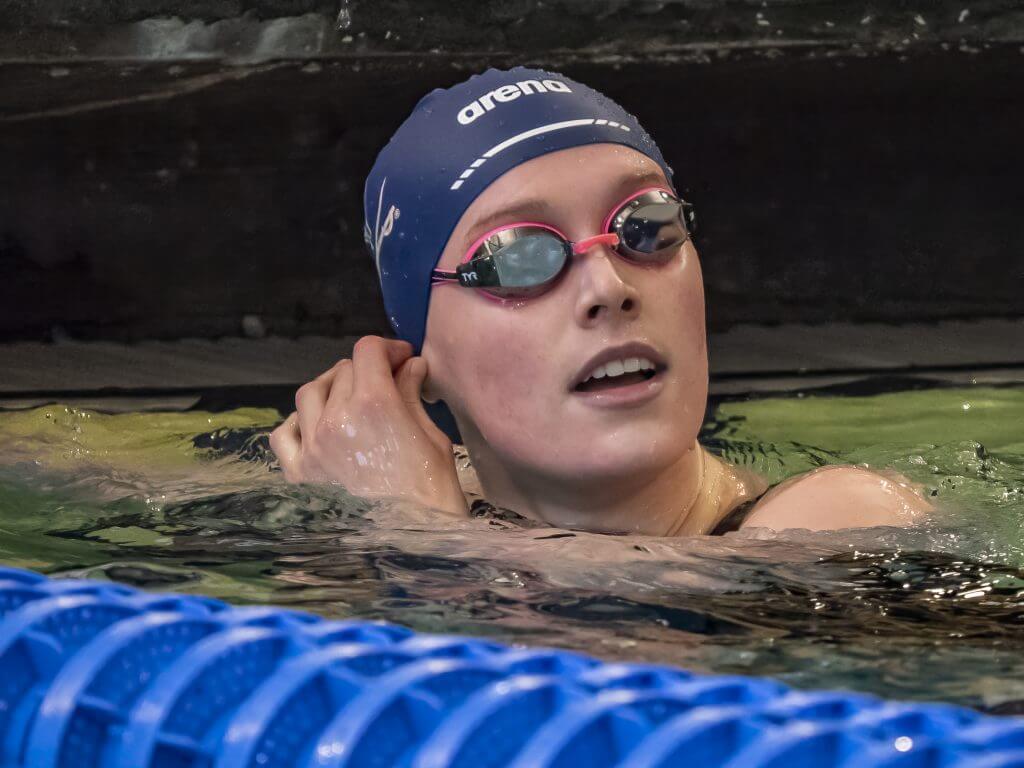















Skins Races Take Over College Swimming: Coaches, Athletes Share Their Thoughts
White water flew through the air, soaking the cheering spectators on the pool deck. The athletes’ hands crashed into the wall, praying they had done enough to produce their best race. A raucous crowd cheered, as their team’s athlete was victorious.
And then it happened four more times.
In its inaugural season, the College Swimming League has brought a newer style of competition to its biggest stage yet. The Skins races are a series of 50s of any stroke, in which eight swimmers compete, with thebottom-two finishers eliminated in each round. The athletes compete until just two swimmers remain, and the winner of the one-on-one race wins the event.
The unique format of the event is something that CSL founder Kyle Sockwell indicated was a good for the league’s overall goals.
“We’re looking to challenge every aspect of how we believe things ‘should be done’ in college swimming,” he said. “By providing a racing format that is really easy for those at home to consume, we’ve created a really electric environment, without overly catering to the diehard fan.”
While easy to comprehend for fans, the Skins approach creates a challenge for the swimmers unlike anything they typically see in dual meets. To win a Skins race, the swimmer must swim fast enough to survive the first three rounds of competition, and possess enough speed to win the final 50.
“When you hear it’s just four 50s fast, it sounds easy, like something you would do at practice,” N.C. State’s Quintin McCarty said. “But when it’s at full intensity off the block, you’re tanking your body every time.”
The demands of the format raise questions about whether it could fit in a dual meet. But its popularity, both with fans and swimmers, could make it a mainstay in the college swimming structure.
“The structure of the College Swim League allows us to serve as a testing ground, to see if this could truly work in those situations,” Sockwell said.
Preparing for Pain
McCarty wasn’t the only athlete to find the format of the Skins events incredibly challenging. Most of the athletes emphasized that the event made for a serious early-season test.
“My legs and arms were shaking, and it was hard to pull myself out of the pool,” Louisville swimmer Nikita Sheremet said. Over the course of the meet, Sheremet swam 10 50-yard freestyles – four in the Skins event, two individual 50 frees, and four on the Super Skins relay, where swimmers race a 200 relay four times, in the elimination format.
“The mindset (to compete in these events) is not for the faint of heart,” he said.
While difficult, many of the swimmers found the setup to be a direct reflection of their training. They pointed to loggin many “best average” efforts at practice, in which swimmers try to hold the fastest possible pace they can, as a way to prepare for the event.
“Threshold sets help you prepare for the top speed endurance you can hold,” said N.C. State sprinter Kaii Winkler, who won the 50 free Skins at his first CSL meet. “We have a lot of practice holding certain times.”
Virginia swimmer Claire Curzan, who won the 50 backstroke Skins at the second CSL meet, even explained that the Cavaliers held a practice earlier this year, where they tested the Skins format.
“We had done a practice run of the format, but it was short-course meters, so it was a lot harder,” she said. “I was grateful when I finished that first 50, that it didn’t feel as bad as practice.”
Given their preparation, the actual swimming wasn’t too out-of-the-ordinary for most swimmers. That didn’t mean it didn’t bring its challenges, nevertheless. For Indiana swimmer Alex Shackell, the act of producing power off the block was the hardest element of the race. Swimmers had just a minute in between efforts, before they had to go off the block again.
“I felt the lactate way more in a 200, than the four 50s, but it was stressful getting out of the pool and getting right back on the block,” she said. “I could feel my legs shaking on the block. It felt like getting into the pool was the hardest part.”
To counter the amount of lactic acid buildup that occurred during the event, the teams utilized different strategies. N.C. State had their swimmers sit and rest, with their massage therapist working on them in between efforts. Sheremet and Curzan tried to stay active behind the block, to “keep the blood flow going.” And Indiana left the choice up to each swimmer.
It seemed to most that the strategy of getting up and moving was most effective. McCarty explained he switched to walking around after his 50 free Skins, feeling the lactic acid buildup had exhausted him.
“You want to shake your legs out, and really conserve that energy,” he said.
Even with different approaches, the plan moving forward seemed unanimous. The coaches will analyze swimmers’ input from the meet, and apply it to the next.
“We’re only going to get better at this in terms of process,” N.C. State Coach Braden Holloway said.
Catering to Fans
While the event may have been painful for the swimmers involved, it certainly seemed to be a hit with those in attendance. Shackell called the energy in the arena “so much fun.” believing that the breaks in between swims made the event a crowd-pleaser.
“For a minute, before every 50, you could hear all these people screaming, I could see my teammates dancing, “ she said. “It was a different type of vibe (from a traditional dual meet).”
Sockwell emphasized the nature of the event, and its tendency to entice viewers as a key part of its inclusion in the new format. When asked, he was hesitant to say whether the same level of energy from the Skins races could be brought to other events.
“It’s hard to replicate, admittedly,” he said. “The energy just continues to build throughout each 50, and it creates so much excitement.”
For now, the focus is on using Skins events to draw crowds at CSL meets. The league reported 2,071 fans were in attendance for the meet at Stanford last weekend.
“It’s all about how we capture the ‘casual fan’ to tune in, and stay in,” Louisville Coach Arthur Albiero said. “That’s what will make the ‘machine’ that is college swimming continue to move.”
Can Skins Fit in a Traditional Dual Meet?
It was clear from the athletes’ evaluations that they enjoyed the Skins events, just like the fans. Whether they thought it was applicable to a traditional dual meet was a different story, though. From a pure structure perspective, many swimmers expressed concerns about how the event would fit in a dual meet lineup. They believed its tiring nature could have an impact on how they performed for the rest of the meet.
“If we had this in a dual meet, it would make everyone gassed,” Winkler said. “My legs felt like Jell-O afterward.”
N.C. State actually hosted a meet where Skins was an event last year. The “Raleigh Rumble” had the team competing in a mixed 200 medley relay with the format. Holloway believed that the race was even more effective in this setting, based on when it took place. The Wolfpack hosted the meet in November, as their midseason meet.
“It was a fun challenge, and why not bring something like that into the meet?” Holloway said. “It’s something that’ll help our sport grow.”
Another question would be whether the event could be swum at NCAA Championships. Shackell explained she’d be concerned to include the event in a championship format. Her fear was its interference with the traditional pre-championships taper.
“If on a pure taper, you’d probably be more tired (competing in the event), since you’re swimming less yards,” Shackell said. “I can’t tell if it’d be a good fit.”
Its popularity, and the atmosphere it brought, will make the decision surrounding the Skins races a tough one. To Sockwell, that’s the exact purpose of these College Swim League meets: a proving ground for innovation within the sport.
“The main thing about this is taking in data,” he said. “We can be the testing grounds for these concepts, without the same pressures (of a dual meet), as we look to get people into the building.”