




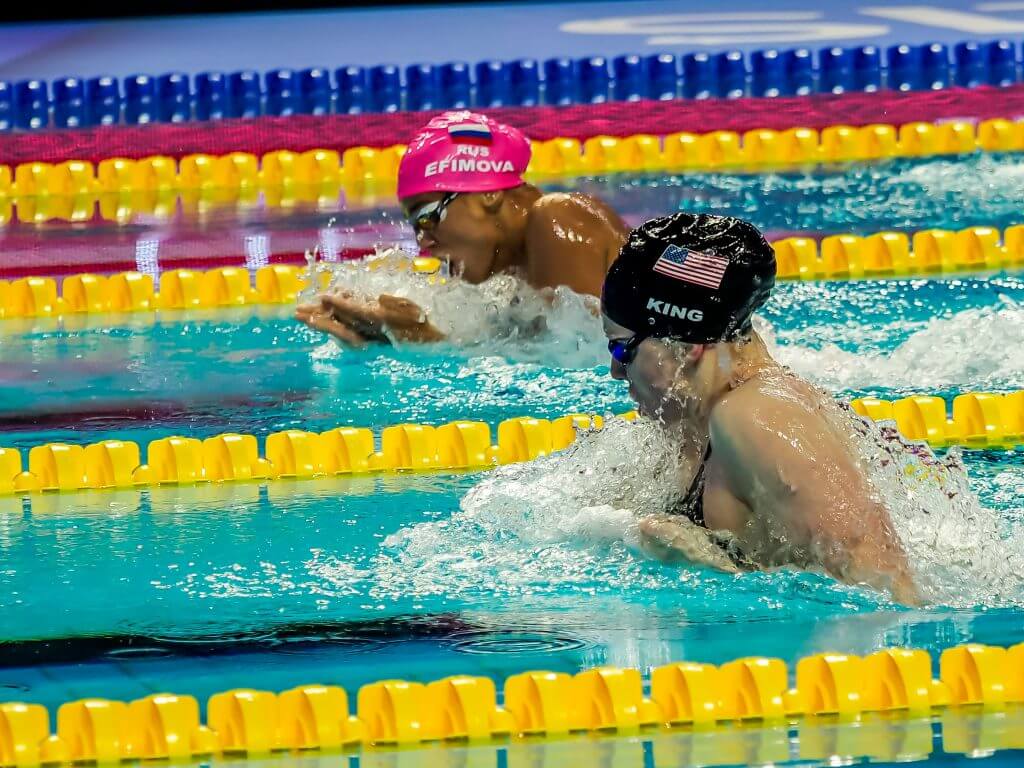

Russian Doping
In what can only be described as an attempt to use the Coronavirus as a cover for past and vast indiscretions, Russian Sports Minister Oleg Matytsin has asked that Russia’s doping ban be lifted for the 2020 Olympics Games in Tokyo, set for next summer. Matytsin suggested that lifting the ban would promote “togetherness” during a time of global crisis. Never mind the fact that clean athletes have repeatedly been victimized by Russia’s continued doping.
As a reminder of Russia’s doping past, particularly as it relates to swimming, here is a look at some archived material from the 2016 Olympic Games in Rio de Janeiro. Perhaps Matytsin would feel otherwise if his athletes were on the receiving end of doped performances that changed the landscape of the sport.
Our archives look at the rivalry between American Lilly King and Russian Yuliya Efimova in the 100-meter breaststroke, a head-to-head showdown that garnered headlines and brought the doping dilemma further into the spotlight.
From The Archive:
John Lohn on the Rio 2016 Final:
Lilly King talked the talk. She then walked the walk.
A day after speaking out against rival Yuliya Efimova and her inclusion in the Olympic Games despite a previous doping ban, the United States’ King produced the finest performance of her career, fending off the Russian down the stretch to win the 100 breaststroke in an Olympic-record time of 1:04.93. Efimova followed in 1:05.50, just ahead of the 1:05.69 by the United States’ Katie Meili.
A standout at Indiana University, King gradually moved up the American breaststroke ranks over the past few years, until she took control of the stroke at the United States Olympic Trials. She brought the confidence she gathered in Omaha to Rio de Janeiro and came away with the biggest achievement of her career.
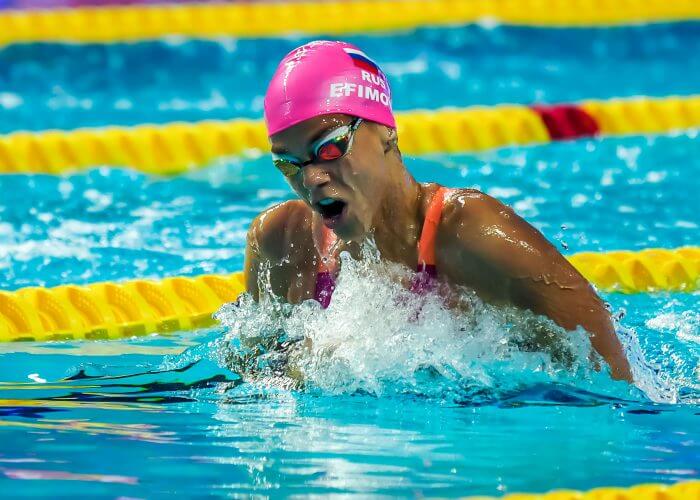
Yulia Efimova. Photo Courtesy: Peter H. Bick
King and Efimova became embroiled in controversy after the semifinals of their event as King responded to Efimova’s showing the No. 1 with a finger-waving, “no you won’t.” King explained her disdain for competitors who violate the anti-doping code and expressed her belief that Efimova should have been banned from the Games. The discussion carried over to the press conference following the final, with King reiterating her remarks and Efimova appealing for mercy. She got none.
King put together a wire-to-wire victory, charging through her first lap in 30.22, with Meili in second at 30.43, reigning champion Ruta Meilutyte of Lithuania third in 30.65 and Efimova fourth at 30.70. As the swimmers made their way down the second lap, it appeared Efimova made a move on King, only to have the American respond and not yield her advantage.
At the touch, King looked to the scoreboard and splashed the water in celebration. She specifically looked to Meili and greeted her teammate, never acknowledging Efimova. When the field was called to the blocks for introductions, the Russian was greeted by cascade of boos from the athletes’ section of the stands. Efimova smirked at the response.
“There was a lot of pressure obviously,” King said. “Even just going into your first Olympic final, any Olympic final for that matter, the pressure is going to be on, but especially standing up for what I believe is right. I felt I needed to perform tonight better than I have done in the past so that’s kind of where I was at.
“(It’s) definitely special. It’s my first Olympic (final), first gold. I am just really proud to compete for the USA and be successful for them knowing I am competing clean and doing what I know is right.”
Meilutyte, who didn’t look comfortable during the first two rounds, faded over the last 50 meters and finished seventh in 1:07.32.
Craig Lord from Rio 2016
The poison in the pool spilt over yesterday as Michael Phelps appealed for someone to save his sport and a fellow American traded verbal blows with a Russian doper she had beaten to gold.
Lilly King, a 19-year-old from Indiana who had wagged her finger at Yuliya Efimova while watching the Russian on television in the 100m breaststroke semi-finals, leant over the lane rope, slapped the water in Efimova’s lane before turning her back on her and swimming off to celebrate with a team-mate.
Efimova — the world champion who is playing one of the central villains in Rio de Janeiro after winning her appeal against a suspension for twice failing drugs tests, first for a steroid and then for meldonium in March — was booed all the way to her blocks.
The drama was only just starting. “It just proves you can compete clean and still come out on top with all the hard work you put in behind the scenes, behind the meet, at practice and weight sessions,” King said. “There is a way to become the best and do it the right way.”
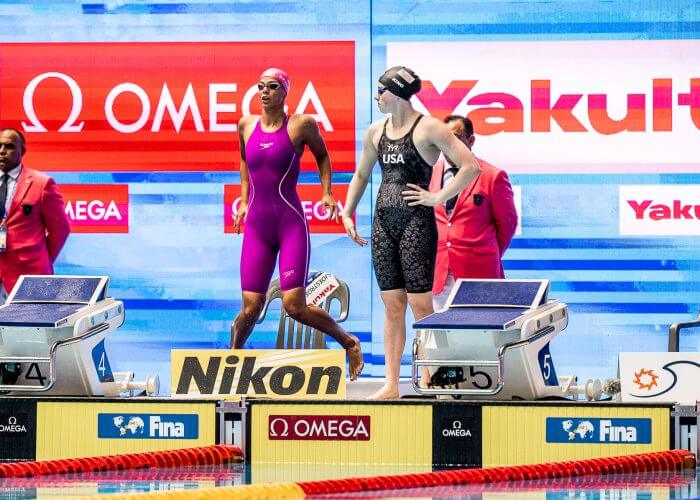
Yulia Efimova and Lilly King at the 2019 Worlds. Photo Courtesy: Becca Wyant
Efimova was served a series of sharp questions and answered in broken English through tears and a trembling voice. Hajo Seppelt, whose team at the ARD German television station broke the scandal of Russian state-sponsored doping, asked whether it was fair that she was able to compete and whistleblower Yuliya Stepanova, the middle-distance runner, was not.
She had no idea “about different athletes and their cases”, but said: “I have once made a mistake and was banned for 16 months. The second time it was not my mistake. I don’t know if I need to explain to people or not . . .”
She then addressed the American swimmers next to her, saying: “Like if WADA say tomorrow, stop [taking] yogurt, or nicotine and you stop. But this [stays in] your body [for] six months and doping control is coming after [you] two months [later] and tested you and you’re positive, is this your fault?” With a glower and a shrug she turned to King, who ignored her.
How had Efimova felt when the Americans did not congratulate her? “I can’t understand it,” she said. “It’s really painful for me that a lot of athletes don’t understand that and just read newspapers and watch the TV and accept that, but it is not true.”
While Efimova was short of supporters, the pool’s other controversial figure was not. Sun Yang, the 200m freestyle gold medallist from China, whose drugs ban was hushed up in 2014 after he tested positive for what he said was heart medication, received a hug from Cornel Marculescu, the executive director of FINA, the world governing body. Asked about the hug, Sun said: “Marculescu is a very good friend of [the] Chinese swim team and he actually watched me like a grandfather. I hope this friendship will last.”
That prompted calls for Marculescu’s resignation, led by World Swimming Coaches Association director John Leonard, who said: “A hug for a convicted doper? Really? Disgraceful. Resign! Your time is up.”
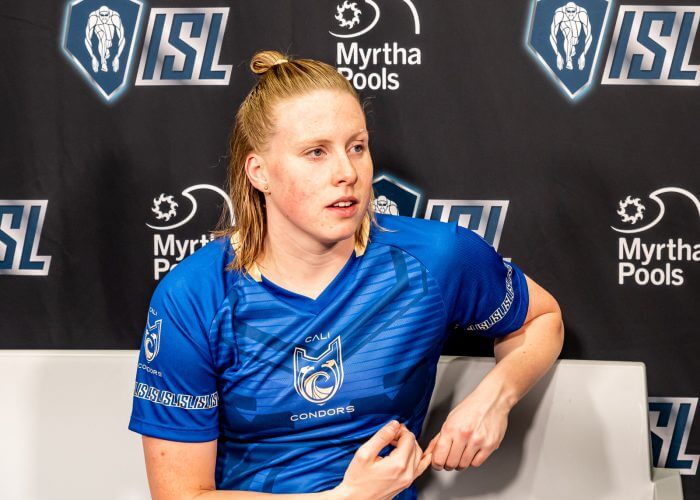
Lilly King speaking to the media at the first ISL match. Photo Courtesy: Peter H. Bick
King was not about to back down, and when questioned on whether her approach was simply anti-Russian or whether she also thought that Justin Gatlin, the American sprinter who has also failed two drugs tests should also be sent home, her response made headline news back home.
“Should people who have been caught for doping issues be on the team? No they shouldn’t,” she said. “There shouldn’t be any bouncing back and forth.”
King’s comments were mirrored by Phelps, the most decorated Olympian of all-time, who said that the sport had reached breaking point.
“You’re probably going to see a lot of people speaking up more,” he said. “I think something needs to be done. It’s sad that today in sports in general, there are people who are testing positive who are allowed back in the sport — and multiple times. It breaks my heart and I wish somebody would do something about it.”
King was challenged on whether FINA was doing enough to protect the competitors. “That’s a good question,” she said.
Efimova was asked whether the anti-doping authorities in Russia had let her down. “I’m, like [the] last four years, training in the USA,” said the Californian-based Russian. “I have been in Russia just, like, maybe one month a year. I don’t know what’s going on in Russia. Usually in the Olympic Games, all wars stopping. Now they try to find a way how they can beat Russia through the athletes — this is unfair.”
Five minutes before the medals ceremony for the 100m breaststroke the stands were full. By the time Efimova was called, the stands were empty.
“I really don’t know how I even reached the final,” she said. “It would have really been the end of a fairytale, a horrible dream, if I’d won gold. But that was all I could do right now.”
It was one of the best moments of the Rio games. Her interview that followed was just as good. #EarnIt ??????
Lilly is awesome!
What a stark contrast between the reception she got for standing up to a doper vs. Shirley Babashoff, who was vilified in the press for questioning the East German women swimmers.
I agree. What was done to Shirley after Montreal by the US press was an embarrassment. It still brings Jack Nelson to tears when he speaks of it. The press made it seem like our girls bombed and were poor sports for saying anything. Look at the time drop all of them had at the olympics. They swam great and were cheated out of their awards.
Efimova should be banned permanently.