




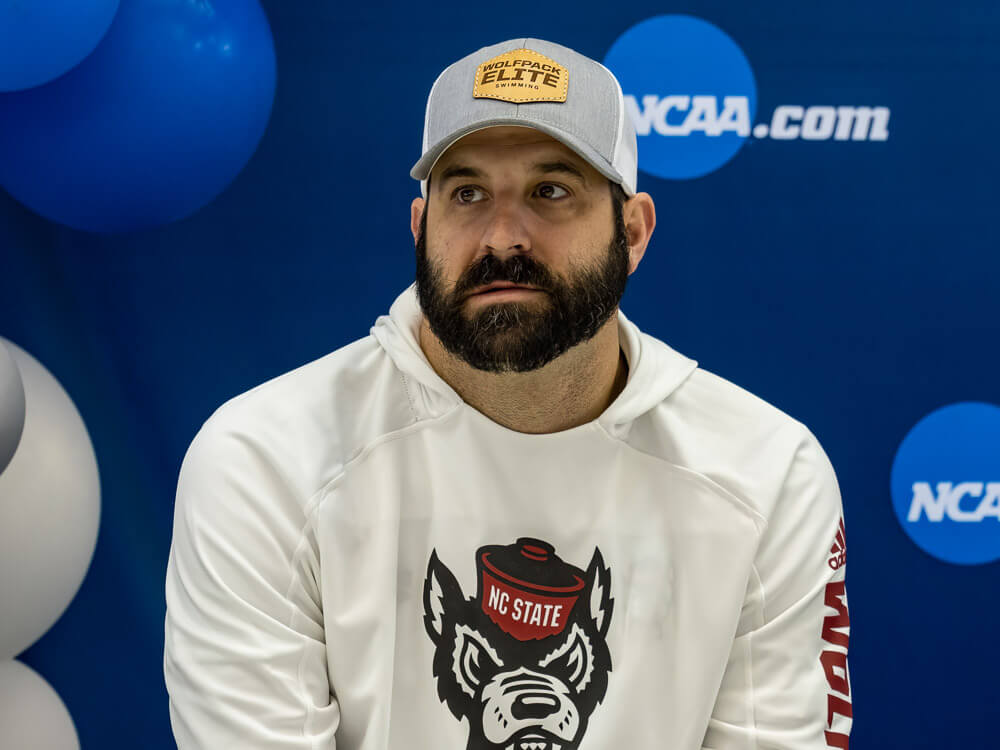















Making History: N.C. State Coach Braden Holloway Shares Thoughts on College Swimming League After Title Run
After weeks of fierce competition, the College Swimming League crowned a champion, N.C. State securing the inaugural crown by outlasting competitors Tennessee, Virginia, and Indiana. It took an impressive team-wide effort, with both men’s and women’s stars like Kaii Winkler (first in the 100 butterfly, 100 I.M., and 50 freestyle skins) and Eneli Jefimova (first in the 50 breaststroke skins, 100 breaststroke, and 200 breaststroke) contributing significantly to the victory.
The Wolfpack’s showing was one that certainly inspired confidence, as the team heads into the remainder of the season with multiple ranked wins. To head coach Braden Holloway, it was also a great way to break up a generally monotonous start to the season.
“Our swimmers really enjoyed the experience of something new,” Holloway said. “They thought it made the fall go by quicker.”
In the aftermath of the meet, Swimming World caught up with Holloway to learn more about the team’s approach to the CSL final, and what the program will look to take away from the competition for the ensuing months.
Bringing Fans to College Swimming
As expressed often by founders Robert Kent and Kyle Sockwell, a large goal of the College Swimming League was to bring “commercial viability” to its sport. Through changes to the format of a traditional dual meet, and added fanfare, the competition looked to draw in a different audience.
Holloway found some of these measures particularly effective. He pointed in particular to the meet being a combined men’s and women’s competition as a noteworthy wrinkle. Instead of competing as separate men’s and women’s teams, the two groups combined for one total team score.
“We have two very close teams, but competing together brought us even closer together,” he said. “There were a lot of situations where the men’s team was rallying and cheering during a women’s event, and vice versa, which was really cool to see.”
The combined score was part of an effort by the league to also create a more accessible format for the average swim fan. Sockwell told Swimming World in October that the league had set out to create “a format easy to consume for those at home.”
In Holloway’s eyes, this goal was accomplished. He explained that the league had created an entertaining product, through the more comprehensive format.
“I had a bunch of people in my life who flat-out don’t watch the sport very much, texting me they watched it, and my neighborhood even had a watch party for it,” Holloway said. He also explained that his family enjoyed the “walkouts,” where swimmers would coordinate dances before they got behind the block to race.
“It really seems like it made its impact on television, which was one of the main goals of putting this together,” Holloway said.
A Test of Toughness
While the College Swimming League provided a fun spectacle, it also presented itself as a serious challenge. Many swimmers, like Winkler and Jefimova, found themselves swimming as many as six times over the span of a two-hour-long meet, far more than the average dual meet.
“It was really tough for many of our swimmers, but not to the point where they wouldn’t do it again,” Holloway said. “They grew to really embrace the challenge.”
Part of that growth, the coach said, was their adaptation of their goals for the format. He explained that swimmers began to see the format as an opportunity to test their physical limits.
“It pushed (the swimmers) to a place they didn’t think they could go to, “ Holloway said.
He used Winkler as an example, explaining that the swimmer set out to test himself, and break 20 seconds four times. Winkler ended up going 20.0 on the last 50, but the coach maintained that the format helped him reach new heights.
“He went from ‘Oh god, this format is gonna be tough’ to really excited for the opportunity,” Holloway said. “It was awesome to watch.”
Room To Grow
Even with all of the benefits of the College Swimming League, Holloway admitted it wasn’t perfect. One challenge, in his eyes, was the lack of an alternative meet for some of his team’s top distance swimmers.
“We just need to do a better job throughout the fall finding something for them to attend,” Holloway said. The CSL, as it currently exists, includes just one “distance” race: the 500 freestyle. It’s been a highly debated topic, as conversations around the future of distance swimming in college swimming roll on.
Nevertheless, the coach stressed that the CSL experience had been a beneficial one, offering the team a chance to compete against college swimming’s best in a challenging new way. With plans for another “season” of the league next year, it seems the program is up for another round.
“Our team had too much fun (not to do this again),” he said. “If invited back, we’re definitely doing it.”