




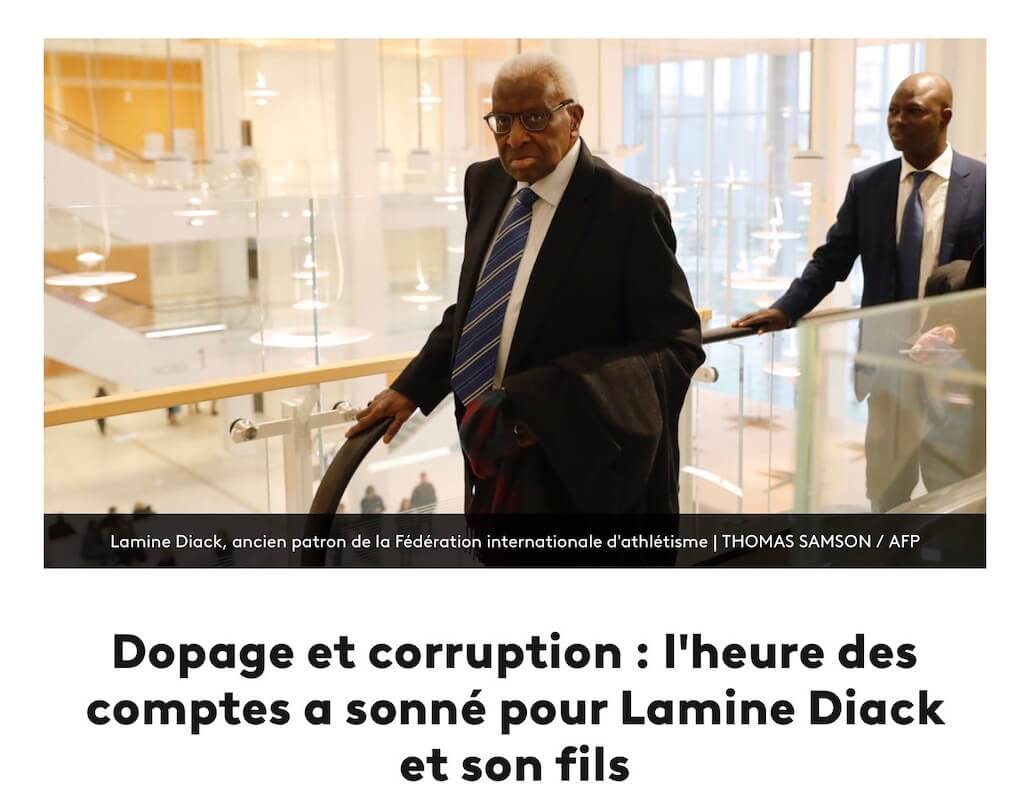

The trial in a Paris court of Lamine Diack, the former head of the IAAF, world athletics federation, on corruption charges at the centre of alleged money for doping cover-ups, went ahead as planned this morning when a plea for further delay was rejected.
Proceedings started with the rejection of a request from Diack’s son, Papa Massata Diack, to postpone the trial because two of his lawyers were unable to travel to the French capital due to travel restrictions imposed in the COVID-19 coronavirus pandemic. Papa Massata, who refuses to be extradited from Senegal, was described by lawyers as a man playing “cat and mouse” with the French court.
The Diacks, together with others, stand accused of corruption and money laundering linked to the Russian doping scandal. Six days of hearings are expected to decide one of the biggest Olympic corruption scandals in a catalogue of scandals down the years.
Lamine Diack’s former advisor Habib Cisse and Gabriel Dolle, ex-anti-doping chief at the IAAF (now World Athletics) will also appear in the Paris money for doping cover-ups trial overseen by judge Rose-Marie Hunault.
Judge Hunault and the court are due to hear evidence that Russian athletes paid millions of dollars to hide their suspected doping so they could compete at the London 2012 Olympic Games and other competitions. Lamine Diack, who turned 87 yesterday, is one of the alleged recipients of the payments. He turned up at court today wearing a face mask.
Prosecutors claim that Lamine Diack, with others and directly or indirectly, solicited Euros 3.45 million (US$3.9 million) from athletes suspected by the IAAF of doping in return for hiding positive tests for banned substances. More than 20 athletes are alleged to have been involved.
Papa Massata, shielded at home from an international arrest warrant, did not attend Monday’s hearing. As IAAF president, Diack was one of the most influential men in Olympic sports, presiding over an era when Usain Bolt became a poster boy for the popularity of the sport.
A dark cloud hung over Diack, his legacy and the creditability of the IAAF when he stepped down in 2015. He was arrested in France and investigators revealed accusations from athletes that they had been blackmailed into making payments to cover up their doping cases.
As the money for doping cover-ups trial gets underway after a postponement back in January, both Diacks deny wrongdoing.
Valentin Balakhnichev, former Russian Athletics Federation President, and Alexei Melnikov, the former head Russian athletics distance coach, are also in trial this week but will not appear: they both refused to cooperate with the French investigation.
The trial could have serious consequences for Olympic governance as politicians and advocates for an end to Olympic autonomy await the outcome.
World Athletics has an Independent Integrity Unit the days, while the IOC has urged the likes of FINA, swimming’s international federation, to follow that example. As yet, swimming bosses have yet to hand over the work of the Ethics Panel it controls under the wording of the FINA Constitution to independent processes.