




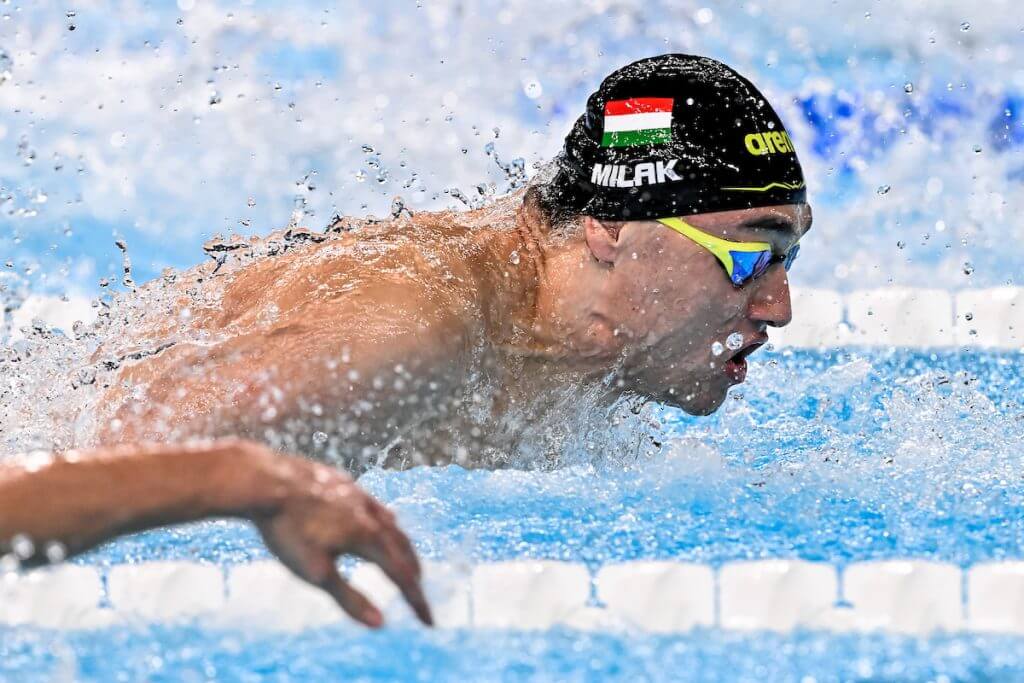















How Kristof Milak Swam 49.48 in the 100 Butterfly
If there were any doubts about Kristof Milak heading into the European Championships, those are gone. The 26-year-old from Hungary swam to a new European Record and the second fastest time in history last Thursday night in the men’s 100 butterfly. His time of 49.48 was just three hundredths off the world record, which was set by Caeleb Dressel when he defeated Milak in the Tokyo Olympic final.
Heading into this season, there was a lot of talk about Milak’s training and work ethic. The way he swam this 100 fly proves that his training has been plenty effective, bringing Milak to the verge of adding the 100 fly world record to the mark he set in the 200-meter race four years ago.
Splits
Milak took the 100 butterfly out faster than normal at Euros. He touched in a time of 23.19 at the 50-meter mark, almost half a second faster than he did in his previous best from 2021. Although his back half was slower, Milak’s front end speed is something that has shown significant development at these championships.
Going out a half-second faster at this level is something that is not usually seen. It shows a development in Milak’s abilities, one that he has not showcased much of in his career. With him taking a step back from the 200 fly, he has definitely taken more time to train his sprint speed.
Milak’s final 50 split was 26.3, about three tenths slower than his back half in Tokyo. This is where the 200 training is important. Milak is someone who has always relied on endurance. The final 50, previously his strong suit, has now taken a slight step back, yet he still had the fastest back half in the field. If Milak resumes training for the 200 fly, he could find his old back-end speed and crush the world record.
Breathing
What stands out the most in this swim, other than the time, is Milak’s breathing on the first 50. Most times in the 100 fly, swimmers will get into their breathing rhythm early on, but Milak went against this strategy. In the first 50, Milak took only two breaths. His first came at the 25-meter mark and his second came just after the 35-meter mark. After the second breath, he would not breathe again until the 65 meter mark. That means he took only three breaths in 65 meters, giving him a huge advantage on the field.
For comparison, in his best time from 2021, Milak took nine breaths on the first 50. By being able to breathe this little, Milak gains an advantage by his head and body being able to stay in the same position for over half of the race.
Once Milak came up from the 65-meter mark, he got into his rhythm of breathing every stroke for the rest of the race. This strategy is one that has never been seen before at the international level. It takes considerable hypoxic training in order to be able to achieve this approach. It is something that needs to be trained over and over again, something that shows Milak’s work ethic should not be doubted.
Stroke Count
As great as every race is, there is always something that can be critiqued. A general goal in fly is to have the stroke count 10 lower than the time. Milak’s first 50 was 23.2, yet he took 16 strokes. As seen with the breathing, Milak is sacrificing efficiency for stroke rate, especially on the first 50. In Tokyo, Milak also took 16 strokes on the first 50, yet that 50 was half a second slower. This means Milak’s efficiency is improving, but it can still get even better.
The second 50 shows much higher efficiency for Milak. His stroke count of 18 is only eight off his time of 26.3. In comparison, Milak took 17 strokes in his previous best from Tokyo in the final 50. Part of the stroke add comes from a jammed touch at the finish. Milak does a great job of holding his stroke rate, which is very high. This shows his sacrifice for rate rather than efficiency.
Returning to some training geared toward the 200-meter race could make his back half almost untouchable. If he can find the perfect balance between efficiency and stroke rate combined with an even better back half, the world record could see a huge drop, and maybe even get into the 48 range.
