


















European Championships, Day Seven Finals: Great Britain Tops Medal Table As Paris 2026 Wraps Up
- Results
- Watch the European Championships Live (And Free!)
- Day 1 prelims report
- Day 1 finals report
- Day 2 prelims report
- Day 2 finals report
- Day 3 prelims report
- Day 3 finals report
- Day 4 prelims report
- Day 4 finals report
- Day 5 prelims report
- Day 5 finals report
- Day 6 prelims report
- Day 7 prelims report
Great Britain enjoyed a final flourish as two golds ensured they finished top of the medal table following the last night of competition at the European Championships in Paris.
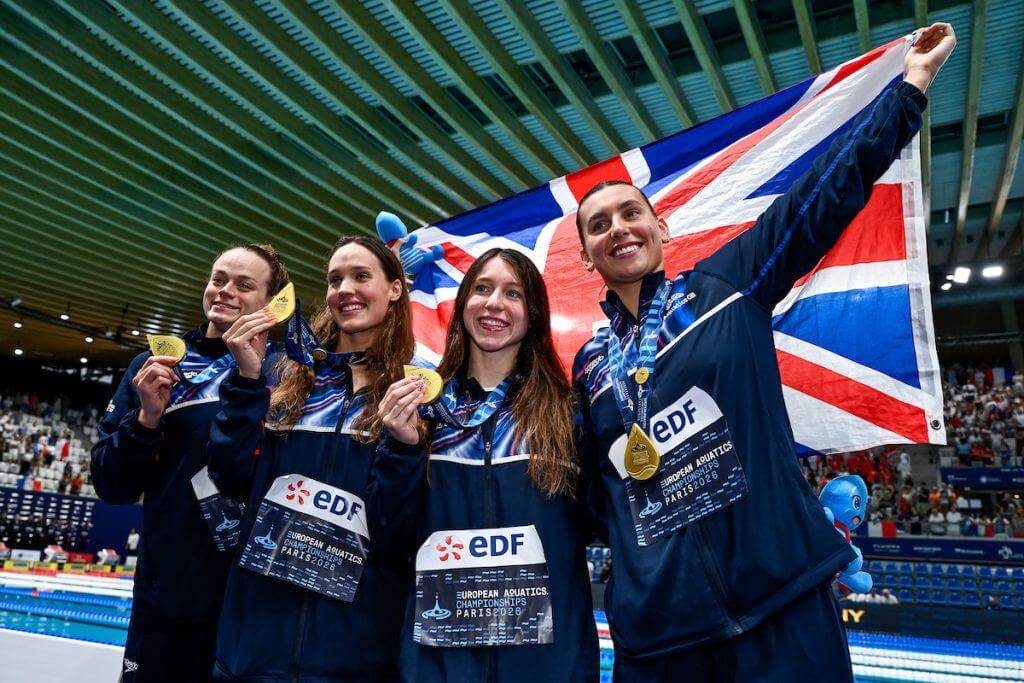
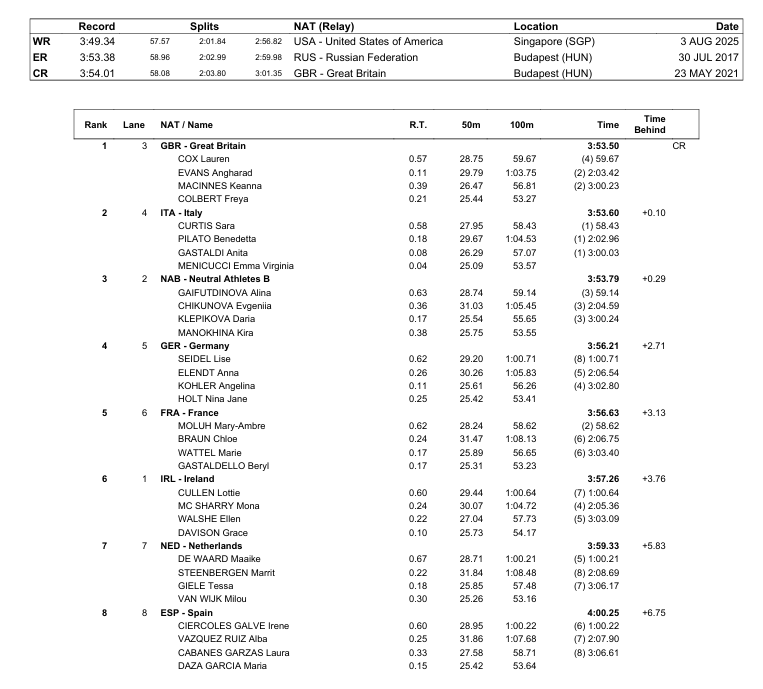
Keanna MacInnes became the first British woman to win the 200 fly title before she returned around 75 minutes later for the women’s medley relay where Freya Colbert snatched victory at the death. It also included a monster 1:03.75 breaststroke split by Angharad Evans, the fastest in history.
It meant Great Britain finished with eight golds, two silvers and four bronzes to lead the honours ahead of Italy (6, 8, 6) and the Neutral Athletes (5,5,9).
MacInnes, who trains with Evans at the University of Stirling, said: “It’s really special to be on the podium with the rest of the girls because I think the girls overall this week have shone really well in the GB team. And often it’s the boys that are carrying the girls so it’s really nice to flip that for once.”
Yuliya Efimova was the first woman to go through 1:04 for a breaststroke split when she posted 1:03.95 at Glasgow 2018. Evans was 0.20 quicker at the Olympic Aquatic Centre and said: “I’ve just made leaps this season. 1:04, I reached that for the first time this season. So now to see a 1:03.7 on the scoreboard is just so surreal. And I think we’re all feeling tired tonight, but none of us suffered fatigue. It was just nice for everyone to put in a shift and no single person won that relay, everyone put in their work. And that was, I think, a lot of people’s fastest relay split or on par with it. But no, to see a 1:03.7 is pretty surreal and it just makes me excited for next season. What’s to come long course.”
Nine titles were decided during the final session of the seven-day meet in front of a jubilant, raucous crowd at the Olympic Aquatic Centre.
Leon Marchand won the 400 free; Apostolos Christou defended his 100 back title for his sixth straight medal in the event; Nikita Sheremet sped to the 50 free gold and the NAB won the men’s medley relay.
Simona Quadarella clinched the golden treble with 400 victory and Ruta Meilutyte took the 50 breaststroke title as just 0.03 separated the first three women home.
Men’s 50 Free
A crown awaited a new dash champion with 2024 and 2022 gold medallists Kristian Gkolomeev and Ben Proud having departed for the Enhanced Games.
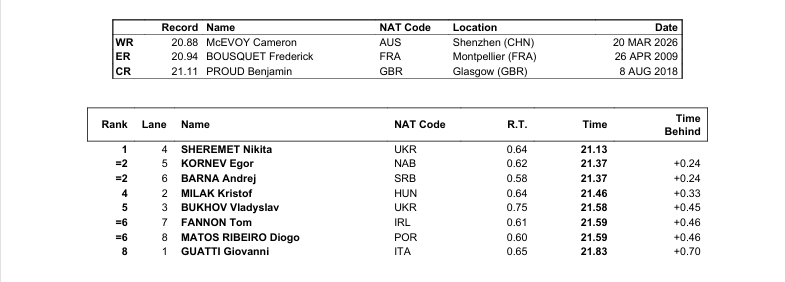
And it was Nikita Sheremet who got his hand to the wall first, the Ukrainian touching in 21.13 ahead of Neutral Athlete Egor Kornev who shared silver with Serbian Andrej Barna in 21.37.
While 19-year-old Sheremet hoisted himself on the lane ropes and slapped the water in celebration, there was no reaction from Kornev.
While not a championship record, Sheremet’s time was the fastest in a European final with Proud’s 21.11 CR done in semis at Glasgow 2018.
Women’s 50m Breaststroke
Benedetta Pilato led through prelims and semis and broke 30secs on both occasions.
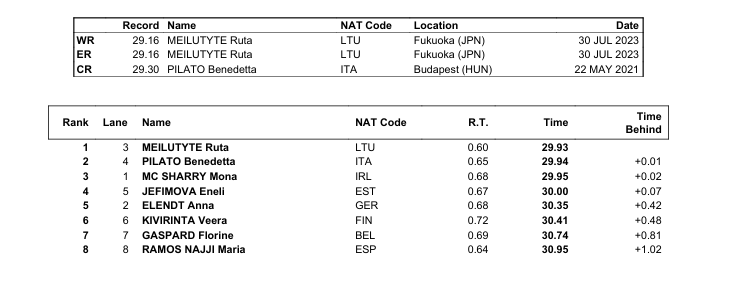
She and Ruta Meilutyte were stroke for stroke in adjacent lanes with the Lithuanian taking the title in the narrowest of margins in 29.93 to 29.94.
It was yet more heartache in the French capital for Pilato who missed out on 100m breaststroke bronze by 0.01 at the 2024 Olympics when she finished fourth behind Mona McSharry.
“It’s a persecution!” said Pilato, who’s been training with Mirko Nozzolillo in Rome since September last year. “I’m happy because swimming three times under 30 is important. It’s certainly the beginning of a journey after a year full of changes. I would have liked to win, but that’s okay and… I’m never going back to Paris.”
Mona McSharry swam an Irish record of 29.95 for bronze as the first three home were separated by just 0.02. She leaves Paris with a medal in each of the three breaststroke events, including 100 silver.
“It’s crazy,” she said. “I didn’t even realise that (it was so close), I kind of just looked for my own spot and I saw, again, the three little red dots on the block. I was like, oh, wow, I actually did it. I felt really good in that one, I think the heat and semi felt a little off the first 25m, and I was like, I just need to trust myself that I go for it, and I did. I happily got my hand on the wall first, and I think it just shows that you’re never out of the race.”
 Men’s 200IM
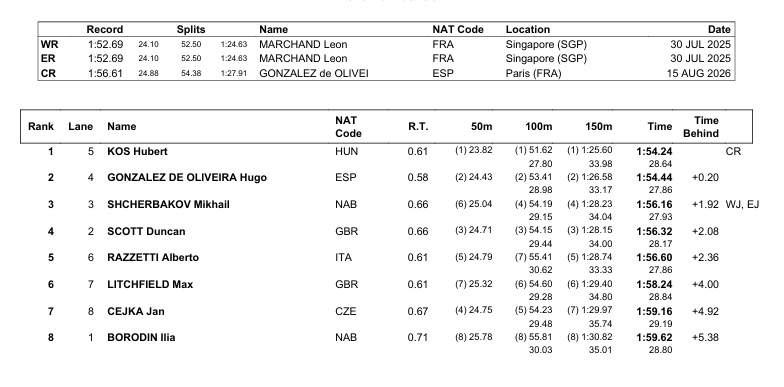
Hubert Kos won the titles in 2022 and 2024 but it was Hugo Gonzalez – the 2021 champion – who’d booked lane four with a CR in the semis.
Kos went out fast and was 0.88 inside WR pace at halfway although he’d fallen almost a second outside after the breaststroke leg.
Gonzalez had made inroads into the deficit and came at Kos down the final 50 with the Hungarian digging into every last reserve to get his hand to the wall in a CR 1:54.24 to 1:54.44. Mikhail Shcherbakov of the Neutral Athletes set a WJR/EJR of 1:56.16 for bronze.
Whereas Gonzalez set the CR in semis, Kos’ winning effort was the swiftest in a final, surpassing by 2.42secs the previous fastest of 1:56.66 by fellow Hungarian László Cseh whose record stood from Debrecen 2012. Kos also surpassed Cseh in the national record books, downing his 1:55.18 from 2009.
It was also a Spanish record for Gonzalez.
Women’s 200 Fly
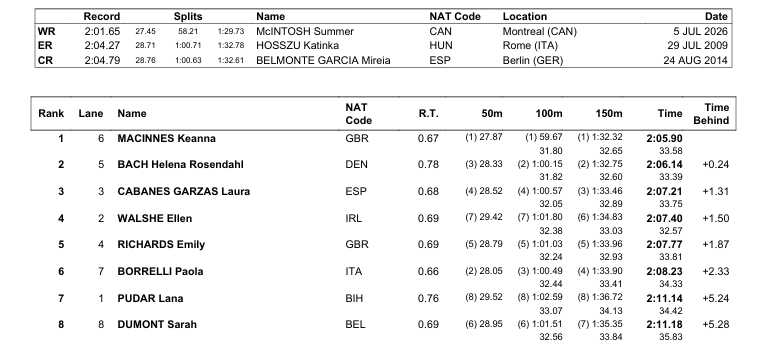
No British woman had ever won a gold or silver medallist in this event but Keanna MacInnes set about the race with clear conviction.
First at 50m and 1.04secs inside European record pace at halfway, the University of Stirling swimmer dug deep into all her reserves to take the title in 2:05.90, adding gold to her double silver at the Commonwealth Games in Glasgow.
“I was focusing on being more relaxed to 100 because at the Commonwealth Games I was fast to 100 but it wasn’t necessarily relaxed,” said MacInnes. “Whereas I was even faster there and it felt good to 100, so that’s definitely positive. And I knew I was in the lead at 150 and I honestly didn’t really see Helena Bach sneaking up on me down in that last 50, but for me it was a race to the 2:05 anyway, so that was the target I had for this season, so I just had my head down into the wall anyway.”
Reigning champion Helena Rosendahl Bach made inroads down the final 50 but she never really threatened the Briton and added silver to her Belgrade 2024 gold in 2:06.14. Laura Cabanes Garzas (2:07.41) took third while Ellen Walshe was fourth, the final turn and last 50 charge that served her so well en-route to the IM double falling shy in 2:07.40.
Men 100 Back
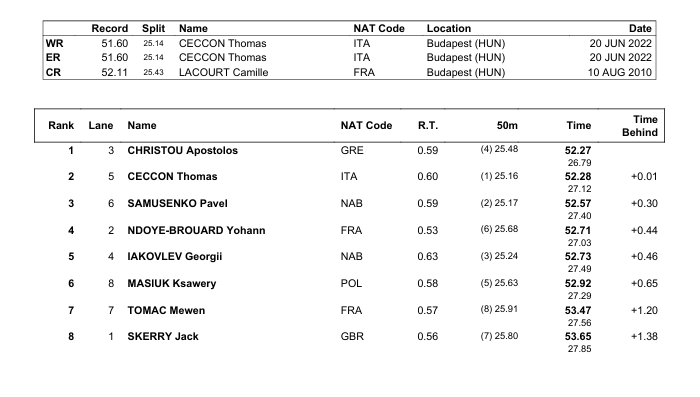
Olympic champion and world record holder Thomas Ceccon led at halfway with Pavel Samusenko in second.
But it was Apostolos Christou of Greece that got his hand to the wall by a hair’s breadth taking the title in 52.27 to Ceccon’s 52.28 with Samusenko third in 52.57. It was a second straight title for Christou and his sixth consecutive medal in the event.
Christou won 200 back silver two years ago across the city at La Defense Arena at the 2024 Olympics and has also won world bronze in the shorter race but extending his run from his maiden trip to the European podium since his first visit at London 2016 was paramount to the 29-year-old.
“The main thing I wanted I achieved, to be on the podium in a row since 2016,” he told the Hellenic Swimming Federation. “When I came here I didn’t care about the colour. But with the Olympic gold medallist next to me and doing this performance, I feel even more beautiful and proud of myself. I reached 50m in fourth, that’s how I had planned it, to have strength at the end, I changed the pace, I counterattacked and my decision was right.
“All the effort and hard work I have done is reflected. The patience I have had in recent years despite the 2024 medal, to continue to star, win medals and above all to inspire the team and show that we can achieve things, as Apostolos (Siskos) and many guys who surpassed themselves did.”
 Women’s 400 Free
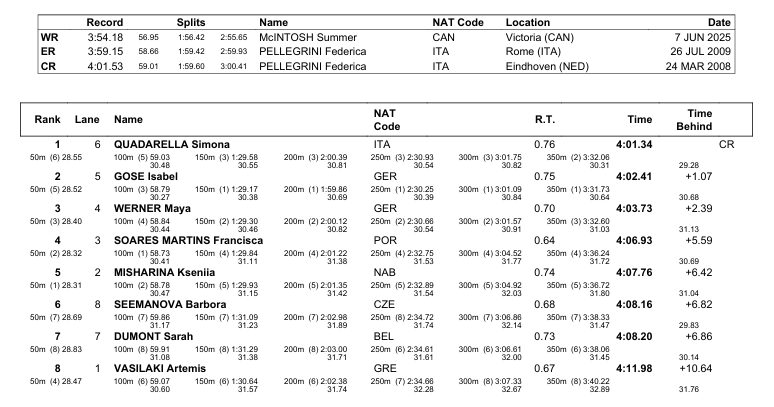
Maya Werner, Isabel Gose and Simona Quadarella pulled away at the halfway mark. Gose, the 2022 champion, went to the head of the field and led Quadarella by 0.33 at the final turn.
The Italian, however, pulled on to the German’s shoulder with the women going stroke for stroke before Quadarella moved ahead and touched in 4:01.34 to clinch a golden hat-trick, adding the 400 to her 800 and 1500 titles.
Her time was a championship record, surpassing the 4:01.53 standard held by fellow Italian and swimming legend Federica Pellegrini since Eindhoven 2008.
Gose was second in 4:02.41 with Werner third in 4:03.73.
It was an 11th individual European title for Quadarella, who moves one clear of Alex Popov who won 10 titles across the 50 and 100 freestyle. She’s very much rubbing shoulders with luminaries of the sport with only Sarah Sjöström (16), Laszlo Cseh (14) and Katinka Hosszu (13) having a larger golden collection.
“I didn’t really think I would win this race, but then in the end I thought ‘I’ll try,” said Quadarella. “I didn’t expect it either. The thing that impresses me is the consistency, being able to stay there even with some difficulties like in the 1500. In the 400 I couldn’t express myself well, now I’ve found the right key to do it. It is a special gold, one of the most special. I’m very happy with how I conducted the race. The last 50 don’t get ready: give everything you have. I was a child in 2018. Now I have a different awareness. I hoped for it, but I didn’t expect it. I don’t know if I would have sprinted in the last 50 before. I feel like thanking my family and my coach. Gianluca (Belfiore) even after the 1500 beyond the gold was aware that I could give more and he was disappointed. We talked about it in a very mature and balanced way and I was very pleased.”
Men’s 400 Free
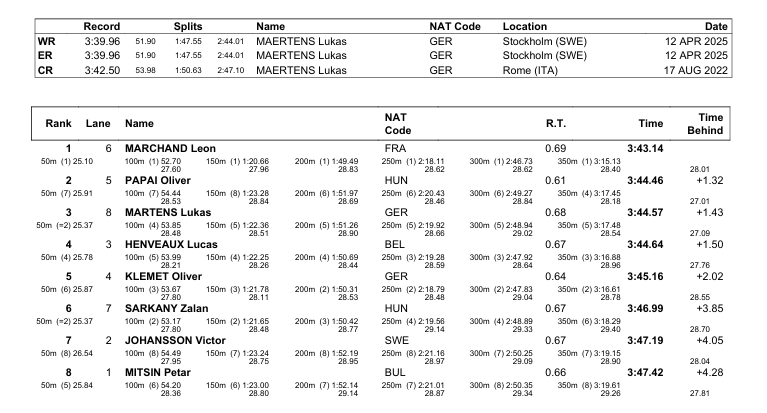
Olympic and world champion and world record-holder Lukas Märtens had only just squeaked into the final by a hair’s breadth and was down in lane eight.
Leon Marchand was in lane six and went out like a rocket, leading after 100 and at the halfway stage by when Oliver Klemet had started eating into the deficit with Zalan Sarkany keeping the Frenchman company in the adjacent lane.
Marchand kept going at the head of the field and whenever his advantage was being whittled down, he restored it with his turns and underwaters.
He came home for his second gold of the meet in 3:43.14 as an exultant crowd celebrated. Behind him Oliver Papai – the 16-year-old born in December 2009 – was charging down the final 50 and got silver in 3:44.46 with Märtens coming from fifth at the final turn to take bronze in 3:44.57.
“It was a new race for me in the 400m freestyle, I really enjoyed it,” said Marchand. “I tried to start a little fast and see what happens. I’m happy because I had some left in my legs for the last 100m. Fortunately because it was coming back. Strategically, there are a lot of things I can improve but I’m European champion in the 400m freestyle and I can’t ask for much more.”
Women’s 4×100 Medley Relay
Italy led through the backstroke, breaststroke, butterfly and until the final metres when Freya Colbert edged ahead of Emma Manicucci to clinch gold for Great Britain in a CR and national mark of 3:53.50.
Splits:
59.67: Lauren Cox
1:03.75: Angharad Evans
56.81: Keanna MacInnes
53.27: Freya Colbert
Italy were second in 3:53.60 and the NAB third in 3:53.79.
Men’s 4×100 Medley Relay
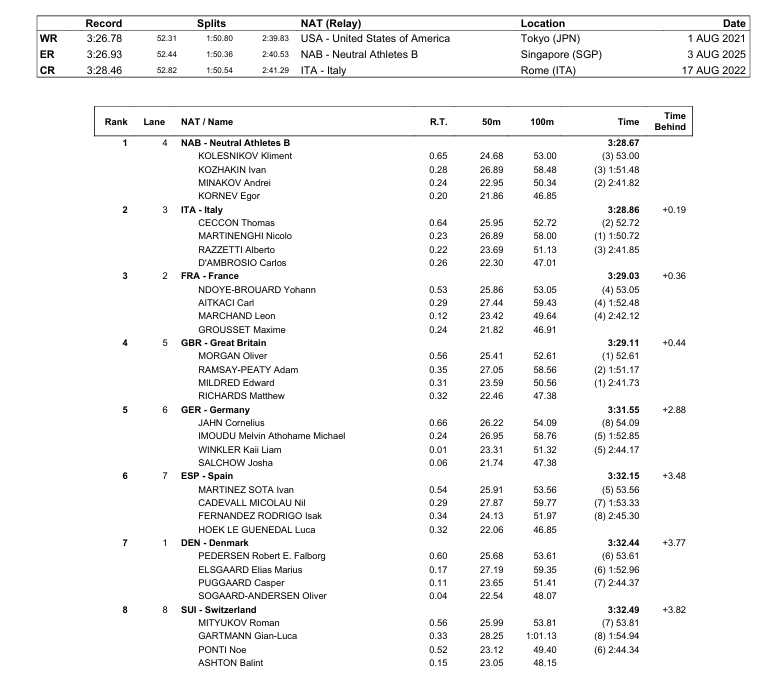
An absolute thriller of a race which embodied the ebb and flow of relays ended with the NAB clinching the final title of the seven-day meet, as Egor Kornev split 46.85 to steer them to a 3:28.67 victory.
Italy were second in 3:28.86 with France third in 3:29.03 as Marchand won his second medal of the session with a 49.64 fly leg and a 46.91 anchor by Maxime Grousset. Great Britain were fourth in 3:29.11.