



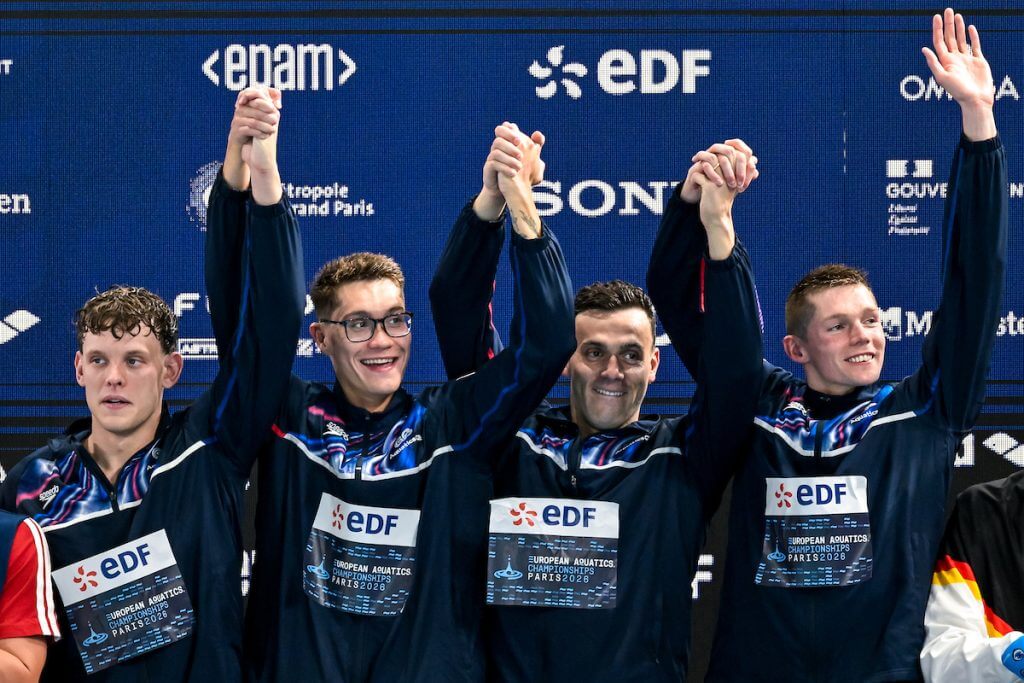















European Championships, Day One Finals: Double Gold Amid Three Medals for Great Britain, Leon Marchand Gets Maiden European Medal
Great Britain won double gold among three medals while Leon Marchand made his first trip to a European podium after scorching to a 1:43 leadoff in the men’s 4×2 relay.
The British women set the tone as they were well clear from start to finish to come home in a championship record that rattled their own European standard.
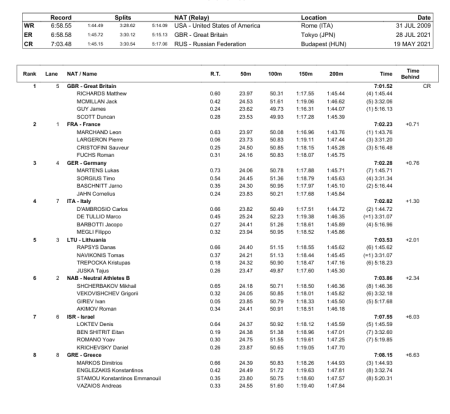
Their male counterparts followed suit although it was a completely different race with Marchand’s 1:43.76 leadoff firing France into the lead before the rest of the field caught up.
Ilia Borodin won the men’s 400IM in the only individual event of the opening night at the Olympic Aquatic Centre in Saint-Denis where the roar of a raucous crowd rose to a crescendo during the final event as France won silver in the men’s 4×2.
Men’s 400m Individual Medley
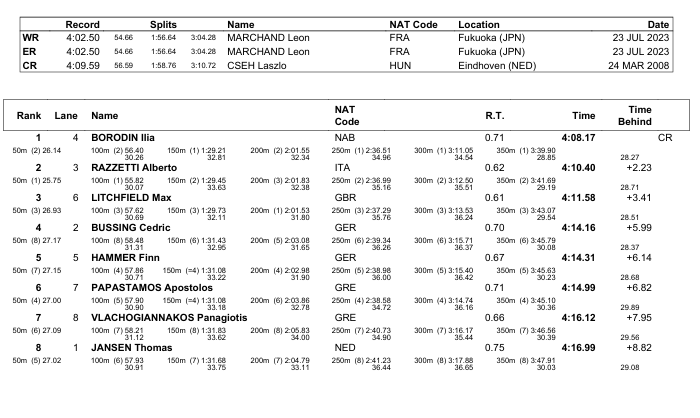
Borodin led the way in the prelims ahead of Finn Hammer of Germany with four men on 4:13.
Alberto Razzetti led through the butterfly, ahead of Borodin with Max Litchfield coming through for a narrow lead after the backstroke.
Borodin led after the breaststroke followed by Razzetti and Litchfield with the positions remaining unchanged.
Borodin came home in a championship record of 4:08.17, taking 1.42secs off the previous standard of 4:09.59 held by the great Laszlo Cseh of Hungary since Eindhoven 2008. Razzetti won silver in 4:10.40 and Litchfield bronze in 4:11.58.
Litchfield said: “This morning was faster than Glasgow, so it’s really good. Let’s say a month ago I wasn’t really sure I was even going to swim Commies or here. A few things been going wrong physically, we’ve not been able to get 100% right yet, so at Edinburgh Scottish Nationals I was like 4:23, so really struggling. So it’s great to see the work we’ve done the last four weeks and stuff to turn it around. It’s great. And some good learnings moving forward as well about how I recover and rest. So yeah, pretty happy.”
 Women’s 4x200m Freestyle Relay
Great Britain won the women’s 4×200 free relay after leading from start to finish.
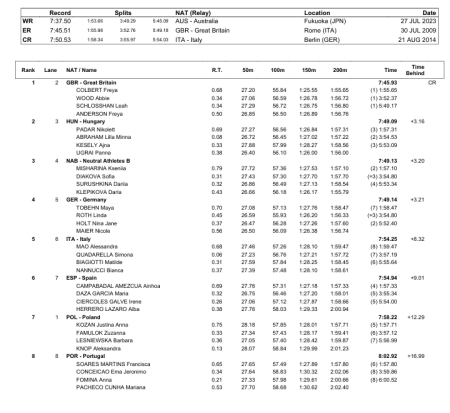
Swimming out of lane two after qualifying fifth, Freya Colbert put them clear with a 1:55.65 lead-off. Abbie Wood split 1:56.72 with Leah Schlosshan going 1:56.80 to hand over to Freya Anderson who split a 1:56.76 anchor.
They came home in 7:45.93 to lower Italy’s CR of 7:50.53 which stood since Berlin 2014. It was just 0.42 off their European record of 7:45.51 that has stood since the 2009 World Championships in Rome.
A battle royale unfolded behind them with Hungary taking silver in 7:49.09 ahead of the Neutral Athletes who took third by 0.01 in 7:49.13 ahead of Germany.
The British victory was in stark contrast to the Commonwealth Games in Glasgow where the women were shy of their usual levels of performance.
Colbert said: “I mean, for all of us, we were about five seconds quicker overall time than in Glasgow. For the past few years we’ve been saying a performance like that was coming, and we just all sort of needed to be on or near our best on the same day and in the same race. And so I think for us all to come together and really bring it today, at such an atmospheric European Championships…. Obviously two years on for the three of us when we were in Paris last time, and I think coming off some minor disappointment in Glasgow, I think we’re just all really proud of ourselves that we brought it together on the day that matters.”
Schlosshan added: “Well, our instructions before by our coaches was commit and command. So it was short and simple. And I think it’s nice to get their encouragement before we know what we could do. We felt really good going in, you know. I think we all felt pretty relaxed as well because we’ve been wanting this time for so long and we’re going to chase that medal in LA. So this is giving us, you know, that one step closer. So just to improve on that.”
Men’s 4x200m Freestyle Relay
“Leon! Leon! Leon!” rang out around the Olympic Aquatic Centre as the four-time Olympic champion got on the blocks followed by a huge roar as he dived in.
It rose to a crescendo as he put the French team into the lead out in lane one in 1:43.76 ahead of the Neutral Athletes.
However, Lithuania chased down Pierre Largeron on the second leg to go ahead at halfway. Olympic and world champions Great Britain were fifth at halfway following legs by Matt Richards and Jack McMillan but James Guy had steered them into the lead after 500m.
The three-time Olympic relay champion split 1:44.07 to hand over to Duncan Scott, who went eyeball to eyeball with Cornelius Jahn of Germany in the adjacent lane with Roman Fuchs on the anchor leg for France out in lane one.
Great Britain came home in 7:01.52 to add the European crown to their Olympic and world titles ahead of France (7:02.23) and Germany (7:02.28). It was a championship record for the British who sliced almost two seconds off the previous standard of 7:03.48 set by the Russian Federation at Budapest 2021.
Amid all the thrills and spills, 16-year-old Sauveur Cristofini split 1:45.28 on the penultimate leg for France.
It was the second time in as many competitions that Guy has split 1:44.0 following his 4×2 leg for the Team England quartet that came second at the Commonwealth Games.
The 30-year-old downplayed his contribution, saying: “Everyone is part of this team, it’s just doing your job to the best of your ability and there’s no I in team. The one thing I said before walking down is just do your part and try and get the best outcome possible. And I knew my race plan going into it, I knew that it could be quite tight after the second leg, so it’s my race plan. And yeah, the overall time was pretty good.”
The French are among several squads who are attempting to reel in the British in this particular event, something Scott is well aware of.
“It seems similar to Worlds last year, you know, that the race got really tight and quite compact,” he said. “And, you know, that’s what happened. And then you look back to Paris, we had a slight edge before I went in. And then Tokyo, just the way that the legs went, we had quite a big gap. So it really does change. But you’re looking at some of the team strategies and they’re coming after us. So I think that’s probably the biggest thing is that we look at that time and we’re a bit like, you know, we know there’s more in there, but I think the credit goes to James again. 1:44.0 back-to-back weeks is just— you know, he’s 30 years old, no slowing up, and I think he really did put in that gap that I needed for the back leg. So yeah, I think he deserves a lot of credit for that, really.”