



















Women’s 500 Freestyle Among Most Competitive Events in College Swimming
After going undefeated in her first three distance freestyle finals at the NCAA Championships, Jillian Cox qualified first for the 500 free final at the 2026 NCAA Championships. The winning streak would end there, though, as Cal freshman Claire Weinstein jumped on the pace early and never let up. Weinstein had tried the aggressive approach two days earlier in the 1650 free, but this race did not leave enough room for Cox to make a comeback.
On the last 50, Weinstein pulled away to touch in 4:30.09, almost one-and-a-half seconds ahead of Cox, with Georgia’s Kennedi Dobson and Tennessee’s Ella Jansen not far back in 4:32-territory. Weinstein said after the race, “I never wanted something so bad,” as she secured her first national title, and her winning time was the quickest recorded in the event in eight years, since Katie Ledecky concluded her two-year run at Stanford.
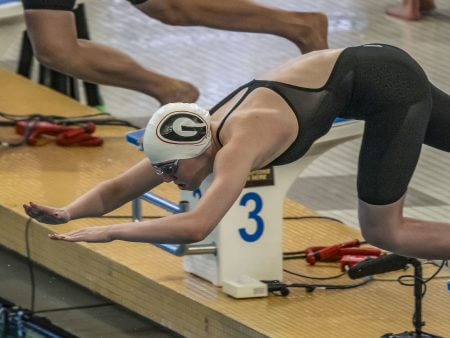
Kennedi Dobson — Photo Courtesy: Peter H. Bick
No one broke 4:30 at any collegiate competition for eight consecutive seasons, a streak that ended when Dobson blasted a time of 4:29.89 Saturday evening at the Georgia Invite. However, Dobson owns the fourth-fastest best time by an active college swimmer. Weinstein swam sub-4:30 during her high school days with Sandpipers of Nevada, as did her then-club teammates Katie Grimes and Bella Sims.
Grimes owns a best time of 4:28.27, ranking third-fastest in history, followed by Sims at 4:28.64 (fourth) and Weinstein at 4:29.38 (sixth). However, neither Grimes nor Sims have come close to their best as collegians. Sims won the NCAA title in the 500 free as a freshman, only to finish outside of scoring territory a year later. Since transferring from Florida to Michigan, she has prioritized the individual medley events over mid-distance free. Over the weekend at the Ohio State Invite, Sims passed on the 500 free to race the 200 IM instead, and her time of 1:51.69 would make her a championship contender in that event.
As for Grimes, she placed fourth nationally as a freshman but struggled at her sophomore-year NCAA Championships, ending up 11th. However, she swam well at her midseason competition, clocking 4:33.94 to win the 500 free at the Tennessee Invite while defeating University of Virginia teammate Cavan Gormsen and Jansen, both of whom swam 4:35s.
The best group of 500 freestylers, however, hails from the University of Texas. Three different Longhorns clocked 4:32s at the Texas Invite, with Cox leading the way at 4:32.00, just ahead of Lillie Nesty (4:32.12) and freshman Audrey Derivaux (4:32.21). Those three swimmers rank second through fourth in the national rankings for 2026-27, trailing only Dobson. Add in Nikolett Padar, Erin Gemmell and Kate Hurst, and this event might be the strongest for a team aiming for a seventh consecutive top-three finish at the NCAA Championships.
Weinstein, meanwhile, will be working her way back to top form after dealing with viral meningitis, leading her to withdraw from this summer’s Pan Pacific Championships and decline a spot on the Short Course Worlds team. Weinstein also sat out Cal’s midseason meet, aiming instead to be close to full strength by the spring.
Eight of the 25 fastest performers in history are active college swimmers this season. Grimes, Sims, Weinstein and Dobson lead the way, and Cox is also among the top-10 thanks to her 4:30.53 from last season’s SEC Championships. The performances from Nesty and Derivaux rank 15th and 16th, respectively, while Jansen sits at No. 21 with her 4:32.82 from the 2026 NCAA Championships.
Dobson currently sits in the driver’s seat in the event thanks to her performance in Athens, but her hold is a precarious one considering the presence of Weinstein, Cox, Jansen, Grimes and others sure to be ready to go for championship competitions this spring.