





By Michael Randazzo, Swimming World Contributor
After an eight-month layoff, the U.S. Men’s Senior National Team is back in action. Last week the Americans traveled to the Kawana Water Aquatics Centre, just outside of Brisbane, Australia, for a five-day training camp and two test matches against the Aussie Sharks—a prelude to the 2018 FINA Intercontinental Cup starting today in Auckland, New Zealand.
The Yanks—despite not having a snappy nickname—split the friendlies, winning the first match 11-7 behind Olympian Alex Bowen’s four goals; the Sharks came back for a 13-12 win behind Richie Campbell and Blake Edwards.
The U.S. women also traveled to Australia, winning both of their test matches with the Stingers—10-7 and 12-10 behind six goals by Stephania Haralabidis—but the story-line down under is not the American or Australian women, who face each other again today in Auckland. Both squads are missing many top players, including Americans Paige Hauschild, Makenzie Fischer, Maddie Musselman, Jordan Raney and Australians Bronte Halligan, Lena Mihailovic and Maddy Steere who are all are in the U.S. for NCAA varsity play. American goalie Ashleigh Johnson and attacker Maggie Steffens—arguably the best in the world at their respective positions—are in Europe playing professionally.

The timing of this competition poses particular challenges to the U.S. and Aussie men. Almost five years after high-profile coaching hirings—USA Water Polo brought in Dejan Udovicic, former Serbian head coach and Water Polo Australia hired Elvis Fatovic of Croatia—the American and Australian men appear to be fighting for scraps from the international competition table. As a new cycle of Olympic preparation begins, will this next round of FINA matches identify pathways to success for America and Australia at the 2020 Tokyo Games?
Who’s In, Who’s Out?
As might be expected from a warm-up for a summer of extensive competition, the training sessions included less experience players, including a pair of young U.S. players. Quinten Osborne who scored once, is a freshman at UCLA, and Hannes Daube who scored twice in the 13-12 U.S. loss, is slated to join USC next fall. Along with Ben Stevenson, a two-time All-American at Pacific, and Dylan Woodhead, a sophomore at Stanford, Daube and Osborne represent the depth of a U.S. youth movement necessitated by the retirement of Tony Azevedo and Merrill Moses and the uncertainty surrounding Bret Bonanni, Josh Samuels and John Mann availability for Tokyo.
Osborne and Stephenson will not continue on to Auckland, but Daube will suit up today when the U.S. faces host New Zealand and Saudi Arabia; his inclusion demonstrates that Udovicic remains open to developing young players, an important consideration given the American talent pipeline.
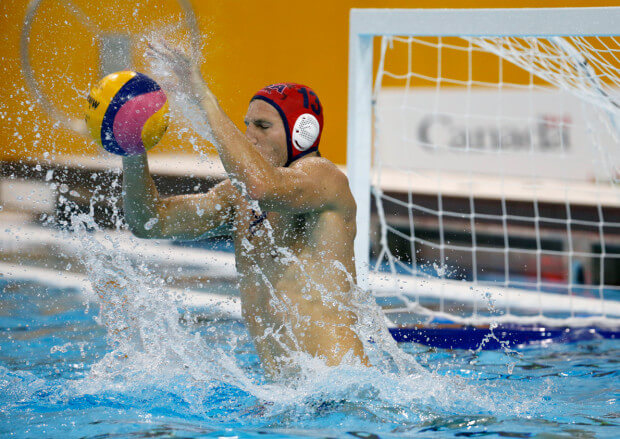
McQuin Baron. Photo Courtesy: Julio Cortez
USC freshman Marko Vavic made the trip, but Vavic’s Trojan teammates McQuin Baron and Thomas Dunstan did not, which causes problems for the Americans. Filling in for Baron—who has progressed from understudy to Moses, a three-time Olympian, to the primary U.S. netminder—are Drew Holland and Alex Wolf. Baron is crucial to the Americans’ Olympic chances; Udovicic has suggested he could become one of the world’s great goalies; but to develop the 6-8 former Trojan must seize every possible opportunity against international competition.
Dunston’s absence represents a different problem; he’s one of only two lefties currently on the U.S. Senior Men’s roster. Nolan McConnell, a 2016 Long Beach State graduate, got playing time last summer at last year’s FINA Intercontinental Tournament, but did not make the roster this year.
Besides Vavic—who has the potential to develop into a key performer for the U.S.—recent college graduates Luca Cupido of Cal and Max Irving, formerly of UCLA, offer great promise. Cupido, a finalist for the 2018 Peter J. Cutino Award, given annually to the top U.S. collegiate male and female players, is already an Olympian; unfortunately he will not be with the team due to a death in the family. His spot will be filled by one-time Cal teammate Nic Carniglia.
Irving has been a key offensive performer for two Bruin NCAA championships and his speed may prove invaluable in this tournament against counterattacks. Cal will also be represented by junior Johnny Hooper who, after a break-out 2017 season, looks to be a valuable component of the American attack.
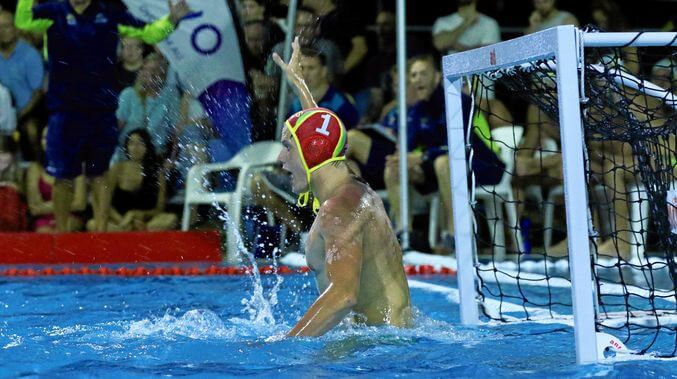
Nic Porter. Photo Courtesy: Steve Robson
Like his U.S. counterpart, Australia’s Fatovic will have a mixture of youth and experience for this week’s competition. Making his international debut for the Sharks in last week’s win over Team USA was 19 year-old goalie Nic Porter, who subsequently punched his ticket to Auckland. Aussie Olympians Campbell, George Ford, Joe Kayes, the Sharks captain, Aidan Roach and Aaron Younger will be in the water, matching American Olympians, Bowen, Ben Hallock, Alex Obert, Alex Roelse and Jesse Smith, who returned to Team USA for the first time in more than a year.
Also suiting up for today’s opening match at the Sir Owen G. Glenn National Aquatic Centre against New Zealand’s “B” squad are: Blake Edwards, Andrew Ford—George’s brother—Lachlan Hollis, Nathan Power, Tim Putt and goalies Anthony Hrysanthos and Porter.
Coaches at Crossroads?
Fatovic and Udovicic have been in their respective positions for approximately the same amount of time—five years—and their programs have remained at roughly the same levels throughout those times. At major tournaments Australia and America typically finish near each other—including a 10th place in the Rio Games for the Yanks and 9th for the Sharks—and out of the medal round. One recent exception was the Americans’ disappointing 13th place finish at the 2017 FINA World Championships; Australia claimed 7th place in Budapest.
Photo Courtesy: Fédération internationale de Natation
At the Intercontinental, which has been contested annually since 2014, the Yanks and Sharks have dominated inferior competition. In the inaugural tournament, held in Shanghai, the US took gold over Brazil by 11-7. Baron—on the cusp of joining Jovan Vavic’s program at USC—was the winning goalie while Bowen, Mann, Olbert and Samuels chipped in two goals apiece. In 2015 Udovicic’s squad had to settle for bronze after a 17-16 shootout loss to the Aussies, who captured gold in Newport Beach, CA. 2016 was an Olympic year, and this time the Yanks came out ahead of the Sharks, with Cupido nailing the game-winner with two seconds left to give his team a 10-9 finals win to take gold in Japan.
2017 reflected the on-again, off-again pattern, as Australia topped the Americans in the finals. Luke Pavillard, who has played the last two seasons at the University of the Pacific, delivered two goals for the Sharks in an 8-6 win on Australia’s Gold Coast.
Besides host New Zealand, this year’s Intercontinental includes Argentina, Canada, China, Japan, Kazakhstan and—perhaps inconceivably—Saudi Arabia. The only teams that pose a threat to either the Sharks or the Yanks are Canada and Japan; in particular, the U.S. match-up with the Japanese on April 5 may be the most compelling match of the tournament. Last year at FINA Worlds, Udovicic’s young squad was surprised by a much older Japanese team that hung an ugly 15-7 loss on the Americans. Another loss like that might erode whatever confidence USA Water Polo’s leadership has in their coach.
Conversely, Fatovic needs to demonstrate that—in a year before the matches that will qualify his squad for the Olympics—he can get strong performances out of the mix of young and experienced players that he’ll bring to Auckland—which just happens to be the Sharks biggest rival to qualify for Tokyo.
Just a simple hint. There is no magical coach that can turn US into waterpolo force.
Instead, it is the system that creates and develops talent.
Unfortunately as the US had it’s hand in old Yugoslavia’s brake up, now, instead of dealing with one team, you are dealing with three mighty waterpolo powers, Serbia, Croatia and Montenegro.
I would study the system of development of young talent in those countries and apply similar model. Until you supply the talent pipeline no amount of Udovicic work will bridge the gap.
BTW I know him from our childhood times. Yugoslavia had middle school waterpolo city leagues. We played in the same league. Do you have such a thing? I know the answer.
Dear Aleksander:
Thank you for your comments. There’s quite a bit of depth to your post, so I don’t know that I will respond to all of it. PLUS, I will confess to be influenced by the US women—coached by someone who might be considered the best in the world—losing to Australia earlier today.
Agreed, the coach is (probably) not the biggest factor for the Yanks and the Sharks BUT it was a big deal when Fatovic and Udovicic were hired. What Udovicic must now realize is that retaining his best players is mission critical (which is why I focused on McQuin Baron’s absence; I mean – what are his summer plans now that he’s done w/USC? Wouldn’t he be full-on for playing polo?).
I love it that you bring up the break-up of the old Yugoslavia (BTW, some might suggest that it was the death of Josip Broz that led to the division – though I won’t quibble that the US had a hand in things).
BUT, I would disagree that America should study what Croatia / Montenegro / Serbia are doing with young talent development (not sure that you saw that Red Star and Partizan have significant financial difficulties); in fact, last summer the U.S. Cadet team had a remarkable run of success in Serbia (http://www.usawaterpolo.org/sports/m-cadet/recaps/082017aaa.html); with 45,000 USA WP members I think it’s safe to say that the US has the deepest pipeline of young talent in the world. Perhaps you know better BUT does such a concentration of young polo players exist in all the countries of the former Yugoslavia combined? AND, you might say that the young Americans not good enough—but I suspect that Nikola Malezanov would beg to differ.
BTW, what I think is VERY encouraging is that Hannes Daube is with the team now; the US has two years to get a lot of new players ready and it will not be easy. Is Udovicic gambling on youngsters? I suppose the answer is “Yes” but it seems that he was right about a young lefty who made the Serbian national team in 2006. Plus, I’d like to believe that Marko Vavic has a great shot at playing professionally – and he’s just 19.
I’d like to think that I’ve written somewhere (!) that having Udovicic in America is a fantastic opportunity for US men’s polo b/c he has the opportunity to work with a large pool of athletes and relatively good financial backing (qualifying b/c I don’t know enough about how other countries support the sport) to produce a winner. But, he’s had five years to make some inroads. So, it’s kinda now or never – starting with the 2018 FINA Intercontinental Cup. And – no more upsets by Japan (please!).
As to your last comment about regional water polo leagues for middle school / high school, I suggest that what’s happening in California is pretty good (it works for the US women); the biggest challenge is keeping our men playing once they’re developed (that’s why I mentioned the uncertain status of Bonanni, Samuels and Mann – they are VERY strong players who would help Udovicic immeasurably).
Your correspondent
Corrections: Quinten Osborne is a freshman at UCLA. Jesse Smith is capitan.
Hi Kimberly:
Thank you for catching those mistakes. I just updated the post.
Is Smith the captain? I didn’t see that (I don’t doubt it); guess I’ll have to keep that in mind.
Your correspondent