





The latest issue of Swimming World Magazine
is now available for download in the Swimming World Vault!
Non-Subscribers Can Download This Issue Here
Takeoff To Tokyo: Olympic Rivalries of Yesteryear
By John Lohn
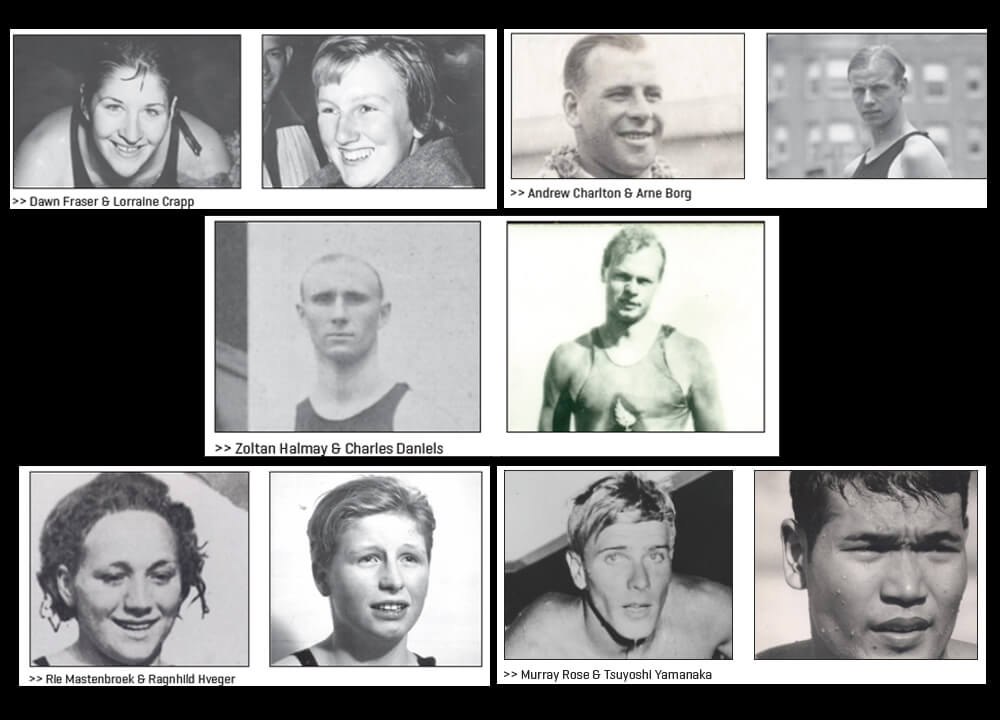
Photos by the International Swimming Hall of Fame
Sponsored By

Rivalries have always defined the sport. Michael Phelps vs. Ian Crocker. Gary Hall Jr. vs. Alexander Popov. Shirley Babashoff vs. East Germany. These are just a few rivalries that stand out and should long be remembered. But what about the rivalries from the early days of swimming? Many of these duels have been forgotten, lost over time. As our “Takeoff to Tokyo” series continues, Swimming World takes a look at some of these rivalries from yesteryear.
ZOLTAN HALMAY vs. CHARLES DANIELS
As the Modern Olympics gained traction and grew in popularity, Hungary’s Zoltan Halmay and the United States’ Charles Daniels engaged in what can be considered the first true rivalry in the sport. On four occasions between the 1904, 1906 and 1908 Olympic Games, Halmay and Daniels produced gold-silver finishes, with each man winning a pair of titles.
Halmay got the early advantage on Daniels, winning the 50 freestyle and 100 freestyle at the 1904 Olympics in St. Louis, with Daniels claiming the silver medal in each event. Daniels, however, had the stronger overall Olympiad, thanks to victories in the 220 freestyle, 440 freestyle and in the lone relay contested.
On a head-to-head basis, Daniels took control of the rivalry at the 1906 Intercalated Games in Athens and the 1908 Olympic Games in London, where he prevailed in the 100 freestyle. The 1906 title is considered unofficial, however, as those Games are not recognized by the International Olympic Committee. Halmay and Daniels each held world records during their careers in the 100 freestyle and 200 freestyle.
Halmay won nine medals during his Olympic career to the eight medals earned by Daniels, although Daniels held the edge in gold medals with five to Halmay’s two. Both men are inductees of the International Swimming Hall of Fame.
RIE MASTENBROEK vs. RAGNHILD HVEGER
Most rivalries feature multiple major faceoffs over several years, but the rivalry between the Netherlands’ Rie Mastenbroek and Denmark’s Ragnhild Hveger consisted of one race. Yet, their one duel was an epic battle in the 400 freestyle at the 1936 Olympics in Berlin.
The race was held on the last day of the Games, but by that point, Mastenbroek had enjoyed a fruitful competition. With gold medals already secured in the 100 freestyle and 400 freestyle relay plus a silver medal won in the 100 backstroke, Mastenbroek was a star and merely looking to finish the Olympiad with a flourish. Meanwhile, Hveger was hoping to play the role of spoiler. Little did she know, she’d also play the role of motivator.
Before the start of the 400 freestyle final, Hveger was given a box of chocolates, which she shared with her teammates and several competitors. Among those who did not receive a chocolate was Mastenbroek, who took the snub personally and used it as fuel for the final race of the Games. While Hveger held the lead for most of the race, Mastenbroek shifted into a higher gear down the stretch and reeled in her foe to prevail by more than a second and in Olympic-record time.
While Mastenbroek became a swim instructor the next year, thereby losing her amateur status and Olympic eligibility, Hveger figured to have future opportunities for Olympic gold. But with World War II forcing the cancellation of the 1940 and 1944 Games, Hveger didn’t get that chance at her peak. She was also banned from the 1948 Games for her ties to Nazism, and while she raced at the 1952 Olympics, she was past her prime and finished fifth in the 400 freestyle.
ANDREW CHARLTON vs. ARNE BORG
At the 1924 and 1928 Olympic Games, Johnny Weissmuller was the undisputed star, thanks to back-to-back victories in the 100 freestyle and a gold medal in the 400 freestyle. In the shadow of Weissmuller, though, Australia’s Andrew “Boy” Charlton and Sweden’s Arne Borg built a strong rivalry.
In four individual races featuring Borg and Charlton between the 1924 and 1928 Games, each man walked away with four medals, including one gold medal. There was no doubt they defined the distance-freestyle events, their Olympic excellence supported by world-record performances, although the bulk were posted by Borg.
Charlton took the upper hand in the rivalry at the 1924 Olympics in Paris when he topped the field in the 1500 freestyle, leaving Borg with the silver medal. Borg added another silver medal in the 400 freestyle, with Charlton picking up the bronze medal. But Weissmuller was too much for either opponent to handle, as he won the race by more than a second despite being better known as a sprinter.
At the 1928 Olympics in Amsterdam, Borg reversed the finish of four years earlier by capturing gold in the 1500 freestyle, with Charlton grabbing the silver medal. Charlton (silver) and Borg (bronze) again medaled in the 400 freestyle, but as was the case at the previous Olympiad, they were beaten for the gold, this time by Argentina’s Alberto Zorrilla.
DAWN FRASER vs. LORRAINE CRAPP
The passing of the torch is a common way for rivalries to develop, largely due to the incumbent not wanting to yield power to the upstart. This scenario played out between Australians in the 1950s, as Dawn Fraser—her country’s rising star—supplanted Lorraine Crapp as the big name in a country that loved the sport.
The 1956 Olympics allowed Fraser and Crapp to meet in their homeland, as Melbourne served as the host. In two individual showdowns, Fraser and Crapp produced a split, Fraser winning the first of three consecutive Olympic titles in the 100 freestyle and Crapp winning convincingly in the 400 freestyle. Together, they helped Australia to gold and a world record in the 400 freestyle relay.
While Fraser and Crapp exchanged world records in the 100 freestyle and 200 freestyle early in their rivalry, Fraser took command in that area in 1956 and never yielded either standard back to her countrywoman, although Crapp maintained her world mark in the 400 freestyle. Meanwhile, Fraser beat Crapp in the 100 freestyle at the 1958 British Empire and Commonwealth Games.
The missing element in the rivalry was a 1956 showdown in the 200 freestyle. The event would have allowed for the women to meet at a point between their strengths, Fraser moving up from the 100 freestyle and Crapp moving down from the 400 freestyle. However, the 200 freestyle did not become part of the Olympic schedule until the 1968 Games.
MURRAY ROSE vs. TSUYOSHI YAMANAKA
The best rivalries are those that go back and forth, neither competitor with an overwhelming edge. On occasion, however, rivalries exist in which one athlete is dominant. Such was the case when Michael Phelps sat atop the sport and repeatedly owned his meetings with fellow American Ryan Lochte and Hungarian Laszlo Cseh.
A half-century earlier, Australian Murray Rose and Japan’s Tsuyoshi Yamanaka had a similarly one-sided rivalry. Between the 1956 Olympics in Melbourne and the 1960 Games in Rome, Rose and Yamanaka met in four distance-freestyle finals. In three of those events, Rose and Yamanaka posted sweeps of the gold and silver medals, with Rose standing on the top of the podium each time.
At a home Olympiad in 1956, Rose set a world record to beat Yamanaka in the 400 freestyle, then held on to defeat his future University of Southern California teammate in the 1500 freestyle. Four years later, the 400 free produced an identical result, this time Rose claiming a three-second win over Yamanaka. In the 1500 freestyle, Rose was dropped to the silver medal by Aussie John Konrads, while Yamanaka finished out of the medals in fourth.
At the 1961 Amateur Athletic Union Championships, Yamanaka finally reversed his fortunes, as he beat Rose in the 200 freestyle and 400 freestyle, the shorter distance producing a world record. For Yamanaka, the effort couldn’t erase his Olympic losses to Rose, but nonetheless was satisfying, given a statement he made months earlier.
“Before I die, I want to beat Murray Rose,” Yamanaka said.
Click here to download the complete March 2021 issue, available now!
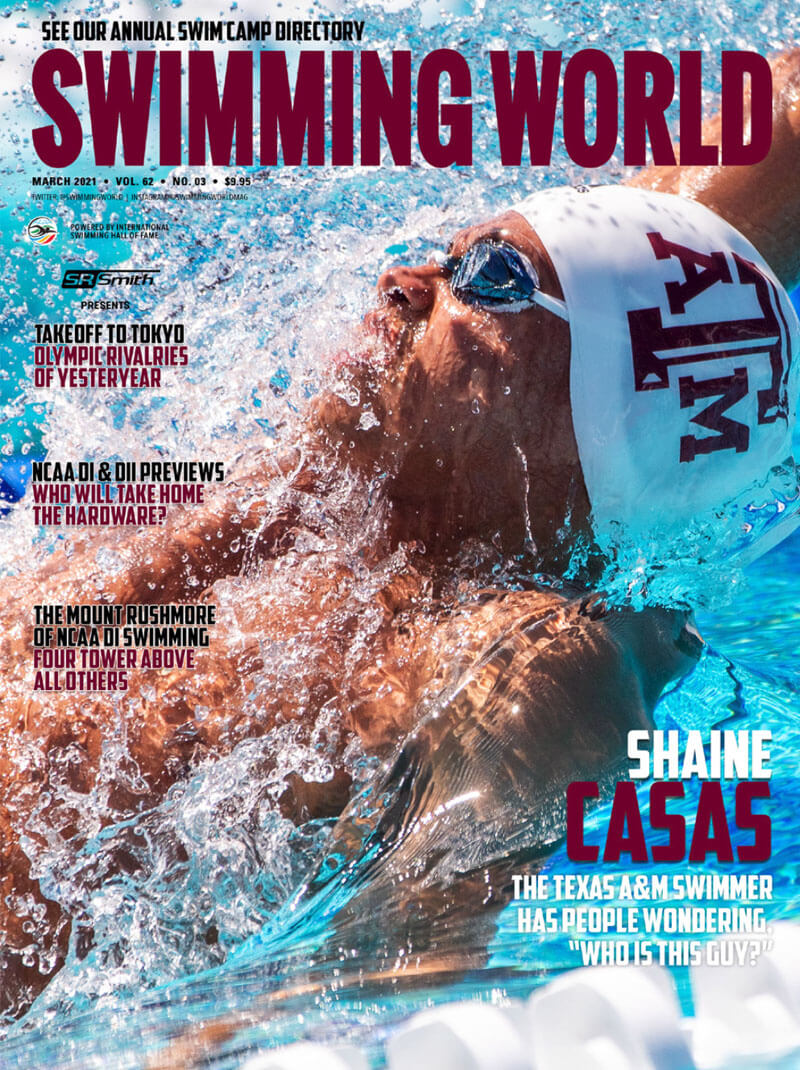 [PHOTO CREDIT: CONNOR TRIMBLE]
Get Swimming World Magazine and Swimming World Biweekly FREE When You
Become A Member of the International Swimming Hall of Fame
New! 30 Day Membership to ISHOF AND Digital Swimming World Subscription for just $10 a month!
Want more? Get a 1 Year ISHOF Family Membership With Swimming World Print AND Digital Subscription Order Now!
Non-Subscribers can click here to download this issue for only $5.94
Swimming World March 2021 Issue
FEATURES
012 THIS SHOULD BE WELL WORTH THE WAIT
by Dan D’Addona
A year ago, all eyes were on Cal and Texas in what looked to be one of the greatest men’s NCAA Championship duels ever. Sadly, the COVID-19 pandemic wiped out that showdown, but spirits are running high one year later—not only for that much anticipated Cal-Texas confrontation, but for the simple fact that college swimmers will again be able to come together and compete at a national championship.
014 YES, VIRGINIA, NOW IS THE TIME TO MAKE YOUR MOVE
by Dan D’Addona
For years, Stanford and Cal have been battling each other for national supremacy at women’s NCAAs, with the Cardinal and Golden Bears finishing 1-2 in the last three championships. Before that, Cal had put together four team titles since 2009. But in 2021, look for Virginia to make its move—not only as a new rival, but quite possibly as a new champion!
016 ALL SYSTEMS GO…FOR NOW!
by Andy Ross
Although the NCAA Division III and NAIA had canceled their championship swimming and diving meets in early February, NCAA Division II was still a “go,” thereby preserving the possibility for Queens University of Charlotte to pursue its sixth straight men’s and women’s team titles.
018 DOC’S GUYS
by John Lohn
In the late 1960s into the early 1970s, Doc Counsilman’s Indiana University swimming program was a focal point of the sport. His legendary teams were a dominant presence not just on the collegiate scene, but also on the national—and international—stage.
021 THE “MOUNT RUSHMORE” OF NCAA DIVISION I SWIMMING
by Andy Ross
If there were a sculpture made of the top American NCAA Division I swimmers similar to the one depicting four U.S. Presidents on Mount Rushmore, Tracy Caulkins, Natalie Coughlin, Pablo Morales and John Naber would be worthy honorees. No other swimmer has won more NCAA D-I individual titles than those four.
024 TAKEOFF TO TOKYO: OLYMPIC RIVALRIES OF YESTERYEAR
by John Lohn
Rivalries have always defined the sport. Michael Phelps vs. Ian Crocker. Gary Hall Jr. vs. Alexander Popov. Shirley Babashoff vs. East Germany. These are just a few rivalries that stand out and should long be remembered. But what about the rivalries from the early days of swimming? As our “Takeoff to Tokyo” series continues, Swimming World takes a look at some of these rivalries from yesteryear.
026 WHO IS THIS GUY?
by David Rieder
Before the summer of 2019, Texas A&M’s Shaine Casas had been swimming under the radar. But if his performances since then are any indication, the end results could be spectacular. His coaches see his potential as basically unlimited, and recent history makes it tough to disagree. As for Casas, he has similarly lofty expectations for himself.
029 ISHOF: THE VALUE OF SWIMMING IN WAR
by Bruce Wigo
In the early 1900s, there was scarcely an American alive who was unfamiliar with the name of Frederick Funston. He was the most decorated and celebrated hero of the Philippine-American War (1899-1902)—famous in military and swimming history for his willingness to have his men swim across rivers, under fire, when, according to press reports, “They couldn’t otherwise get at the enemy quickly enough to suit them.”
COACHING
041 SPECIAL SETS: BOWE KNOWS SWIMMING
by Michael J. Stott
Bowe Becker has trained with Sandpipers of Nevada coaches Ron Aitken and Cutter Haupt as well as Kelly Kremer at the University of Minnesota (2015-19). The eight-time NCAA All-American, Big Ten champion and conference record holder in the 50-100 free now swims with the ISL’s Cali Condors. Coach Haupt provides some sample workouts from November 2014, which were done prior to that year’s December sectionals.
043 Q&A WITH COACH MATT BARANY
by Michael J. Stott
044 HOW THEY TRAIN MAGGIE PURCELL
by Michael J. Stott
TRAINING
040 DRYSIDE TRAINING: PULLING POWER
by J.R. Rosania
JUNIOR SWIMMER
046 UP & COMERS: LIAM CUSTER
by Shoshanna Rutemiller
COLUMNS
008 A VOICE FOR THE SPORT
009 DID YOU KNOW: ABOUT PRINCE DABULAMANZI & THE BATTLE OF ISANDLWANA?
011 THE OFFICIAL WORD
032 2021 SWIM CAMP DIRECTORY
047 HASTY HIGH POINTERS
048 GUTTERTALK
049 PARTING SHOT