





The latest issue of Swimming World Magazine
is now available for download in the Swimming World Vault!
Non-Subscribers Can Download This Issue Here
Swimming Technique Concepts
Maximizing Swimming Velocity (Part 5):
Minimizing The Arm Recovery Phase
By Rod Havriluk, Ph.D.
As shown in a previous “Swimming Technique Concepts” article (SW June 2021), when swimming velocity increases, the time of all four stroke cycle phases decreases. The greatest possible time decreases for additional swimming velocity increases are in the non-propulsive phases (entry and recovery). Strategies to minimize the entry phase were covered in previous articles (SW July and August 2021). This article includes strategies to minimize the recovery phase time of all four strokes.
RECOVERY PHASE
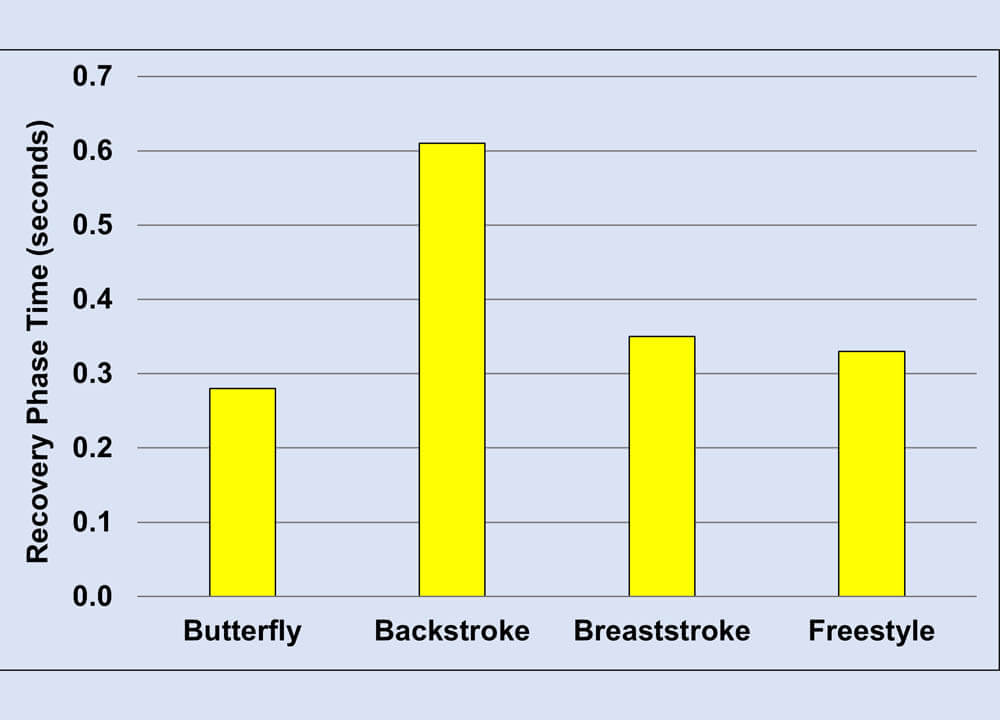
The recovery phase time at sprint speed is shown for elite male swimmers in Fig. 1 for butterfly (Seifert, Delignieres, Boulesteix & Chollet, 2007), backstroke (Chollet, Seifert & Carter, 2008), breaststroke (Leblanc, Seifert, Baudry & Chollet, 2005) and freestyle (Seifert, Chollet & Bardy, 2004). The graph shows that recovery time varied from less than 3-tenths of a second (for butterfly) to more than 6-tenths of a second (for backstroke).
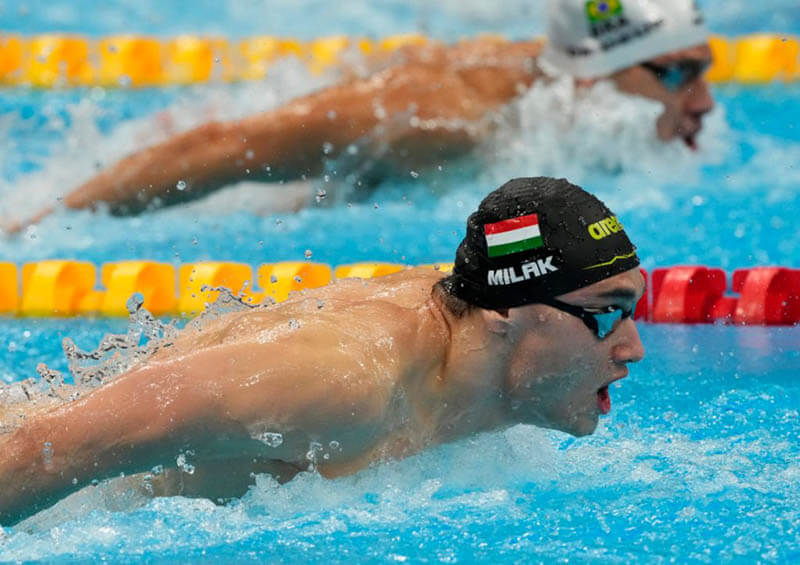
FIG. 2 > Butterflyers have an incentive to recover the arms quickly to submerge body segments and regain buoyancy.
BUTTERFLY
As shown in Fig. 1, butterflyers had the shortest recovery time. This is not surprising, when considering the incentive to recover fast due to the loss of buoyancy (see Fig. 2).
According to Archimedes’ principle, buoyant force depends on the weight of the displaced water, which, in turn, depends on the volume of the body below the surface.
When multiple body segments (i.e., head, arms and part of the torso for about one-third of the body volume) are elevated above the surface, there is a considerable loss in buoyant force.
In response, the body quickly sinks (i.e., submerges body volume) to regain buoyancy.
Consequently, a butterflyer has an incentive for a fast arm recovery to regain buoyancy and an effective body position.
Dr. Rod Havriluk is a sport scientist and consultant who specializes in swimming technique instruction and analysis. His newest ebooks in the “Approaching Perfect Swimming” series are “Optimal Stroke Technique” and “Swimming Without Pain,” and are available at swimmingtechnology.com. Contact Rod through info@swimmingtechnology.com. All scientific documentation relating to this article, including scientific principles, studies and research papers, can be provided upon demand.
 [PHOTO BY GEORGIO SCALIA / DEEPBLUEMEDIA]
Get Swimming World Magazine and Swimming World Biweekly FREE When You
Become A Member of the International Swimming Hall of Fame
New! 30 Day Membership to ISHOF AND Digital Swimming World Subscription for just $10 a month!
Want more? Get a 1 Year ISHOF Family Membership With Swimming World Print AND Digital Subscription Order Now!
Non-Subscribers can click here to download this issue for only $5.94
FEATURES
010 THE OLYMPIC “QUADRENNIUM:” A LOOK BACK AND A LOOK AHEAD
by David Rieder
Swimming World reflects on the last five years since the last Olympic Games in Rio and ponders the questions that lie ahead during the next three years leading up to Paris 2024.
014 A CANADIAN SURGE
by Matthew De George
Swimmers from Canada exceeded expectations at the Tokyo Games. And the Canadian delegation showed that the future is as bright as the present, with prolific young talents on both sides of the competition.
020 ISHOF FEATURE: AQUATOTS MURDER CASE—THE KATHY TONGAY STORY (Part 1)
by Bruce Wigo
It is doubtful that in the annals of aquatic history, there has ever been an example of abusive parents like the story of “little Kathy Tongay.”
024 EXPECT GREAT THINGS!
by John Lohn
David Popovici just turned 17 years old, but the Romanian sprint freestyler appears poised to follow a path to prominence.
031 NUTRITION: KNOW THYSELF
by Dawn Weatherwax
Knowing your body composition can help you swim fast and stay healthy.
COACHING
029 BASIC DRYLAND TRAINING
by Michael J. Stott
A concentrated, ongoing strength and conditioning regimen provides a quality supplement to in-pool training, helping swimmers become stronger and faster. Coaches Ron and Rich Blanc of Santa Margarita Catholic High School in Southern California share last season’s dryland training schedule that helped his girls’ and boys’ teams become national powers.
030 WEIGHT ROOM COMMON SENSE
by J.R. Rosania
These “Do’s and Dont’s” are courtesy of exercise scientist J.R. Rosania, whose performance enhancement firm Healthplex serves multisport athletes worldwide.
034 SWIMMING TECHNIQUE CONCEPTS: MAXIMIZING SWIMMING VELOCITY (Part 5): MINIMIZING THE ARM RECOVERY PHASE
by Rod Havriluk
The greatest possible time decreases for additional swimming velocity increases are in the non-propulsive phases (entry and recovery). This article includes strategies to minimize the recovery phase time of all four strokes.
045 Q&A WITH COACHES RON & RICH BLANC
by Michael J. Stott
046 HOW THEY TRAIN MAGGIE McGUIRE & JACK NUGENT
by Michael J. Stott
TRAINING
033 DRYSIDE TRAINING: BACK TO BASICS (Part 1)
by J.R. Rosania
JUNIOR SWIMMER
044 UP & COMERS: MARYJANE (MJ) NEILSON
by Shoshanna Rutemiller
COLUMNS & SPECIAL SECTIONS
008 A VOICE FOR THE SPORT
009 DID YOU KNOW: ABOUT FAMOUS GUYS WHO GOLF?
016 HOLIDAY GIFT GUIDE
036 PREP SCHOOL DIRECTORY`
048 GUTTERTALK
049 PARTING SHOT
Swimming World is now partnered with the International Swimming Hall of Fame. To find out more, visit us at ishof.org