




















Marrit Steenbergen, Anna Moesch Have Changed Landscape of 100 Freestyle
Until recently, there had only been two occasions ever when a woman swam the 100 freestyle under 52 seconds. Sarah Sjostrom first broke that barrier on a relay leadoff at the 2017 World Championships, touching in 51.71 to obliterate the world record. Four years later, Emma McKeon achieved the second-quickest mark ever at 51.96 as she stormed to Olympic gold in Tokyo.
Five women had lifetime bests in 52.0 range, including Siobhan Haughey, Cate Campbell, Simone Manuel, Britta Steffen and Mollie O’Callaghan. Haughey, a two-time Olympic medalist in the event, and O’Callaghan, a two-time world champion, both achieved their best times in 2023 but were unable to swim faster in the coming years. Sjostrom, despite holding the world record, had never captured a global-level gold in the event until an upset win two years ago at the Paris Olympics.
Now, McKeon is retired while Sjostrom is focusing on 50-meter races in her comeback to the sport after giving birth. That has opened the door for new swimmers to make their mark on the 100 free level, and two women did so with breakthrough performances in late May. No one had clocked 51 in almost five years before Anna Moesch and Marrit Steenbergen combined for three such swims in the span of a week.
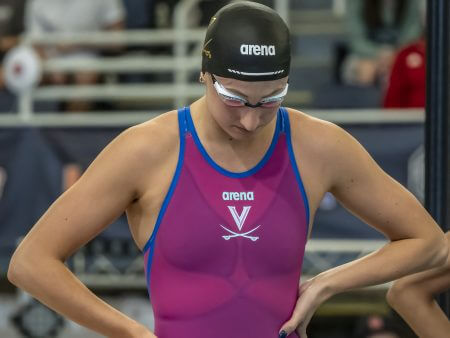
Anna Moesch — Photo Courtesy: Peter H. Bick
Moesch, a 21-year-old American who represents the University of Virginia, blasted her way to the top of the event with a remarkable performance at the AP Race London International. She dominated the event in 51.94, the second-fastest time in history behind Sjostrom’s world record. She lowered the American record Manuel had set seven years earlier on the way to a world title. Moesch crushed her best time by a whopping 1.29 seconds, having previously topped out at 53.23 in that morning’s prelims. Hoping for a swim in the 52-range, she instead skipped that entirely.
The drop was not unexpected, not after Moesch’s performances during the college season. Moesch parlayed her first World Championships appearance (she swam two prelims relays in Singapore) into a breakout sophomore season. At the NCAA Championships, she clocked the second-fastest time ever in the 200-yard freestyle, then moved up to No. 3 all-time in the 100 free while finishing second to Torri Huske. Moesch also helped UVA to wins in four relays.
In London, Moesch’s performances also included times of 24.27 in the 50 free and 1:55.81 in the 200, placing her into the international mix in those distances as well. She would swim another sizzling 100 free a month later at the Indianapolis Pro Series, going 52.11 for a U.S. Open record. But her reign as clubhouse leader in the 100 would last just two days before the Netherlands’ Marrit Steenbergen took to the pool during the Mare Nostrum tour.
Unlike Moesch, Steenbergen established herself long ago as a consistent performer on the international stage. She has captured world titles in the 100 free the last two years and reached the Olympic final in Paris. The 26-year-old won her first medal at a global meet more than a decade ago, and between long course and short course, she has captured 13 European titles. Most recently, Steenbergen won six golds at last winter’s short course meet in Lublin, setting five continental records in the process.
Steenbergen then exploded in her signature event during the three Mare Nostrum meets. The opening stop in Monaco brought a time of 52.13, which briefly lasted as the world’s top time for 2026 before Moesch went to work in London. Next, she went 51.86 at the stop in Canet, France, moving ahead of Moesch and coming within 0.15 of the world record. She backed that up with a mark of 51.97 at the Barcelona stop, making her the first woman to ever break 52 on two separate occasions.
Now, the rest of the world will try to respond to this challenge, with numerous opportunities to do so. No global-level long course meet will take place in 2026, so the best swimmers in the world will concentrate on one or more of the Commonwealth Games, European Championships, Pan Pacific Championships and Asian Games.
O’Callaghan, who won the Australian Trials in the event in 52.33, will lead the Australian contingent at the Commonwealth Games in Glasgow, Scotland, and then they will travel to Irvine, Calif., to face off against the top American threats at Pan Pacs. However, Moesch did not qualify for the Pan Pacs team, having finished 2025 as the sixth-best American in the 100 free; she will instead finish off her summer season at U.S. Nationals in late July. Still, the Americans have a loaded contingent awaiting: Huske, Manuel, Gretchen Walsh and Rylee Erisman all swam 52s last year while Kate Douglass holds the short course world record.
Expect a big performance from Steenbergen at the European Championships, where her top competition could include countrywoman Milou van Wijk, Russia’s Daria Klepikova and Sara Curtis, a rising Italian sprinter who trains alongside Moesch, Walsh and Douglass at Virginia. Haughey should race at peak form at the Asian Games.
We’ll see if Steenbergen, Moesch or anyone else can throw down additional 51-second performances. After years of stagnating times in the event, Steenbergen and Moesch have established the new standard for everyone else to chase, finally putting a real scare into one of the longest-lasting world records in the sport.