


















Could Australia Take Down Legendary World Record in Men’s 400 Freestyle Relay Before United States?
Thanks to the heroics of Kyle Chalmers, Australia captured world titles in the men’s 400 freestyle relay in 2023 and 2025, both in upset fashion. On both occasions, Australia had never led before Chalmers entered the water in third place. A 46.56 split in 2023 blasted Chalmers past Italy’s Thomas Ceccon. Same story in Singapore, with Chalmers storming ahead of Italy and the United States, only this time splitting 46.53. In between, he went 46.59 in the Olympic final to bring Australia into silver-medal position.
Now, a decade after Chalmers emerged as a teenage Olympic champion in the 100 freestyle, he could lead Australia to history in relay action. Assuming he returns to the 400 free relay squad at next year’s World Championships, he will join the most accomplished contingent of countrymen he has ever raced alongside.
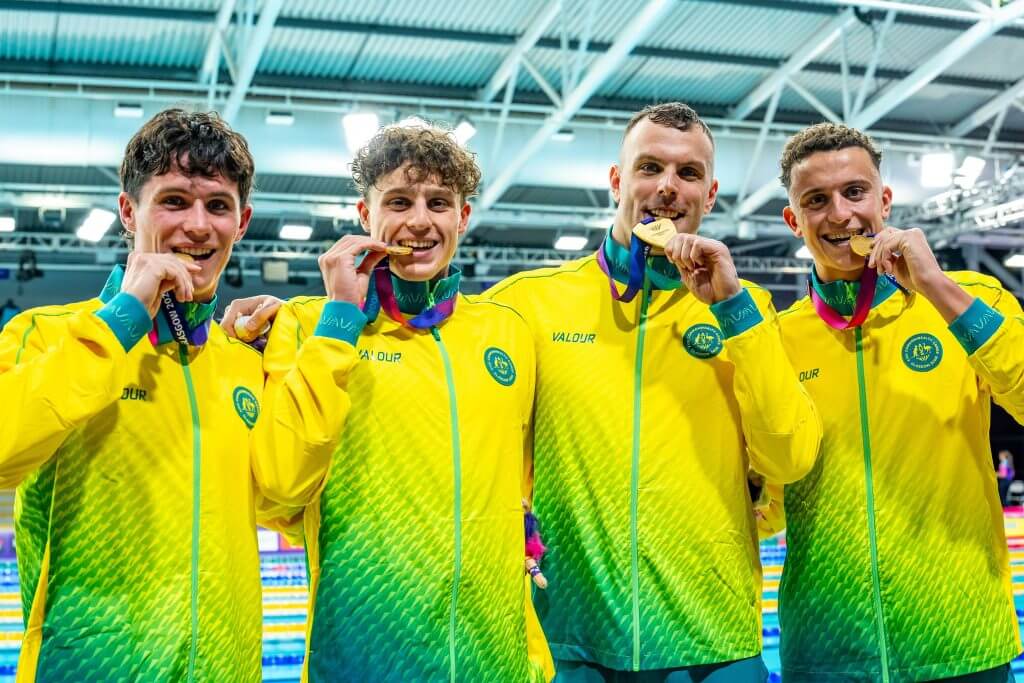
The evidence came at the two major competitions where the Dolphins competed over the past month, the Commonwealth Games and Pan Pacific Championships. Gold in Glasgow was no surprise, particularly as the British team was split into various home countries. But no one counted on a 47.09 leadoff leg from Flynn Southam, a best time by six tenths quickly placing the 21-year-old into the global elite in the event.
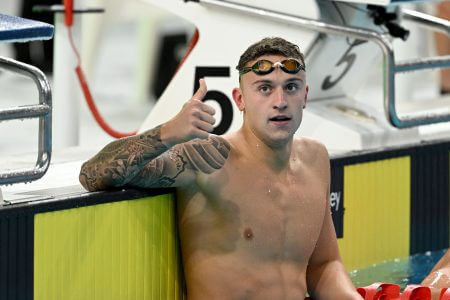
Photo Courtesy: Delly Carr (Swimming Australia)
Southam’s star turn in this relay allowed Chalmers to cruise home in 46.93 to wrap up the gold medal. In between, Kai Taylor split 47.53 while Harrison Turner, in his first appearance on this relay, went 47.94.
Two weeks later, the Australian team raced at the Pan Pacific Championships but with several of its biggest names having returned home, Chalmers and Southam among them. Without that duo, surely the Aussies would struggle against a full-strength team from the United States… except this less-heralded foursome only fell by a half-second.
The two swimmers joining this squad in Irvine, Jamie Jack and Ed Sommerville, both performed admirably, Jack splitting 47.46 and Sommerville 47.31 to close the gap heading into the anchor leg. Turner, best known for his surprise bronze medal in the 200 butterfly at last year’s World Championships, dove in 0.35 behind American Jack Alexy, twice a World Championships silver medalist in the 100 free and the Pan Pacs winner a day earlier.
No contest, right? Not exactly, not with Turner riding Alexy’s wake to a 46.99 split, almost a second ahead of what he went at the Commonwealth Games. Alexy pulled away slightly to give the American team the gold medal and top time in the world for 2026, but Australia’s valiant silver-medal effort left a sense that the U.S. team will not be favored come next year’s long course World Championships.
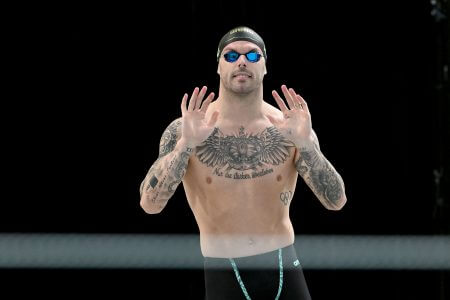
Kyle Chalmers — Photo Courtesy: Delly Carr (Swimming Australia)
Imagine an Australian team with the best versions of Chalmers and Southam alongside whoever among the next four swimmers is carrying momentum. Adding up this year’s top splits delivers a telling result. Southam’s 47.09, Sommerville’s 47.31, Turner’s 46.99 and Chalmers’ 46.93 add up to a total time of 3:08.32, only eight hundredths behind the world record established by the American team 18 years ago in the legendary Olympic matchup with France in Beijing.
Incorporate times from 2025, and the math looks even more promising. Assume that when pushed, Chalmers can replicate his 46.53 form. Taylor went 47.04 on that world-title-winning relay. Add in Southam’s leadoff and Turner’s anchor split from Pan Pacs, and suddenly Australia has a time of 3:07.65, under the world record by more than a half-second. That assumes everything goes perfectly, but it still leaves breathing room.
That said, the Americans will not roll over easily. Just from the past few weeks, the Americans have flat-start times of 47.14 from Alexy, 47.16 from Chris Guiliano, 47.49 from Patrick Sammon, 47.53 Brooks Curry and 47.66 from Destin Lasco, and that’s before reaching the 47.70 Caeleb Dressel produced in his victorious effort at U.S. Nationals. The Americans’ best flat-start times combine for a composite time of 3:09.32, well within the range of the record once relay starts are considered, and Alexy holds the American record in the event at 46.81.
But Australia’s not-so-secret weapon will be looming when the two teams square off next year on the opening day of the global meet in Budapest. Given his history, Chalmers anchoring should scare any competitor, and his country’s much-improved depth should ensure that he enters the pool within range of gold — and perhaps that elusive record.