




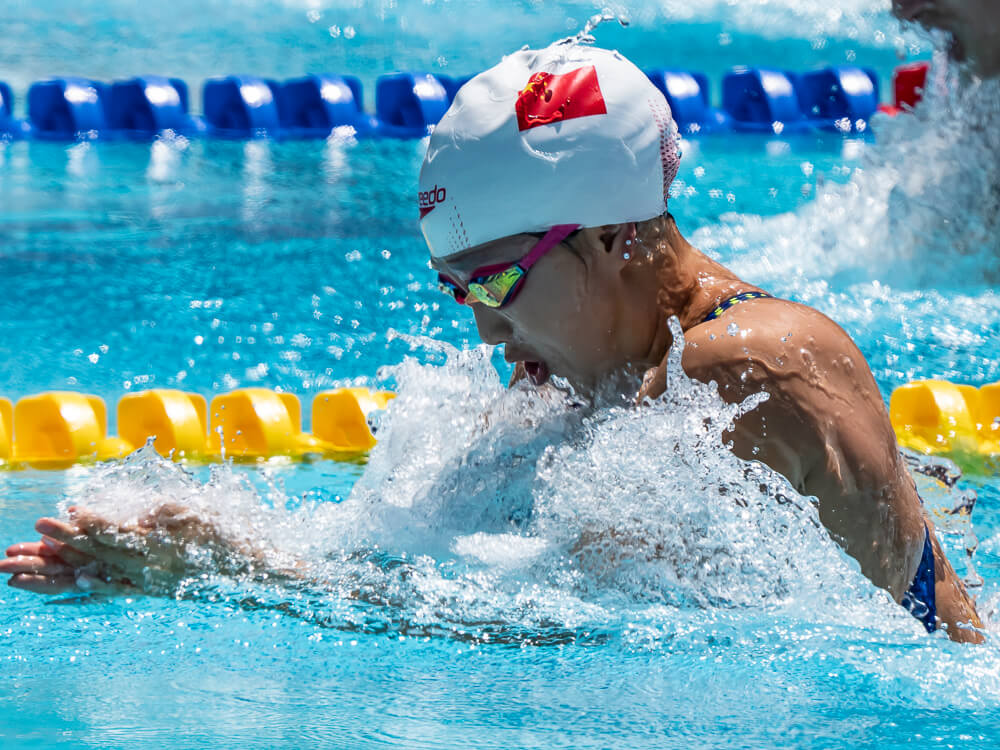















Asian Games Preview: Tang Qianting Targeting Longstanding World Record in 100 Breaststroke
The world record in the women’s 100-meter breaststroke is nearly a decade old, held by Lilly King since the 2017 World Championships. In Budapest, King ripped a performance of 1:04.13, and no one has come within a quarter-second of the standard in the ensuing nine-plus years. The closest pursuer? China’s Tang Qianting, who set an Asian record of 1:04.39 in 2024.
If someone is going to challenge King’s record in the near future, Tang is the logical choice. An argument can be made that Tang has been the sport’s most-consistent 100 breaststroker over the past few years. In 2024, the Chinese standout was the long-course and short-course world champion in the 100 breaststroke, and captured a silver medal in the event at the Olympic Games in Paris. A year later, she was the runnerup in the 100 breaststroke at the World Championships in Singapore.
Most recently, Tang earned a silver medal in the 100 breaststroke at last month’s Pan Pacific Championships. The 22-year-old was part of a small Chinese contingent to race in Southern California, and Tang went 1:05.46 to finish behind American McKenzie Siroky (1:05.32). Now, Tang is gearing up for this month’s Asian Games in Tokyo, her focus competition of the year. With Pan Pacs serving as a tuneup, a return to 1:04 territory is likely.
Also a multi-time medalist at the World Championships in the 50 breaststroke, Tang is known for her pure speed and early aggression in the 100 distance. Additional rest at the Asian Games, compared to her condition at Pan Pacs, should provide her with stronger closing ability. If she is in peak form, threatening King’s world record is possible. When King set her mark, she delivered splits of 29.80 and 34.33. En route to the Asian record, Tang was out in a ridiculous 29.64 and came home in 34.75.
Tang’s Asian record makes her the No. 4 performer of all-time, trailing only King, Lithuania’s Ruta Meilutyte (1:04.35) and Russsia’s Yuliya Efimova (1:04.36).
Obviously, Tang possesses the front-end speed necessary to attack King’s world record. The question is whether she can find the endurance to cap the race and notch a world record. Tang has been a consistent presence, as she holds nine of the 10-fastest times in Chinese history. Can she complement that steadiness with an event-altering effort? The opportunity is just around the corner.