



















Why NCAA Swimming Championships Switching to Yet Another Event Order in 2027
Another new event order will await swimmers at next season’s NCAA Championships, albeit a lineup bearing more resemblance to the traditional one from 2025 and before.
For the 2026 season, nine of 13 events ended up on different days of the meet than before; now, the individual race combinations are almost entirely back to the original setup but with the days switched around. The only exception is the 1650 freestyle, which will remain in its new Wednesday slot as the opener of the entire competition. The full lineup includes:
- Day 1: 1650 Freestyle, 200 Medley Relay and 800 Freestyle Relay
- Day 2: 200 Backstroke, 100 Freestyle, 200 Breaststroke, 200 Butterfly, 1-Meter Diving and 400 Freestyle Relay
- Day 3: 500 Freestyle, 200 Individual Medley, 50 Freestyle, 3-Meter Diving and 400 Medley Relay
- Day 4: 100 Butterfly, 400 Individual Medley, 200 Freestyle, 100 Breaststroke, 100 Backstroke, Platform Diving and 200 Freestyle Relay
The 1650 is in fact the lynchpin of the entire puzzle. The whole point of these massive changes to the NCAA Championships has been to secure live linear television coverage and thereby secure the sport’s place in the ever-changing reality of college athletics. And among the main stipulations from broadcast representatives is to avoid having the 66-lap race on the final day, when the broadcast would surely take place.
Samantha Barany, the executive director of the College Swimming Coaches Association, explained the discussions within the working group tasked with making recommendations for the NCAA. “The mile can’t be on the last day,” she said. “Where does the mile go? It then becomes a puzzle. The 500 free and 50 free have to be coupled together. The 500 free and the mile cannot be back-to-back days. So you put the mile on the first day, you put the 50 free and the 500 on the third day and then you insert other events accordingly.”
That’s how the event order for this past season came together, only for big-name swimmers to be forced into difficult event decisions. Torri Huske had to choose between the 200 IM, in which she was the defending national champion, and the 100 free, the meters version of which she won Olympic silver in 2024. Hubert Kos had dominated the backstroke events and the 200 IM in 2025, but in his senior season, he decided against a grueling 200 IM-200 back double.
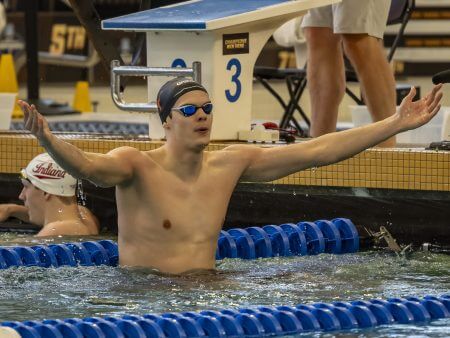
Hubert Kos — Photo Courtesy: Peter H. Bick
That’s what led to Kos picking the 100 butterfly rather than the medley. Fans in Atlanta received an unexpected thrill as Kos pushed Josh Liendo to the limit and swam under the existing NCAA record, but scheduling that double eliminated some of the high-performance potential expected of a championship meet. That’s why the working group opted for a return to the same race groupings.
“Keeping the same events on the same days, just reordering the days so we’re achieving what TV wants, that makes sure that we’re taking care of high performance,” Barany said. “When the working group got together, everything they considered was, ‘How do we create an experience that’s going to allow for high performance and achieve the commercial realities that are before us?’ If we can do those things, allow our athletes to compete at the highest performance level possible and give TV the things they need to make us commercially viable, everything after that became a want and not a need.”
The relays had remained in their usual slots in 2026, but the 2027 minute will see a major change as the 400 free relay moves to the second day, leaving the 200 free relay to end the competition. The 400 free relay has been the traditional conclusion to the NCAA meet as well as all conference meets and even most dual meets, but the committee determined that such a move would mesh best with the goals of a potential TV broadcast. A Saturday finals session concluding with the 200 free relay could fit into an optimal 90-minute window.
“You can save serious time if you move from a 400 free relay to a 200 free relay,” Barany said. “Everything is coming down to 15 and 30-second intervals, and now you’re talking about walkouts and races and getting people out of the water and doing it again. There was some serious time savings there, and the 400 free relay has always been coupled with that other day. The coaches were like, ‘We know how to manage this from high performance, and we get some minutes back on the clock for TV.’”
Returning from the 2026 meet will be the conference champion qualifier pathway, where swimmers who win their conference while surpassing the NCAA qualifying mark will receive automatic berths at the meet. This year’s time standards, however, will be based exclusively on time’s from last season than a rolling three-year average, a change made to ensure that a maximum of 10% of participants qualify that way. The women’s time standards are based on last year’s 88th-best time, and the men’s are the 64th-best.
But how long this format lasts remains to be seen, particularly with the NCAA having approved a long-term strategic working group to analyze the potential of a combined championship. Barany floated the idea of creating a single six-day meet, with events more spread out but still plenty of swimming to show off each day with women and men in action. She hopes to learn if such a meet is feasible and how it would directly benefit or detract from the sport.
“There’s a lot of opinions on it, but I think there hasn’t really been a study on it,” Barany said. “In a moment of time when change is inevitable, this is not a conversation we should just be throwing around anymore. It’s actually a conversation that we should take seriously and put some muscle behind.”