




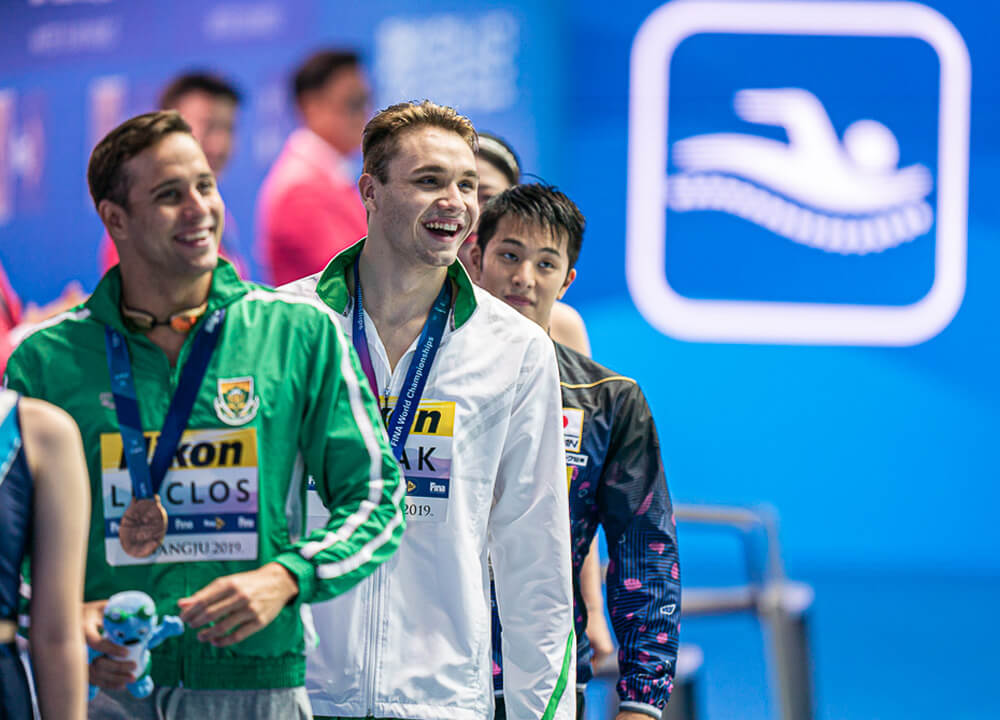

The latest issue of Swimming World Magazine
is now available for download in the Swimming World Vault!
Non-Subscribers Can Download This Issue Here
The Tokyo Olympic Games International Swimmer Preview
By Dan D’Addona, Matthew De George, John Lohn, David Rieder and Andy Ross
As the United States was still selecting its Olympic swimming team in mid-June, most countries had already decided who would be competing at the COVID-19 pandemic-delayed Olympic Games this summer. Here are profiles of 10 swimmers from around the world (listed alphabetically) who have been preparing to make an impact in Tokyo.
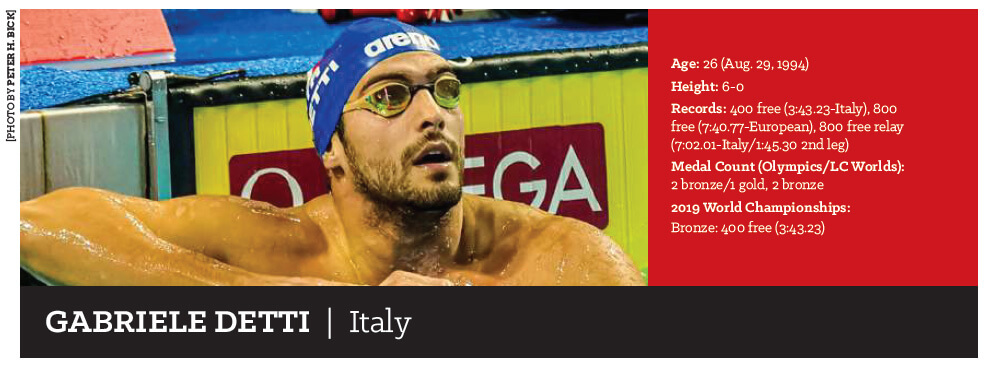
Gabriele Detti has proved to be one of the top distance swimmers in the world. With the 800 meter free added to the Olympic program, the Italian has one more event to showcase his talent.
Detti won the 800 at the 2017 World Championships, and has been a mainstay on podiums across big meets for years. It started in 2012 when he qualified for the London Olympics in the 1500 free, where he finished 13th. It was just the beginning.
In 2014, he broke the European record in the 800 at the Italian Championships. He then earned the bronze in the 800 and 1500 free at the 2014 European Championships in Berlin, his first international medals.
Just as his career was starting to take off, Detti had to spend most of the following year out of the water while he battled an extremely painful urinary tract infection, missing the World Championships in Kazan, Russia. That made the next year all the sweeter. Detti qualified for the 2016 Rio Olympics in the 400 and 1500 free, winning gold in the 400 free at the European Championships.
He won bronze medals in both the 400 free (3:44.01) and 1500 free (14:40.86) in Rio.
It wasn’t long before Detti was again at the top of the podium, winning the 800 free at the 2017 World Championships with a 7:40.77 and breaking the Italian and European records. He claimed the bronze medal in the 400 free at the 2018 Short Course World Championships and again at the 2019 Long Course Worlds before the pandemic hit.
But with all of his success, the 800 free is still a bit of a mystery. This year’s Games in Tokyo will be the first time the men will have the 800 on the Olympic program, giving Detti a chance to be a pioneer in the event.
He has proved to be in good form in the event recently, taking third in the 800 at the 2021 European Championships (7:46.10), behind Ukraine’s Mykhaylo Romanchuk (7:42.61) and Italian compatriot Gregorio Paltrinieri (7:43.62). That trio will be in the mix for medals in Tokyo. Detti also took fourth in the 400 (3:46.07), but did not swim the 1500 free.
With Detti’s focus on the 800, the world champion could make history in the very first Olympic race of the event with the entire world watching. — Dan D’Addona
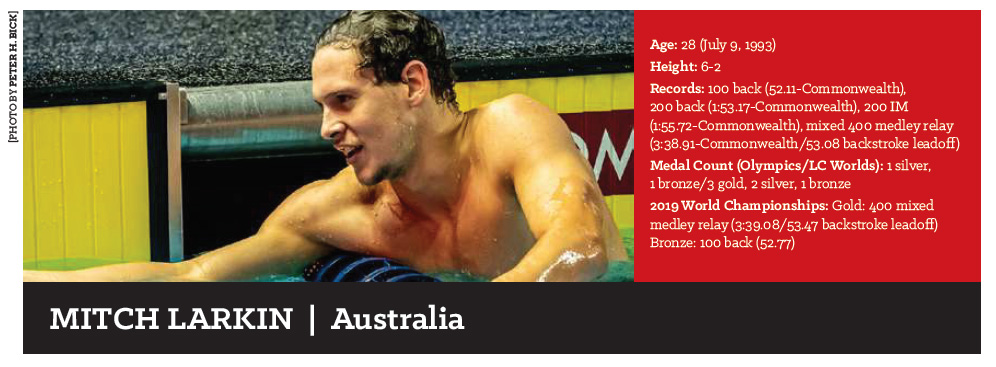
The search for Australia’s next men’s swimming star is well into its second decade. It seems only fitting for how frustrating the quest has been that arguably the country’s brightest hope is, through a quirk of scheduling fate, facing a mid-career transition.
When most of the world met Mitch Larkin at the 2016 Olympics, it was as a backstroker, a 22-year-old standing on the medal stand in the 200-meter event. But five years later, Larkin won’t contest what was considered his signature event, opting instead for the 200 individual medley.
For a men’s program that has won just five individual and three relay medals combined at the last two Olympics—or what Ian Thorpe once would’ve called a busy week all by himself—the swap of specialties is another sigh-worthy moment. For Larkin, though, the bold decision could be a chance at a second win on his career.
In Rio, Larkin almost passed as a veteran in the backstroke ranks, though he was just 22. But the Queensland native was surrounded by a pair of 20-year-olds in Ryan Murphy and Xu Jiayu and 19-year-old Evgeny Rylov. The American won gold that day in 1:53.62, short of Larkin’s pre-Olympics best time, with Larkin edging Rylov for silver by 1-hundredth of a second.
Since those Games, Xu has won consecutive World Championships in the 100 back, an event in which Larkin finished fourth in Rio (52.43), third in Gwangju (52.77), and whose best time this year is 53.04. Rylov has claimed consecutive 200 back titles. Murphy has two 200 back silvers, a 100 back silver and retains the world record in the 100.
Larkin was 15th in the 200 back in 2017, then scratched the event at 2019 Worlds, opting instead for the 200 IM, in which he finished seventh in 1:57.32. It was a far cry from the 100-200 back double he did in 2015 at Worlds in Kazan.
There’s a balance for Larkin, who declared just before Australian Trials that he wouldn’t swim the 200 back. In mid-June, he was ranked second in the world in that event with a very fast 1:54.38 set just in April at the Australian Swim Club Championships, though he hasn’t touched the personal best he set back in 2015 at 1:53.17 in quite some time. On the other hand, his 1:56.29 in the 200 IM from Trials, June 16, was the second fastest in the world—and his best time from 2019 is 1:55.72, a Commonwealth record and faster than anyone has swum so far this year.
“I’ve been looking at it for a number of months now, and I have never swum the medley at an Olympic Games, which gives me a lot of excitement,” Larkin said ahead of Trials. “It’s like coming back to my roots when I made my first (Australian) Junior team in the 400 IM, and also the depth (in both events) in terms of who’s going to win it and what times would win the 200 backstroke versus what time it’s going to take to be competitive in the 200 medley, and I think that was the deciding factor. It wasn’t an easy decision.”
Larkin has only dabbled in the 200 IM internationally. He won silver in the event in the 2018 Pan Pacific Championships and gold at the 2018 Commonwealth Games. But of his 28 medals in senior international competition, those are the only two not set in backstroke (50, 100 and 200) or on medley relays.
But the silver lining, as Larkin said, is in Larkin’s consideration of the bigger picture. With depth in backstroke, Larkin can pursue what would be, almost inconceivably, the first Australian medal in the men’s 200 IM, dating to its installation in the Olympic program in 1968. No Aussie man has won an IM medal since Rob Woodhouse’s bronze in 1984.
That’s a lot of pressure to foist on the shoulders of Larkin. But by now, it’s something he and his cohort of promising Aussies are accustomed to handling. — Matthew De George

Each Olympic cycle, the men’s 200 freestyle is often billed as one of the “can’t-miss” races of the swimming portion of the Games.
In 1988, three world record holders lined up behind the blocks in Seoul only for none of them to win the gold medal, that distinction going to Australia’s Duncan Armstrong in one of the greatest Olympic upsets in the sport.
In 2000, the Netherlands’ Pieter van den Hoogenband scored a monumental upset over Australian Ian Thorpe in front of the Sydney crowd, tying the world record from the night before. Thorpe, although just 17, was looked at as an unbeatable force, and no one expected him to lose in front of a home crowd, but Hoogie beat him to the wall, leaving the crowd stunned.
Four years later, those two lined up for the ultimate grudge match in Athens. Throw in a 19-year-old Michael Phelps, who wanted to challenge two living legends of the sport, and you have what was dubbed as “the race of the century.” Thorpe ultimately got his revenge in that race, while Phelps went on to dominate four years later in 2008.
Flash forward to 2021, and with questions surrounding reigning Olympic gold medalist Sun Yang’s status in the Games, the 200 freestyle seems up for grabs.
Enter Katsuhiro Matsumoto. The Japanese star didn’t make his senior debut until the 2017 Worlds, where the then-20-year-old finished 27th in the 200 free. He swam in two finals on relays, where he gained valuable experience racing on the global level. A month later, he was at the 2017 Summer Universiade, where he had another disappointing showing individually in the 200 free—a 19th-place finish and no second swim.
But Matsumoto rebounded later on to lead Japan to a gold medal in the 4×200 free relay at those Games, and he returned home with his first international medal.
A year later, Matsumoto was on the international podium for the first time individually, accepting the bronze medal in the 200 at the 2018 Pan Pacs in his home country for his 1:45.92, which put him ninth in the world that year. Ten days later at the Asian Games, he won silver in the 200 free and gold in the 4×100 and 4×200 free relays.
That international experience helped him break through in 2019, where he won the silver medal in the 200 free at the World Championships in Gwangju, setting a national record in the process at 1:45.22.
In the lead-up to the original 2020 Games, the 200 free looked to be up for grabs due to reigning world champ Sun Yang’s original eight-year suspension, leaving Matsumoto and Danas Rapsys (who touched first in that 200 free final in 2019 before getting disqualified) as the logical new favorites.
On April 5, Matsumoto lowered his Japanese record to 1:44.65 to briefly lead the world rankings in the event for two weeks—until Duncan Scott (1:44.47) and Tom Dean (1:44.58) went faster at the British Nationals. Matsumoto also qualified to swim the 100 freestyle and has dabbled in the 400 this year, but he has been all-in on the 200 freestyle for the home Olympics.
Will his efforts for the 200 result in Matsumoto being Japan’s first male gold medalist in freestyle since 1936? A home Olympics has given a boost to the host nation’s athletes, and Japan’s rich history in the pool will certainly be on full display in Tokyo. In a race as tactical and wide open as the 200, this could be the perfect moment for Matsumoto. — Andy Ross
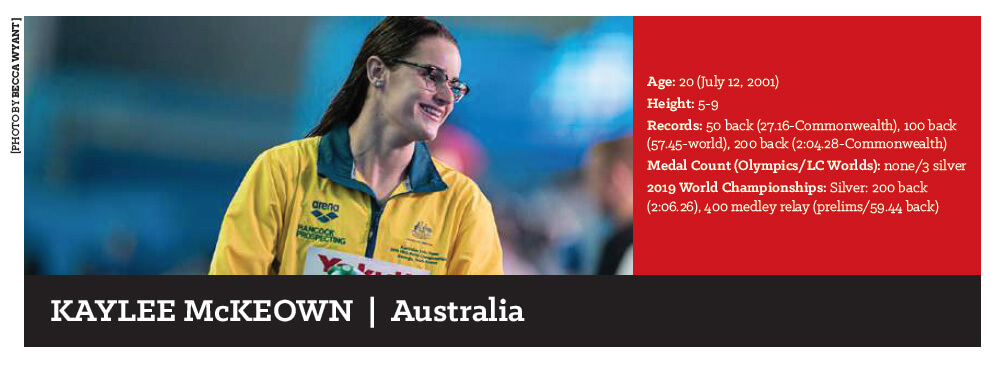
Anyone in the sport understands the grueling nature of training. In the water. In the gym. In the mind. But no matter how difficult the sessions may be from day-to-day, Kaylee McKeown recognizes how they pale in comparison to the fight her father, Sholto, waged against brain cancer. In August, it will be a year since McKeown’s father lost his battle with glioblastoma, his life shortened to 53 years.
Now, McKeown is surging toward the pandemic-delayed Olympic Games with her father as an inspiration, and with the knowledge that her family’s patriarch passed along a powerful mindset. On the road to Tokyo, and under the guidance of Coach Chris Mooney, McKeown sees the importance of seizing the moment and fighting to the end.
“Dad was taken from us too soon by something so cruel,” McKeown said at the time of her father’s death. “But the love, the memories and the laughter will forever be cherished in our hearts. He was so unbelievably strong and wanted to defy the odds that were stacked against him. With no time to waste, we buckled up for a hell of a journey and held each other’s hands every step of the way. The heavens above have gained another beautiful angel to watch over us.”
Since COVID-19 emerged and pressed the pause button on the 2020 Olympic Games, athletes around the world have responded differently in their returns to the water. Some have looked sharp. Others have yet to regain their pre-pandemic mojo. Still others are floating somewhere in between. Count McKeown in the top 1% of performers.
Entering the Olympic summer, McKeown’s greatest international achievement is the silver medal she claimed in the 200 meter backstroke at the 2019 World Championships. But by the time Tokyo comes to a close, there is a chance the just-turned 20-year-old (July 12) will own a fistful of medals from the biggest stage her sport has to offer.
At seemingly every stop ahead of the Australian Olympic Trials, June 12-17, McKeown was in statement-making mode. In the 100 backstroke at the Sydney Open, she just missed the world record with a Commonwealth standard of 57.63. There have been 2:04 markers in the 200 backstroke. And in the 200 individual medley, McKeown has been sub-2:09 to earn podium-contender status for the Games. (As SW was about to go to press, McKeown set a world record at the Australian Olympic Trials with a 57.45 in the 100 back and won the 200 back in 2:04.28 and 200 IM in 2:08.19.)
In an era in which the Australian women do not lack for starpower, thanks to the presence of Cate Campbell and Emma McKeon, it can be argued that McKeown has the potential for the greatest fireworks in Tokyo. With considerable momentum behind her, McKeown could be a disruptive force to the United States’ backstroke battalion—a unit powered by Regan Smith.
McKeown, too, has a chance to make history for her country. Despite Australia’s longstanding greatness in the pool, no Australian woman has ever won gold at the Olympic Games in a backstroke event. The closest it has come are silver medals from Bonnie Mealing (1932) and Emily Seebohm (2012) in the 100 backstroke.
From her individual schedule to the role she will play in Australian relay duty, McKeown has the opportunity to emerge from the Tokyo Games as a global star. And as she pursues that success, there is no doubt she will have support from above. — John Lohn
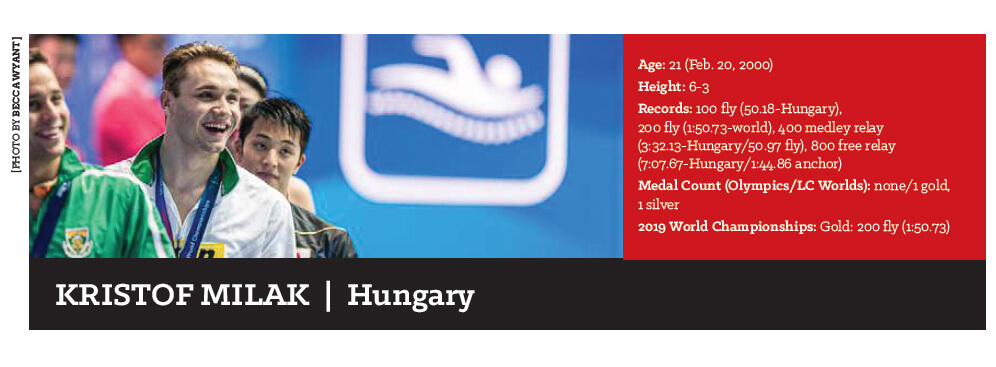
It is not a large country, but Hungary knows a thing or two about producing big results in the pool. From the days of original superstar Alfred Hajos to the modern-day excellence of Krisztina Egerszegi and Tamas Darnyi, Hungary is proud of its rich tradition in the sport.
And now, as the Olympic Games are set to begin in Tokyo after a yearlong delay due to the COVID-19 pandemic, Kristof Milak is the latest Hungarian to carry his nation’s banner.
Milak has seemingly been destined for greatness, his talent recognized at an early age and generating high expectations. While World Junior and Youth Olympic titles dot his résumé, it was a silver medal in the 100 butterfly as a 17-year-old at the 2017 World Championships, behind American Caeleb Dressel, that proved he would be a factor on the biggest stage. And since that day arrived in his hometown of Budapest, Milak has not let up.
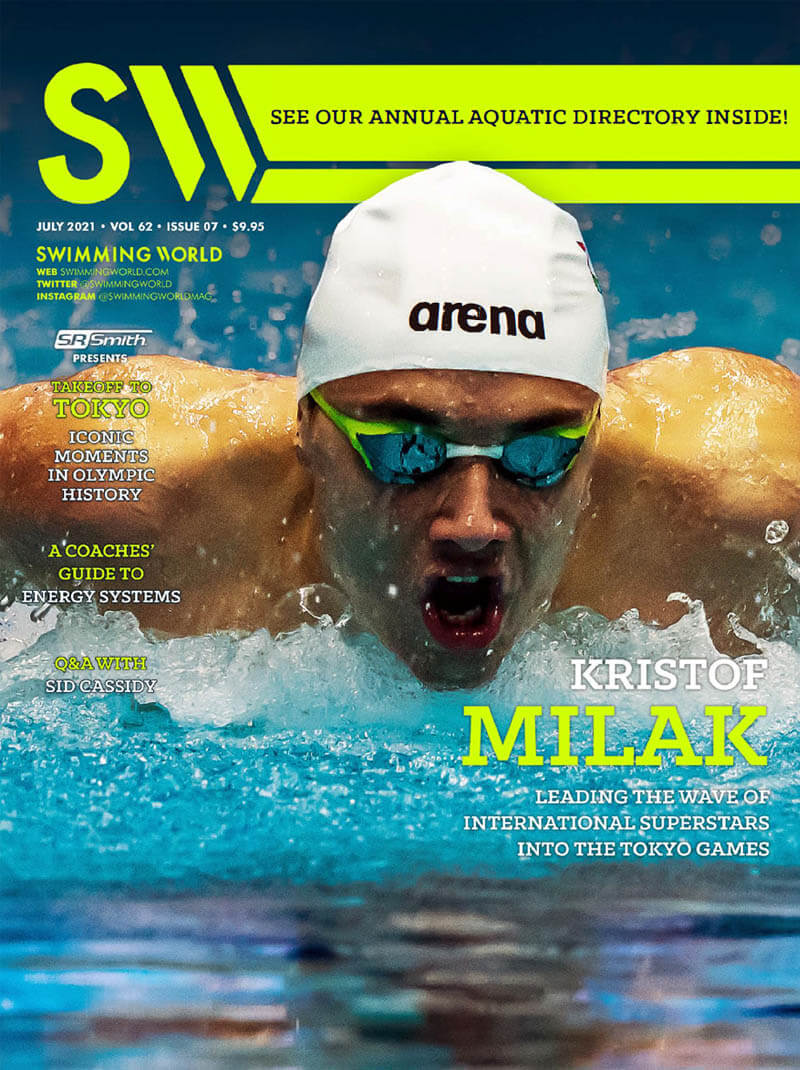
These days, Milak is best known for his prowess in the 200 butterfly, arguably the most grueling event in the sport. In a discipline where each stroke saps the body of energy, and the brain begs for the wall to appear, Milak can stay powerful and fend off the proverbial piano. Never was that ability more evident than at the 2019 World Championships in Gwangju, South Korea.
En route to a 1:50.73 world record, Milak charged home in 29.16, a split that was more than a second faster than six of the other seven finalists. And that closing leg came after Milak pressed the first 150 meters to build an insurmountable edge. The silver medalist in that race, Japan’s Daiya Seto, finished in 1:53.86, more than three seconds in the rearview mirror.
What Milak is doing in the 200 butterfly is comparable to the dominance that Great Britain’s Adam Peaty has shown in the 100 breaststroke and what American Katie Ledecky has enjoyed in the distance-freestyle events. Simply, he is racing in his own realm, his primary competition the clock. Heading into the Tokyo Games, Milak owns the three fastest times in history, with his world record from Gwangju sitting 78-hundredths clear of Michael Phelps’ career best of 1:51.51, which stood as the world record for a decade.
It is not preposterous to suggest that Milak could threaten the 1:50 barrier at the Olympics, a threshold that is difficult to digest. Some context for what Milak is chasing? Phelps is the only other athlete to eclipse the 1:52 barrier in the 200 fly, and that performance was delivered in 2009—during the tech-suit era.
As much as the 200 butterfly is Milak’s prime event, he recently claimed the European title in the 100 butterfly, his time of 50.18 making him the No. 4 performer in history. More, he has established himself as one of the world’s elite swimmers in the 200 freestyle, with an Olympic medal not out of reach. Simply, Milak continues to develop into a multidimensional force.
Years down the road, when greats of the sport are discussed, it would not be a surprise if the name of Kristof Milak is part of the conversation. He is, after all, headed in that direction, and further enhancing his nation’s aquatic excellence. — John Lohn
 [PHOTO BY PETER H. BICK]
Get Swimming World Magazine and Swimming World Biweekly FREE When You
Become A Member of the International Swimming Hall of Fame
New! 30 Day Membership to ISHOF AND Digital Swimming World Subscription for just $10 a month!
Want more? Get a 1 Year ISHOF Family Membership With Swimming World Print AND Digital Subscription Order Now!
Non-Subscribers can click here to download this issue for only $5.94
FEATURES
010 | TOKYO OLYMPIC GAMES: READY FOR IMPACT
by Dan D’Addona, Matthew De George, John Lohn, David Rieder and Andy Ross
As the United States was still selecting its Olympic swimming team in mid-June, most countries had already decided who would be competing at the COVID-19 pandemic-delayed Olympic Games this summer. Here are profiles of 10 swimmers from around the world who have been preparing to make an impact in Tokyo.
022 | TAKEOFF TO TOKYO: ICONIC MOMENTS IN OLYMPIC HISTORY
by John Lohn
In October of 2019, nearly a year prior to the original date of the 2020 Olympic Games in Tokyo, Swimming World designed a series that would pay homage to the history of the sport on its biggest stage. For our final installment of “Takeoff to Tokyo,” we offer a look at some of the most prominent moments in Olympic lore.
026 | AS GOOD AS IT GETS
by Dan D’Addona
In our Olympic preview of artistic swimming, Swimming World notes that Russia is a perfect 10-for-10, winning every Olympic gold medal possible—duet and team—since the turn of the century. Led by Svetlana Romashina and Svetlana Kolesnichenko, Russia will be tough to beat next month, Aug. 2-7, in Tokyo.
COACHING
20 | SWIMMING TECHNIQUE CONCEPTS: MAXIMIZING SWIMMING VELOCITY (Part 3)—MINIMIZING THE ARM ENTRY PHASE TIME IN FREESTYLE AND BUTTERFLY
by Rod Havriluk
The non-propulsive time in a stroke cycle consists of the time for the entry phase and the recovery phase. This article presents strategies to minimize the entry phase time for freestyle and butterfly so that a swimmer can decrease stroke cycle time, increase stroke rate and increase swimming velocity.
040 | A COACHES’ GUIDE TO ENERGY SYSTEMS (Part 2)
by Michael J. Stott
Last month, Swimming World explored the concept of energy systems and how coaches can use them to maximize athlete development and performance. In Part 2, we examine how one incorporates his understanding of energy systems into a seasonal training plan.
042 | Q&A WITH COACH SID CASSIDY
by Michael J. Stott
043 | HOW THEY TRAIN MEGAN MORONEY AND ASPEN GERSPER
by Michael J. Stott
TRAINING
019 | DRYSIDE TRAINING: SUMMER SPEED
by J.R. Rosania
JUNIOR SWIMMER
45 | UP & COMERS: KAYLA HAN
by Shoshanna Rutemiller
COLUMNS & SPECIAL SECTIONS
008 | A VOICE FOR THE SPORT
018 | THE OFFICIAL WORD
027 | 2021 AQUATIC DIRECTORY
046 | GUTTERTALK
047 | PARTING SHOT
Swimming World is now partnered with the International Swimming Hall of Fame. To find out more, visit us at ishof.org