



















Long-Form Feature: The Rivalry of Alexander Popov vs. Gary Hall Jr.; 30th Anniversary of Atlanta 1996
To coincide with the 30th anniversary of the 1996 Olympic Games in Atlanta, Swimming World examines – through a long-form feature – the sensational and intense rivalry between sprint legends Gary Hall Jr. and Alexander Popov.
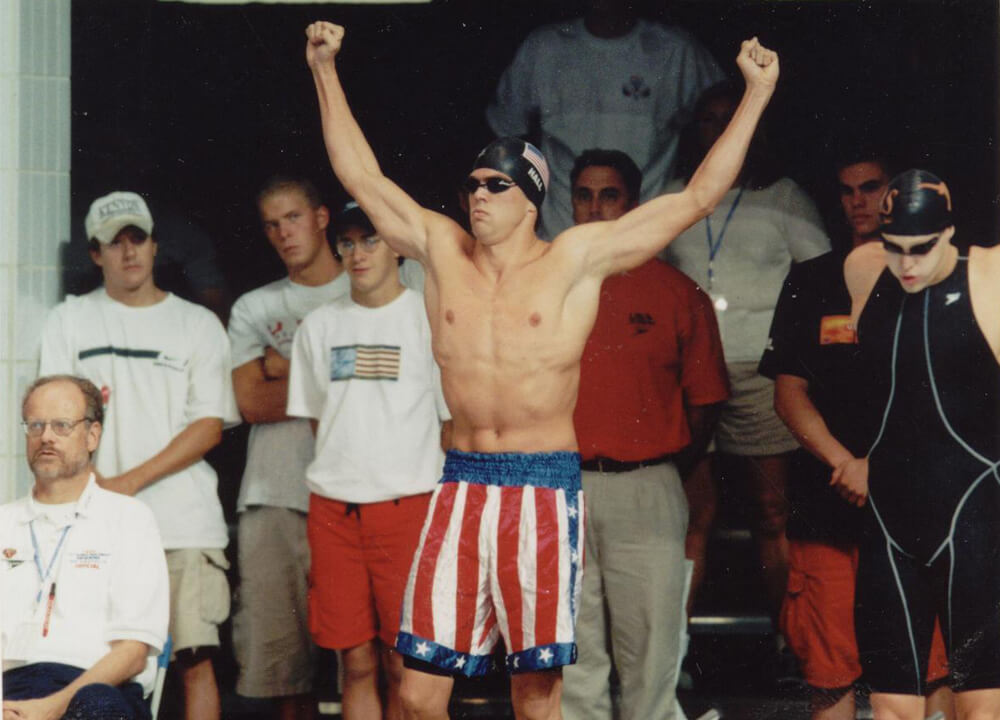
One was known for an icy stare, everything around him shut out when it was time to work. The other operated via a looser approach, comfortable entertaining and connecting with the crowd up until go time.
One was tenacious in his training approach, regularly logging thousands of meters during a workout. The other took a freer approach to training, shorter workouts the norm and, occasionally, held in the ocean and not the pool.
One was eager to test himself at most international competitions, seeking world and continental crowns alike. The other was much more selective with his schedule, and made it clear the Olympic Games were his main – and often only – priority.
They couldn’t have been more different.
Over the course of a decade, from the mid-1990s into the mid-2000s, Russia’s Alexander Popov and the United States’ Gary Hall Jr. engaged in one of the best rivalries the sport has seen. The fact that they were opposites in several ways supplied a layer of intrigue to their duels, as did the back-and-forth insults that were exchanged.
But it was their sheer speed that was most enticing, spectators enthralled by their epic battles for the title of Fastest Man in Water. From Atlanta to Sydney to Athens, and with stops in between, Popov and Hall were showmen, and jointly wrote a chapter in the sport’s history that will be long remembered.
This is their story.
************************
The best rivalries are those that endure. When given a chance to grow, they often develop depth that goes beyond the black-and-white results shown on the scoreboard. They reveal differences in personality. They pit athletes from different countries. They can be friendly or hostile. The days of Popov vs. Hall featured some of these traits.
But before the Russian and American tangled in a sequel to the Cold War, they were preceded by a gentler conflict. It was a rivalry that captivated the sport, built hype around the sprints and served as a red carpet to the Popov-Hall era.
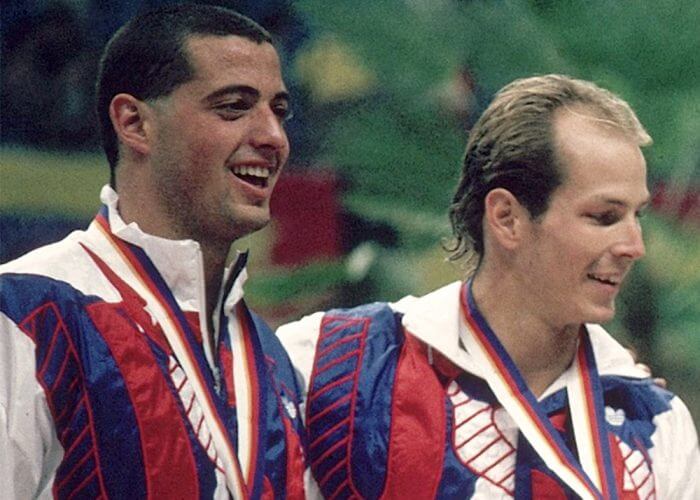 Between 1985 and 1991, the sprint-freestyle events belonged to the tandem of Matt Biondi and Tom Jager. When they stepped on the blocks during their heydays, it wasn’t a matter of whether the Americans would finish on the podium, but on which step. While Jager won back-to-back world titles in the 50 freestyle in 1986 and 1991, Biondi claimed bronze and silver, respectively. In the 100 freestyle, it was Biondi who repeated as world champion, Jager snaring bronze in 1986.
In between the World Championships, Biondi swept the sprints at the 1988 Olympic Games in Seoul. Jager was the runnerup in the 50 freestyle and teamed with Biondi to lead the United States to gold in the 400 freestyle relay by nearly two seconds over the Soviet Union.
During this stretch, Popov was busy honing his skills as a teenager with limitless potential.
Entering the 1992 Olympics in Barcelona, either Biondi or Jager had been ranked first in the world for seven straight years and, at one point, combined for 24 of the 25-fastest times in the history of the 50 freestyle. Meanwhile, Popov didn’t make his first international dent until he won the 100 freestyle at the 1991 European Championships. That victory certainly provided a career boost, along with Popov’s mental approach, which was an outlook that provided no mercy for the opposition.
“When I go to competitions in Europe or America, or even here in Australia, I am always looking for potential challengers,” Popov said. “If I see any, I have to swim faster and make them feel sick. If they have a little potential, you must get on top of them and kill that enthusiasm right away so they will lose their interest in swimming.”
As veterans, Biondi and Jager were not going to succumb to the intimidating nature of Popov, but the Russian’s belief that he could compete at the same level as two legends was evidence of his toughness. His confidence ultimately led to the greatest achievement of his career – at least to that point.
Racing the 100 freestyle first, Popov easily took care of the field, as he recorded a time of 49.01 to finish .41 ahead of Brazil’s Gustavo Borges, with Biondi back in fifth in 49.53. Two days later, Popov put on another speed display, winning the 50 free in 21.91, Biondi and Jager completing the podium. It was clear that Popov had ascended to the top of the sprint mountain. Hall, for the record, was a teen with aspirations to be in the mix one day.
“Popov obviously had the courage to stand up to Matt Biondi and Tom Jager and take them down,” Jager said. “The first person in the world to do that. I take my hat off to Popov. He has a great career ahead of him.”
************************
Olympic titles now on his resume, Popov – who was nicknamed “The Tsar” – moved forward from Barcelona with a wrecking-ball approach. He was the 1993 European champion in both sprints and replicated that feat at the 1994 World Championships in Rome. Another sprint sweep followed at the 1995 European Champs, leaving Popov to surge into the 1996 Olympics as a seemingly unstoppable force.
 Popov’s success followed a major life change. In late 1992, Popov’s coach, Gennadi Touretski, accepted the head-coaching position at the Australian Institute of Sport in Canberra. Popov didn’t think twice about leaving Russia and joining his mentor in the Australian capital. Obviously, the shift in locales wasn’t a disruption in the slightest.
For his part, Hall used the 1994 World Championships to put his name in the spotlight. He might not have beaten Popov, but he gave a glimpse of the next great American sprinter, the guy who would take the baton from Biondi. On the way to a pair of silver medals behind the Russian, Hall also showed he was a different breed than Biondi, who was a measured and stoic figure. Hall had an opposite personality. He liked to play to the crowd and was brash with his words, confident he could back them up.
The combination of Hall’s threatening status and loud demeanor did not sit well with Popov, whose oversized ego made his disdain for Hall a paradox. So, when the 1996 Olympics in Atlanta opened, Popov not only sought a defense of his gold medals but had a deep desire to muzzle his American rival on his home soil.
As was the case at the World Champs two years earlier, Popov emerged triumphant in both sprints at the Atlanta Games. He prevailed in the shorter distance by .13 over Hall, with a margin of .07 separating the combatants in the 100 freestyle. By capturing back-to-back Olympic victories in the 100 freestyle, Popov became the first man to repeat in the event since the legendary Johnny Weissmuller doubled in 1924 and 1928.
“He talks too much,” Popov said. “He always says he’s going to beat me. He likes talking about himself. If you’re going to say something, you have to go out and do it. If you’re not the best at something, you may as well go and look for something else to do. I like to let my results speak for themselves.”
Popov undoubtedly had the upper hand in the rivalry through Atlanta, but Hall wasn’t about to accept a permanent bridesmaid identity. He knew his peak years were in front of him, and he simply needed to follow the blueprint he had mapped out. The fact that he cut his deficits to Popov between 1992 and 1996 suggested he was making positive strides.
************************
Hall hailed from a family with a rich tradition in the pool and he took pride in carrying his family legacy forward. His grandfather, Charles Keating Jr., was the 1946 NCAA champion in the 200 breaststroke for the University of Cincinnati while his uncle, Charles Keating III, finished fifth in the 200 breaststroke at the 1976 Olympics in Montreal.
The lineage runs strongest, though, with Hall’s father, Gary Sr., a three-time Olympian who excelled for Indiana University. Under the guidance of legendary coach Doc Counsilman, the elder Hall molded himself into an all-around standout for the Hoosiers and for Team USA. In an era in which Olympic careers were short-lived, Hall was an anomaly, racing at the 1968, 1972 and 1976 Games, and earning a medal in each Olympiad.
Known for enduring grueling workouts and pushing himself beyond what Counsilman designed in workouts, Hall set world records in four different individual events, a testament to his versatility. But for his success, which earned him induction into the International Swimming Hall of Fame in 1981, Olympic luck was never on Hall’s side.
After Hall claimed the silver medal in the 400 individual medley and just missed the medals in the 200 backstroke following a fourth-place finish at the 1968 Olympics in Mexico City, he seemed poised for major success at the 1972 Games in Munich. While Hall won the silver medal in the 200 butterfly, he placed fourth in the 200 individual medley and fifth in the 400 individual medley, events in which he entered the Olympics as the world-record holder.
Four years later, Hall closed out his Olympic career with a bronze medal in the 100 butterfly, an effort that was somewhat surprising given his talent was better suited to the 200-meter distances and up. At those 1976 Games in Montreal, Hall was part of an American squad that won 12 of the 13 events on the schedule and is regarded – almost without argument – as the greatest team in swimming history.
Always on the hunt for a mental edge, Popov didn’t miss an opportunity to take a shot at the Hall family as his rivalry with Gary Jr. heated up. Aware of the younger Hall’s penchant for shorter workouts and his father’s history, Popov went on the attack in 1997.
“He doesn’t work hard,” Popov said of his rival. “He’s doing 1500 meters? That’s what I swim in warmups. (Hall) says he will be at the Sydney Olympics and that he will win both sprint titles. I don’t know how he can say that. His father was never an Olympic champion, and he never will be either. It’s a family of losers.”
When Popov’s words got back to Hall, the American responded, feeling the need to defend not only his reputation, but the honor of his father.
“(Popov) is the epitome of unsportsmanlike conduct,” Hall said. “In the world of swimming, Alexander brings a new definition to the word shallow. What really upsets me is that in order to make himself feel better, Alexander must put down the Olympic accomplishments of his opponent’s father. I am embarrassed for this coward of a man. He ought to quit now because that road is going to be a long and hard one. Or, he can learn the words of the Star Spangled Banner because that’s what Olympic audiences will be hearing for years to come.”
************************
What didn’t unfold was a meeting between the athletes at the 1998 World Championships. While Hall anchored a pair of United States relays in Perth, he was absent from the 50 freestyle and 100 freestyle, leaving his next showdown with Popov until Sydney. And before they would meet again, much transpired out of the water.
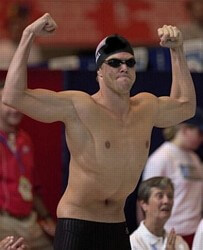 A little more than a year shy of the 2000 United States Olympic Trials, Hall was dealt news that not only complicated his pursuit of a gold medal but brought adversity to his daily life. In March 1999, Hall was informed he had Type 1 diabetes, a disease in which the body does not produce enough insulin or does not effectively use the insulin created by the body.
Upon his diagnosis, doctors informed Hall that his career – almost certainly – would be short-circuited, leaving him to retire at his peak. Initially, Hall was devastated by the news and the knowledge that all his work and goals were crushed by a medical issue beyond his control. In short time, however, Hall flipped the script and didn’t buy into the doctors’ career-ending diagnosis.
After researching the disease and discussing his situation with medical experts and his coaches, Hall focused on creating the proper balance between treating his medical condition and the preparation necessary to earn a ticket to the Sydney Olympics. While Hall had to give himself as many as eight insulin injections each day, he managed to adhere to a training program that allowed him to remain one of the world’s premier sprinters.
Sure, there were speed bumps along the way, including blurred vision and rapid fatigue. Ultimately, though, Hall responsibly monitored his blood-sugar levels and drafted a tutorial for how to battle the disease and maintain an active, demanding and healthy lifestyle. More, he used his platform as an Olympic champion to raise awareness of the disease.
“The diabetes was really a major factor in my life, not just my swimming career,” Hall said. “The travel took something out of me. It affected my blood-sugar levels. But I paid attention to what I ate and made sure I got the right amount of insulin. It was so scary when I was diagnosed. I heard these horror stories and the statistics. My reaction was it’s just a matter of time. I’ve only got so much time before these things happen.
“But the quality of life a person with diabetes can have really comes down to the individual and the management that individual can provide. Other people have been able to successfully manage this disease and avoid very serious complications that stem from this disease, so it can be done. If there are complications, it’s difficult to blame anybody but yourself.”
With a plan in hand to manage his diabetes, Hall still had to get through the United States Trials and qualify for Sydney. It turned out that Hall accomplished that feat in emphatic fashion, an American record of 21.76 providing him with a narrow victory over Anthony Ervin, a rising star on the sprint scene.
The month following Trials was a critical time for Hall and Ervin. Under the guidance of coach Mike Bottom at the Phoenix Swim Club, the Americans trained side-by-side every day and helped one another hone their skills for Sydney. Also under the mentorship of Bottom, and adding to the competitive atmosphere, was Poland’s Bart Kizierowski, a European champion. Simply, practices emulated an international showdown.
The setup, in which three medal contenders trained together, needed to be handled delicately by Bottom, and the veteran coach delivered. Each day, Bottom provided his swimmers with what they individually needed.
“Mike Bottom graduated near the top of his class in psychology,” Hall said. “It was applied every day, at every practice. Unlike any other coach I’ve ever met, Mike was able to alter his approach with each individual. Unlike any therapist, he was able to measure results to one hundredth of a second. What motivates and demotivates varies from individual to individual. Three personalities required three different approaches. Though our end goal was the same, our needs were all very different. We knew that we would be competing against each other at the end of the season. We competed against each other every day in practice, jockeying for minute advantages. This is the nature of the sport. Teammates and friends compete against each other. There was a lot of psychology involved, in how we all interacted with one another, through the training and competitions. Not just between coach and swimmer, but also between swimmers. Mike was so skilled at shepherding this lively, and sometimes volatile, dynamic.”
************************
As much as Hall recognized Ervin as a top contender for gold in Sydney, he knew Popov would be an equally daunting figure. Like Hall, Popov encountered a medical emergency on the road to the 2000 Games, but the Russian’s situation was a case of bad timing.
In August of 1996, just weeks after he swept the sprint-freestyle events at the Atlanta Olympics, Popov was walking with friends on a Moscow street when members of his party got into an argument with watermelon vendors. The exchange of words quickly escalated into a physical altercation and one of the vendors stabbed Popov in the stomach. Popov was rushed to a hospital where he underwent a three-hour surgery to treat knife damage to his lungs and kidney.
Popov spent 45 days in the hospital and resumed training three months after the incident, with his return to major competition arriving at the 1997 edition of the Santa Clara International Swim Meet, 10 months after the stabbing. After winning the 50 freestyle in Northern California, the only hint of his near-death experience was the six-inch scar on his chest.
“You know, we probably could have gotten out of the situation if it had been handled differently,” Popov said. “But they approached us, and somebody started talking with them, and they misunderstood us and started to fight. The men didn’t know who I was. We were in the wrong place at the wrong time.”
************************
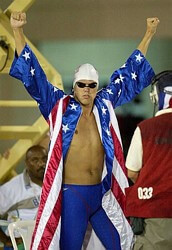
Gary Hall – Photo Courtesy: ISHOF
With Hall’s diabetes managed and Popov’s incident in the rearview mirror, the sprint stars were able to direct their attention to the 2000 Games. Although Hall and Ervin headed to Sydney in fine form, Popov looked to be the sharpest of the bunch. At the Russian Olympic Trials, Popov took advantage of a time trial and unleashed a world record of 21.64 in the 50 freestyle. The effort cut .17 off Jager’s global standard, a sizable chunk of time for any event, but especially for a one-lap sprint. From Moscow, a message was sent.
As the two-time defending Olympic champion, Popov was in position to make history as the first man to win the same event at three consecutive Olympiads, and he had two opportunities to pull off the feat. This fact was not lost on the Russian.
“If you win the Olympics once, you’re good,” Popov said. “Win the Olympics two times, you’re great. Win the Olympics three times, you’re history.”
The 100 freestyle was the first individual showdown between Popov and Hall, although both had raced in the 400 freestyle relay on the opening day of competition. While Popov’s Russian squad was disqualified, the bigger news was the United States’ silver-medal finish with Hall on the anchor leg. Fueled by Michael Klim’s world record on the leadoff leg, Australia snapped Team USA’s Olympic unbeaten streak in the event at seven. The defeat was a tough loss for Hall to accept since he predicted a United States victory prior to the Games, going so far as to claim the United States would “smash (Australia) like guitars. When he was out-touched at the wall by Ian Thorpe, Australia’s teenage superstar, the Aussies celebrated with an impromptu air-guitar routine. Still, Hall carried himself with grace, acknowledging Thorpe and his teammates for their stellar performance.
By the time the final of the 100 freestyle was held, Popov and Hall had settled into their routines and were ready for the latest chapter of their feud. The problem was a Dutchman inserted himself into the middle of the fray and decided it was his turn to reign. The rising talent of Pieter van den Hoogenband was not unknown to Popov or Hall, who raced against him at the 1996 Olympics in the 100 free, where van den Hoogenband placed fourth to just miss the podium. Meanwhile, “Hoogie” was fourth at the 1998 World Championships before capturing the 1999 European crown over Popov.
Van den Hoogenband was also coming off a stunning victory over Thorpe in the 200 freestyle, the Dutchman setting a world record of 1:45.35 in the semifinals before matching that time in the final. His defeat of Thorpe hushed the Aussie crowd and confirmed what had been suspected for a few years: van den Hoogenband would emerge as one of the sport’s greats.
At half the distance of his initial Olympic triumph, van den Hoogenband was equally impressive. Turning in third place at the midway mark, he blasted the field over the second lap to touch in 48.30, with Popov earning the silver medal in 48.69 and Hall taking the bronze in 48.73. The result left Popov short of history in his initial pursuit of a treble, but Hall was thrilled with his podium finish. As for van den Hoogenband, he recognized the enormity of the moment.
“I like to race against him,” van den Hoogenband said of Popov. “He’s such a legend. If you beat him, it means a little more than beating anyone else.”
************************
There wasn’t much turnaround time between the end of the 100 freestyle and the start of the 50 free, the one-lap mad dash where a single mistake proves deadly. None of the big guns had any difficulty advancing out of the preliminaries and Hall, van den Hoogenband, Ervin and Popov went into the final as the top four seeds, separated by a tenth of a second.
As the final approached, the familiar verbal jabs between Hall and Popov had ceased, each athlete merely focused on his job. Perhaps it was evidence of maturity in both men, or maybe their quiet nature was affected by the fact that Ervin and van den Hoogenband were significant threats to the sprint throne.
Off the blocks faster than their fellow finalists, Hall and Ervin – as they had so many times in preparation for Sydney – engaged in a stroke-for-stroke duel at the Sydney Aquatic Center. The difference from practice was that this clash was viewed by more than 17,000 spectators and the prize was what all world-class swimmers strive to claim: Olympic gold.
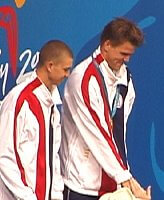 As Hall and Ervin approached the wall, it was impossible to determine which man was in front, and for good reason. When the scoreboard flashed the results, a pair of 21.98 performances were listed. One was produced by Hall. The other was courtesy of Ervin. For the first time since 1984, there was a tie in an Olympic swimming final, and the guys who shared the top step of the podium just happened to see each other every day.
“The first thing you do is check your name and see the number next to it,” Hall said of the finish. “It took me awhile to realize there was another ‘1’ up on the board, and then I thought it was (van den Hoogenband) who had tied with me. When I realized it was Anthony, I was very happy. I couldn’t have shared this medal with a nicer guy.”
The sprint events are considered the macho disciplines of the sport. There is a lot of testosterone on the deck and the miniscule margin for error tends to create stress and tension among the combatants. Somehow, though, Hall and Ervin successfully navigated those chest-thumping land mines and proved to be supportive on the road to Sydney. Throughout training, Hall could only recall one spat with Ervin, a flareup that quickly subsided and was forgotten.
For Hall, gold was the realization of a family dream, one that started with his father as a Team USA stalwart in the 1960s and 1970s. For Ervin, his emergence as an Olympic champion sparked discussion of whether he could etch himself as one of the greatest sprinters of all-time.
“We pushed each other every day in training,” Ervin said. “We got up and raced and I think that prepared us. It’s an honor to share the gold with him. (Hall) is someone I look up to. He is very misunderstood. Until I roomed with him at the Olympics, I had never really gotten a true glimpse of what Gary is like. He’s very deep, and well-spoken. We’re similar in a lot of ways.”
Touching behind Hall and Ervin for the bronze medal was van den Hoogenband, who pulled off the rare – and impressive – feat of medaling in three freestyle distances. Back in a surprising sixth was Popov, who never found his usually unmatched speed and watched another opportunity at a three-peat washed away. In a way, Sydney witnessed a changing of the guard in the sprint realm, the formerly untouchable Popov surrendering his kingdom to new blood.
************************
As he was wont to do, Hall went off the radar between Sydney and the Athens Olympics of 2004. Appearing at the World Championships was never a high priority, so he skipped the global competitions of 2001 and 2003. Really, Hall’s approach was simple: He cared only about the Olympic Games, and he was confident he could excel without racing frequently, or against the best in the world.
Popov, too, vanished into the shadows the year after the Sydney Games, but the Russian was back in action at the 2002 European Championships. In Berlin, Popov finished fifth in the 50 freestyle, but confirmed he wasn’t slipping when he won the silver medal behind van den Hoogenband in the 100 freestyle.
There was more to come.
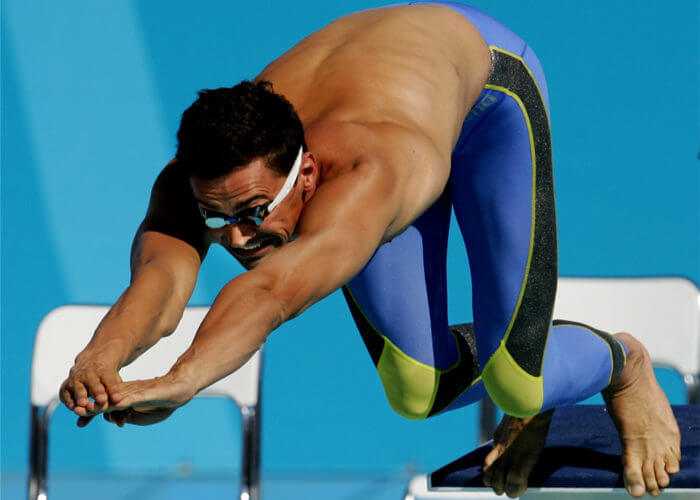 With the 2003 World Championships scheduled for Barcelona, Popov was eager to return to the city where he celebrated his initial Olympic success. The visit could not have unfolded in more perfect fashion as Popov decisively won both sprint-freestyle events. At 31 years old, he set a championship record of 21.92 in the 50 free and captured the 100 freestyle in 48.42, van den Hoogenband back in second place.
“Barcelona has always been a special city in my life,” Popov said after winning the 100 freestyle. “This is the place where I started and, well, Barcelona is where we continue.”
Coming off his age-defying and surprise double at the World Championships, Popov headed into the 2004 Olympic year with momentum. Hall? His lack of competition prompted a question mark. It also didn’t take Hall long for Hall to make waves as part of a controversy within the Team USA camp.
With the help of Hall, the United States had no trouble qualifying for the final of the 400 freestyle relay on the second day of the meet. But when the lineup for the final was revealed, and Hall was not one of the listed names, Captain America voiced his displeasure. As one of the two-fastest Americans from prelims, Hall felt he earned his spot on the evening relay. The coaching staff, headed by University of Texas coach Eddie Reese, opted to bring back only Neil Walker from the prelim squad, and use Jason Lezak, Ian Crocker and Michael Phelps for the other three legs. Lezak and Crocker were locks, based on their one-two finish from the U.S. Trials. But Phelps’ selection generated controversy, since he didn’t contest the 100 free final at Trials.
When the United States managed only bronze in the final in Athens, marking its worst Olympic showing, there was considerable disappointment. Crocker’s leadoff leg, in which he was eighth, proved to be too much to overcome, and even the inclusion of Hall would not have affected the outcome. Still, precedent had been bypassed in the selection of Phelps, and the decorated Hall was the man who got the boot.
“I was disappointed in the decision,” Hall said. “I don’t think it was the right decision. (Reese) said he wasn’t going to second-guess himself and that’s fine, but it’s something I have to live with and something that I take personally. That relay, I wanted very much to be a part of it.”
After his relay snub, Hall had several days to focus on the defense of his title in the 50 freestyle. Popov, meanwhile, had the 100 freestyle two days after his Russian team tied for fourth in the 400 freestyle relay. The event did not go according to plan as Popov’s ninth-place effort in the semifinals left him shy of the final.
If Popov saw the 100 freestyle as a disappointment, then the 50 freestyle was a disaster. The two-time champion of the event experienced a premature ouster from the prelims of the dash after posting a time that was nearly a second slower than his world record. Since the effort arrived just a year after Popov was crowned world champion, shock filled the air.
Hall didn’t encounter similar difficulties. After easily advancing through the preliminaries and semifinals, Hall joined Popov as a repeat champion of the 50 free. Winning by the slimmest of margins, .01, Hall touched the wall in 21.93 to edge Croatian Duje Draganja. Hall engaged in a muted celebration, raising his hands to acknowledge the crowd.
“Gary’s a racer,” Bottom said. “Nothing surprises me from Gary. He steps up. “He’s got heart, he’s got soul, he’s got desire. He’s also creative in what he does. He doesn’t swim miles and miles in the pool every day. He goes out and swims in the ocean. He goes to Costa Rica. He enjoys his life.”
************************
Their trophy cases each filled with two Olympic gold medals from the 50 freestyle, Popov and Hall went different directions after Athens. Popov announced his retirement in early 2005 while Hall made a final run at the Olympics at the 2008 United States Trials, coming up short of a trip to Beijing following a fourth-place finish.
As long as the history of sprinting and great duels are discussed, the decade-long rivalry between Popov and Hall will be mentioned. They spent years trading insults and playing mind games with one another. But most important, they spent years producing epic races and raising the bar in the sprint game.
“I hated Alex. And he hated me,” Hall said. “He was such an asshole the first time we met, in the ready room before finals at the (1994) World Championships. I was a threat and he was going to do anything he could to gain an advantage, trying to get inside my head. It was a legitimate rivalry. Like any rivalry, it fueled us both.”