




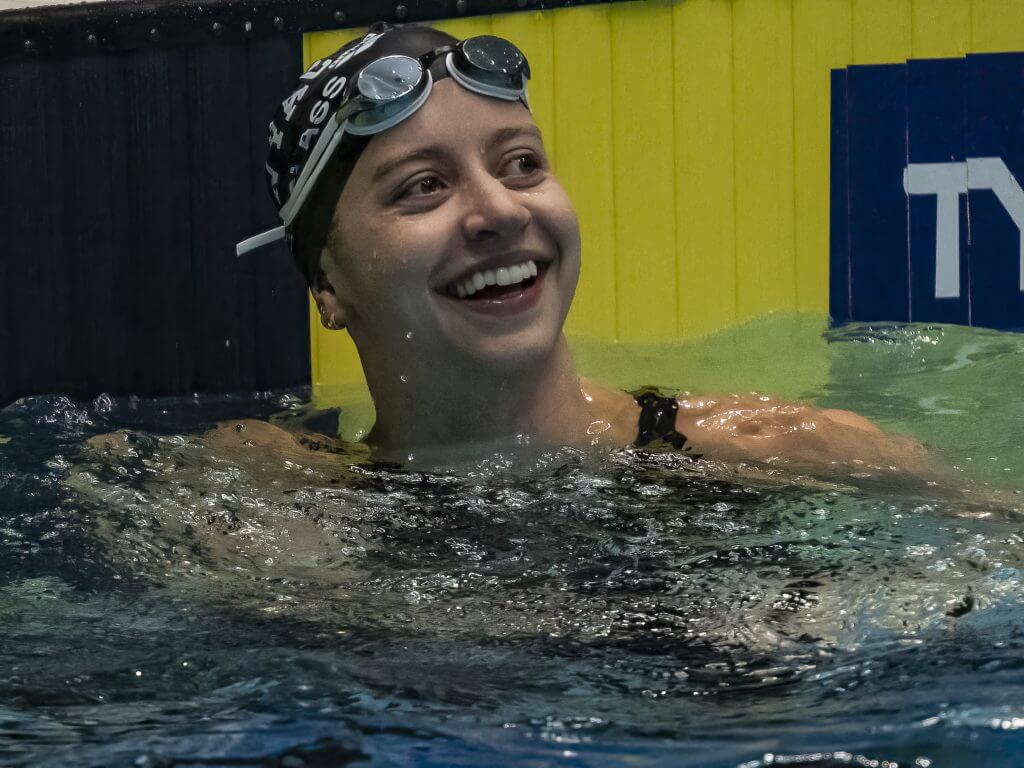















Kate Douglass ‘Shocked’ at 50 Freestyle World Record; Sprint Breakthrough Means Tough Event Decisions to Come
A quick scan of the impressive medal record Kate Douglass has put together over the past six years indicates the 50 freestyle is her third-best event, at best. Few, including Douglass, would have imagined the sport’s shortest race would provide the canvas for her first long course world record.
Douglass earned the title of fastest female swimmer in history at the Indianapolis Pro Series, pulling away from Gretchen Walsh, her training partner and the swimmer with whom Douglass previously shared the American record. Douglass finished in 23.59 to edge out the previous world record of 23.61 set by Sarah Sjostrom three years ago. Walsh finished in 23.78, also under the previous domestic mark. Douglass had previously broken short course meters world records in three events.
“I obviously was very shocked when I heard that I broke the world record,” Douglass said. “I definitely felt confident that I was going to go a best time, especially after my prelims swim, but that was definitely like a lot faster than I expected.”
Douglass has captured medals in the 200 IM at the last two Olympics, with two world titles over that span. She has emerged as the world’s premier 200 breaststroker, winning medals in the event at every major meet since 2022, with an American record, an Olympic gold medal and a world title last year to boot. In 2025, Douglass competed internationally in the 100 breast for the first time, coming within eight hundredths of gold, and then she took over as the breaststroker on the U.S. women’s gold-medal-winning, world-record-setting 400 medley relay.
As for sprint freestyle, Douglass has entrenched herself as a central player for the U.S. women’s 400 free relay, but her lone international appearance in the one-lap race came at the 2024 World Championships, a meet held in February with light attendance as many international stars focused on their preparation for the Paris Olympics. Douglass raced the 50 free and captured a silver medal, swimming a time of 23.91 to set the American record. But four months later, Douglass scratched the event at the U.S. Olympic Trials thanks to a scheduling conflict with the 200 IM.
The 50 Freestyle Opportunity
Already considered one of the most versatile swimmers in history, the 24-year-old needed everything to line up in her favor to take a real crack at the 50 free. She hoped that chance would come in 2025 when she opted out of the 200 IM on the final day of U.S. Nationals, but she just missed qualifying for the World Championships, her time of 24.04 leaving her six hundredths behind runnerup Torri Huske. That swim came at the end of a busy week, with Douglass having already won two breaststroke events and finished second in the 50 fly and fourth in the 100 free.
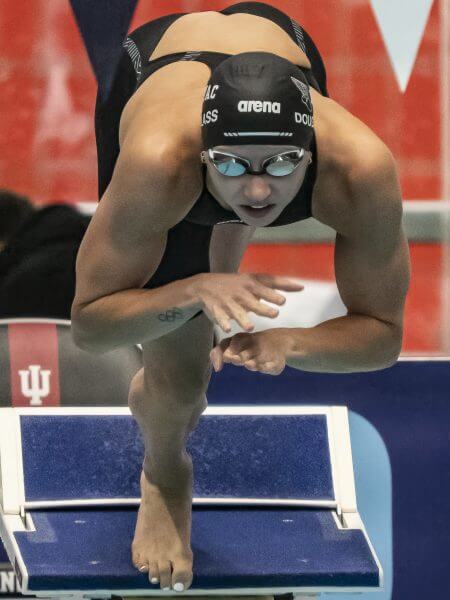
Kate Douglass — Photo Courtesy: Peter H. Bick
That ambitious program meshes with the way Douglass trains at the University of Virginia under Todd DeSorbo. “I just kind of do a little bit of everything,” she said, recounting how a typical week will include one practice focused on the 50 free, another focused on the 100 free, two or three breaststroke-centric swims as well as some sprint butterfly. “The one thing I don’t really train for is the 200 IM, but I think I do enough of everything else to be able to put together that race without having to really focus on that for a full practice.”
Finally, everything worked out when she returned to Indianapolis this month, the schedule for this particular Pro Series meet placing the 50 free on the third day, away from any of her other focus events. Douglass had not shifted her training focus to lean toward the 50 free, but for whatever reason, the stroke had felt particularly strong even when her breaststroke was further away from peak form.
“I’ve just been having like really awesome freestyle practices, and I’ve been excited to get up and race,” Douglass said. “Thinking back to when I went my 23.9 at Worlds in Doha (in 2024), I remember how that swim felt. I felt like I was going to be able to recreate that and replicate it. I was like envisioning how that race went, and I was like, ‘I know that I can do that tonight,’ and that was where my confidence came from.”
For the long course version of this event, Douglass describes herself as “more of a two-breath person” at a time when most of the world’s best take one breath or even zero. The only previous time she had taken one breath was in the 2024 Worlds final. After a relaxed morning swim, Douglass resolved to make it down the pool with just one breath, turning to the right just before she entered the final 15 meters of the race — and seconds before one of the most spectacular surprises imaginable.
Unconventional Greatness
Describing Douglass’ career as unconventional would hardly be a misnomer if only for her unusual combination of specialty events. At the 2023 World Championships, she made the finals in both the 100 free and 200 breast despite the two events following the same schedule of prelims, semifinals and finals. In two decades with nearly the same event order at that meet, no previous swimmer had attempted to race both.
Another oddity, at least in the world of swimming orthodoxy, is her willingness to take breaks of two to three weeks multiple times per season, often after the summer’s main championship meets and around the winter holidays, and she calls those breaks “super beneficial physically and mentally.” DeSorbo fully encourages those respites, knowing his swimmers can bounce back. He endorsed Douglass taking a few days off to travel after the Indy Pro Series, despite the Pan Pacific Championships looming in August.
“Toward the end of the season, you get a little burnt out. I sometimes get annoyed with swimming because I feel like I can’t live my life to its full extent. Like, I can’t go on, like, trips and vacations without worrying about where am I going to work out,” Douglass said. “Every time I’ve taken a break, I’ve been able to come back and be a little bit better in practice and be a little bit more motivated, so I feel like it always is just a great reset all around.”
Douglass has prioritized staying fresh mentally as a mental trick designed to prolong her career. After her second Olympics in Paris, Douglass returned to swimming in time for the fall short course meters season, simultaneously working on her masters degree in statistics at UVA, but not committing to swimming four more years until the Los Angeles Olympics. Now, with that masters recently completed and the Games getting closer, Douglass has become willing to verbally commit to two more years at least.
“For a while I was like, ‘Wow, that feels like a really long time away,’ and now it doesn’t feel like it’s that far away,” she said. “I definitely think it’s easier for me to think about having goals for 2028, but it’s still two years away, and I don’t want to get too ahead of myself there, and so I do still feel like I’m taking it little by little.”
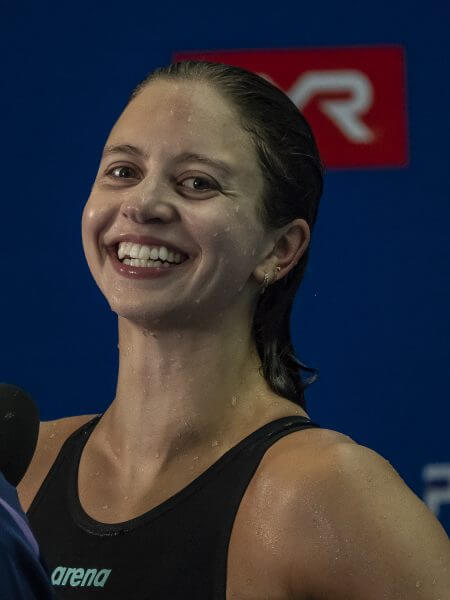
Kate Douglass — Photo Courtesy: Peter H. Bick
More Unique Scheduling Conflicts
Next up, Pan Pacs, the major international competition for U.S. swimmers in 2026. Unlike the World Championships and Olympics, this meet will be condensed into four days with only prelims and finals (no semifinals). The event schedule carries over from the last edition of Pan Pacs eight years ago, certainly before planners could imagine the same swimmer might have the 200 IM, 50 free and 200 breast as their three best events.
Lo and behold, those three will all take place on Saturday, August 15, the meet’s final day. The finals session that night also includes the 400 medley relay, where Douglass is the likely candidate to handle breaststroke duties for the United States. An event or two, perhaps even the one in which she just broke the world record, could fall off her program.
“It definitely is not in my favor, and so that’s definitely been a little frustrating and confusing trying to figure out what I want to focus on. I definitely don’t think I’ll be doing the triple on the last day. I don’t think that’s worth it at all,” Douglass said. “I’m definitely gonna have to choose what I want to swim on that last day. I feel like I have an idea of what I want to focus on, but I think it’s just going to come down to what’s feeling really good leading up to meet.”
Looking further down the line, Douglass has not studied the Los Angeles Olympic lineup too closely, but the nine-day program would conceivably allow her to swim the 100 breast, 200 breast, 200 IM and 50 free with all races spread out on different days.
“It’s nice in theory, but with the semifinals, that’s so much racing. Even with just doing two individual events in Paris, I was completely exhausted by the time I got to the 200 IM, and that was only my second individual race,” Douglass said. “It’s definitely a lot of racing, and I don’t know how my body will keep up with that in two years.”
Difficult decisions but decisions that most swimmers, even elite ones, could only dream of. This latest world record, the shocking blast that represented her first the Olympic-size pool, added yet another option as she builds toward a third Olympic shot in 2028.