3/30/05 Freestyle: Straight-Arm Recovery
Text and Photo/Video by Glenn Mills
Demonstrated by Scott Tucker
Premium
Members - Click Here to Download Bonus Video Clip (Windows Media Player Format
2.0MB)
Premium
Members - Click Here to Download Bonus Video Clip (Quick Time Format 2.0MB)
I received an email recently from a swimmer who had been reading about the pros
and cons of swimming freestyle with a straight-arm recovery. This seems to be a
controver-sial topic these days, and I admit that I had some reservations about
the effectiveness of straight-arm-recovery free…until I had a chance to film
Scott Tucker and then watch his stroke in slow motion from a dozen different
angles. Scott, a two-time Olympic medal winner in the 400 free relay and
four-time US National Champion in the 100 free, has convinced me that
straight-arm-recovery free is worth a try…or at least some seri-ous study.
There are many elements of straight-arm-recovery freestyle that we could talk
about, but I’d like to address only the main question raised by the swimmer in
the email: “If you swim freestyle with a straight-arm recovery, does your upper
body lift out of the wa-ter when you hand enters the water? And would this
cause the lower part of your body to sink?”
Let’s take a look Scott’s stroke and see.

|
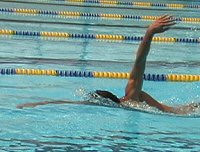
The first photo shows that, without a doubt,
Scott recovers his arm in a very straight position. His swings his forearm,
wrist, hand, and fingers high above his body during the recovery. Scott’s
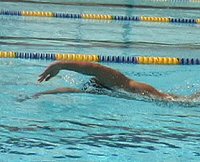
shoulder comes out of the water, but this doesn’t cause the lower half of his
body to sink, i.e., he doesn’t lose his balance. You can see this more clearly
in the second photo.
|
|
Why doesn’t Scott lose his balance when he swims
this way? There are several rea-sons.
#1. Scott’s recovery is very fast. The momentum of his arms helps him to rotate
his body quickly and cleanly. He turns the momentum of his arms into FORWARD
move-ment (rather than up-and-down movement) when he places his hand in the
water. No-tice that Scott’s shoulder comes out of the water, but that the rest
of his body stays low and horizontal.
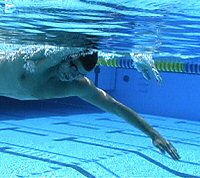
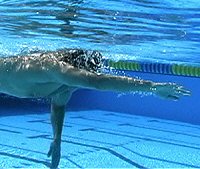
#2. Scott’s hand entry is clean and precise. When we think of straight-arm
freestyle, we usually think of a swimmer slamming the hand and arm into the
water on every stroke. There’s no hesitation when Scott’s hand enters the
water, but there’s no thrash-ing, either. As you can see in the third and
fourth photos (tucker03 and 04), Soctt di-rects his fingers and wrist down into
the water. The hand enters cleanly, fingers first, and is in position to grab
water the instant it enters. What Scott has mastered is the ability to swing
the arms forcefully through the recovery and yet send the hands into the water
with great control. When done correctly, there’s more to this stroke than what
most people imagine.
#3. Scott reaches full extension on every stroke. Again, our image of
the straight-arm freestyler is of someone windmilling through the water, never
reaching full extension on any stroke. The fifth photo (tucker 05) shows that
Scott’s body continues to rotate as his arm extends completely to get ready for
the next pull.
|
These images were captured when Scott was swimming smoothly and slowly. When he
swims faster, a few things change, but Scott’s hand continues to enter cleanly
and ex-tend fully, even if just for a moment, on each stroke. If you’re a
premium member, you’ll be able to see Scott hammering some freestyle. It’s only
a couple strokes, at the end of the clip, but you’ll notice that Scott
continues to extend on each stroke.
One thing you won’t be able to see on the last part of the video clip is that
Scott is pull-ing a parachute. You’d think that, under this much resistance,
Scott would shorten his stroke and try to grab and pull as quickly as possible.
But no. Scott STILL reaches a bit forward. You can tell by the fact that the
bubbles drop off his hand as it extends for-ward. Bubbles don’t fall off like
that if you pull DOWN as the hand enters.
Straight-arm-recovery freestyle isn’t for everyone, but it IS for some people,
and de-serves to be experimented with by swimmers of all levels. When executed
properly, it DOESN’T cause the body to go out of balance, it DOESN’T add more
stress to the shoulder during the recovery, and it DOESN’T cause the body to
pop up during the en-try.
The trick is to do it properly, not like an out-of-control, crazed windmill.